Q.1.
To help avoid skidding on slippery surfaces, you should:
Q.2.
On a two-lane street, your vehicle is being followed by a fire engine that is not using its emergency signals. You should:
Q.3.
A person who drives much slower than the speed limit:
Q.4.
Roads are slippery after it first starts to rain. When the road is slippery, you should:
Q.5.
You should never park a vehicle:
Q.6.
Headlights must be used:
Q.7.
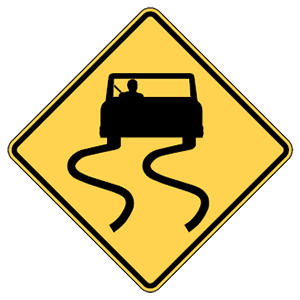
This road sign means:
Q.8.
Which statement about making a right turn is true?
Q.9.
As you approach the top of a hill, you should:
Q.10.
At many intersections, a right turn may be made while the traffic light is red. Before turning right on red:
Q.11.
When driving at night, you should:
Q.12.
You should allow an extra cushion of space:
Q.13.
On a green arrow, you must:
Q.14.
Drivers may not pass a school bus when its red lights are flashing.
Q.15.
Which of the following blocks the smooth flow of traffic?
Q.16.
When turning left at an intersection:
Q.17.
Hydroplaning occurs when tires ride on a thin film of water instead of on the road. To prevent hydroplaning in wet weather, you should:
Q.18.
When driving in fog, rain, or snow, use:
Q.19.
When may you legally drive around or under a railroad crossing gate?
Q.20.
When preparing to make a left turn from a two-way street, you should drive:
Q.21.
Which of the following statements is true?
Q.22.
When stopped at a red traffic light with a green arrow, you may proceed in the direction of the arrow if you:
Q.23.
Work zones on highways have become increasingly safe for workers and drivers.
Q.24.
In rainy weather, you should be most careful when turning or stopping:
Q.25.
If an emergency vehicle with flashing lights is traveling in the area where you are driving, you should:
Q.26.
You are required to stop your vehicle:
Q.27.
Motorists should maintain a safe operating distance when driving near a cyclist.
Q.28.
When passing, you should move back into the right lane when:
Q.29.
A person's ability to drive can be impaired by:
Q.30.
When entering a parked vehicle, you should: