MCQGeeks
CBSE
JEE
NTSE
NEET
English
UK Quiz
Quiz
Driving Test
Practice
Games
Driving Test
South Carolina
South Carolina Car Driving Permit Test-23
Answers
Q.1.
Slowing down just to look at collisions or anything else out-of-the-ordinary:
Causes traffic congestion.
Prevents rear-end collisions.
Improves traffic flow by preventing collisions.
Q.2.
If you need to drive in foggy weather:
Turn on your low beam headlights.
Turn on your hazard lights.
It is okay to drive at the maximum speed limit.
Do not drive at a speed above 10 miles per hour.
Q.3.
You must stop at a railroad crossing when:
Directed to do so by a flagger.
It is controlled by a stop sign.
Flashing red signals and gates are present and operating.
All of the above.
Q.4.
A telltale sign of a drunk driver is:
They are weaving between lanes.
They are driving more slowly than the normal traffic flow.
They are making quick and sudden stops.
All of the above.
Q.5.
When driving past a vehicle that has just stopped in a parked position on the side of the road, you should:
Assume that the driver will open the car door as you approach.
Speed up.
Slam on your brakes.
Assume that the driver will wait for you to pass before opening the door.
Q.6.
When should drivers yield the right-of-way to pedestrians in a crosswalk?
Only if the pedestrians first wave to the driver.
Only if the pedestrians are not texting while walking.
At all times.
Q.7.
If you miss your exit on the freeway, you should not:
Continue on the freeway and find an alternate route to your destination.
Proceed to the next exit, leave the freeway, and return to your proper exit.
Back up on the road or shoulder.
Q.8.
When driving under low-visibility conditions due to fog, you should:
Turn on your high beam headlights.
Slow down and use your low beam headlights.
Increase your speed so you do not cause an accident.
Q.9.
Which of the following statements is true?
Trucks have larger blind spots than passenger vehicles.
Always avoid driving beside a large truck for long periods of time.
Both of the above.
Q.10.
When you are parallel parking, it is usually best to:
Give a right signal on the approach, drive past the space and stop, then back into the space.
Park your vehicle within 18 inches of the curb or edge of the road.
Center your vehicle inside the space to give surrounding cars room to maneuver.
All of the above.
Q.11.
Before you change lanes, you should check your mirrors and:
Never look over your right shoulder.
Always slow down in your traffic lane.
Glance over your shoulder.
Q.12.
A steady red arrow displayed on a traffic light means:
Drivers cannot turn in the indicated direction.
Drivers may turn in the indicated direction after coming to a complete stop.
Drivers may turn in the indicated direction.
Q.13.
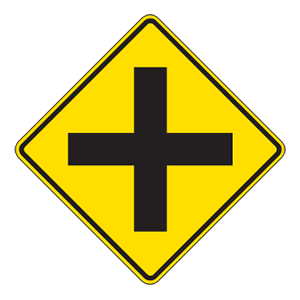
This sign shows one type of:
Intersection.
Road curve.
Right turn.
Q.14.
Before switching on the ignition, you should:
Be sure only backseat passengers have buckled their seat belts.
Be sure only adult passengers have buckled their seat belts.
Be sure only child passengers have buckled their seat belts.
Be sure all of the vehicle's occupants have buckled their seat belts.
Q.15.
You are crossing an intersection and an emergency vehicle is approaching while using its siren and flashing lights. You should:
Stop immediately in the intersection until it passes.
Pull to the right of the intersection and stop.
Continue through the intersection, pull to the right, and stop.
Q.16.
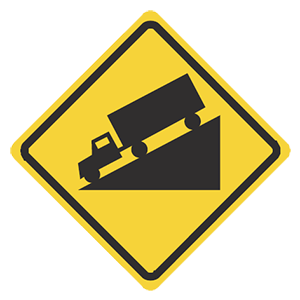
This sign means:
Upcoming downgrade or hill.
Road construction area.
Upcoming narrowing of roadway.
Q.17.
When you are backing up, it is usually best to:
Steer with one hand while looking into the rearview mirror.
Open the driver side door and look back.
Steer with both hands while looking into the side view mirror.
Steer with one hand while looking over your shoulder through the rear window.
Q.18.
Lanes of traffic moving in the same direction are divided by ____ lines.
Yellow
White
Red
Black
Q.19.
Which is not a factor in determining the distance that it takes to stop your vehicle?
Steering ability
Braking distance
Reaction distance
Perception time
Q.20.
If you want to make a three-point turnabout and there is traffic approaching, you should:
Begin the turnabout right away.
Flash your headlights and begin the turnabout.
Yield to oncoming traffic coming from all directions before performing the maneuver.
Q.21.
As you are driving on a two-lane highway, you approach a school bus that is stopped with its red lights flashing. You:
May pass if the way is clear.
May pass if a pedestrian indicates that the way is clear.
May not pass until the school bus driver turns off the flashing lights and continues driving.
Must turn on your emergency flashers.
Q.22.
Sudden wind gusts on highways:
Generally affect only the movement of large vehicles.
Only cause visibility problems.
Can cause problems for all vehicles.
Q.23.
Extra space in front of a large truck is needed for:
Other drivers to merge onto the freeway.
The truck driver to stop the vehicle.
Other drivers when they want to slow down.
Q.24.
If a vehicle is equipped with airbags:
Seat belts should still be worn.
Seat belts do not need to be worn.
Seat belts should be worn behind the back.
Q.25.
Allowing a space cushion between your vehicle and its surroundings is important because it:
Prevents distractions from other vehicles.
Allows you time to react to unexpected situations.
Keeps traffic flowing at a safe pace.
Keeps other drivers alert.
Q.26.
To change lanes you should:
Check your mirrors and signal, then change lanes.
Signal, check your mirrors, check your blind spot in the direction you plan to move, then change lanes.
Signal, check your mirrors, and change lanes.
Signal and change lanes.
Q.27.
You are entering a crowded freeway. What should you do to merge into traffic?
Use your side and rearview mirrors and check your blind spots.
Use the acceleration lane to adjust your speed to match the speed of freeway traffic.
Yield to traffic already on the freeway.
All of the above.
Q.28.
Which of the following statements is true?
You should maintain at least a three- to four-second following distance under normal conditions.
As speed increases, following distance should decrease.
Following distances are only important on snow and ice.
Q.29.
As a pedestrian, you should:
Always insist on the right-of-way over a vehicle when using a crosswalk.
Never enter a street or crosswalk when vehicles are approaching.
Enter a crosswalk at any time because it is the vehicle driver’s responsibility to stop.
Use crosswalks only if they are convenient.
Q.30.
Which statement about tires is true?
Tires must have good tread and be free of damage.
Tires with low air pressure provide a smoother ride.
Over-inflated tires do not skid on wet pavement.
Support mcqgeeks.com by disabling your adblocker.
×
Please disable the adBlock and continue.
Thank you.
Reload page