MCQGeeks
CBSE
JEE
NTSE
NEET
English
UK Quiz
Quiz
Driving Test
Practice
Games
Driving Test
South Carolina
South Carolina Car Driving Permit Test-8
Answers
Q.1.
This sign means:
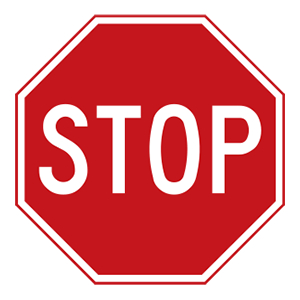
Stop.
Side road.
Two-way left turn.
Farm machinery.
Q.2.
Which is the most common cause of traffic crashes?
New drivers
Human error
Bad weather
Bad roads
Q.3.
When you are backing up, it is usually best to:
Steer with one hand while looking into the rearview mirror.
Open the driver side door and look back.
Steer with both hands while looking into the side view mirror.
Steer with one hand while looking over your shoulder through the rear window.
Q.4.
Which statement about making a right turn is true?
You should swing wide to the left when making a right turn so you won't run over the curb.
You may make a right turn at a red traffic light, unless a sign prohibits the turn.
When making a right turn onto a four-lane roadway, finish the turn in the far left lane.
Q.5.
It is unlawful to:
Pass another vehicle in any marked no passing zone.
Pass another vehicle over a railroad crossing.
Both of the above.
Q.6.
Two solid yellow lines on the pavement mean:
Passing is allowed for drivers from both directions.
Passing is not allowed.
Passing is allowed if you are at the top a hill.
Passing is allowed during daylight only.
Q.7.
It is important to slow down:
On narrow or winding roads.
At intersections or railroad crossings.
When the road is wet or slippery.
All of the above.
Q.8.
When the driver behind you wants to pass, you should:
Speed up.
Go the same speed.
Slow down to allow room in front of your vehicle for the other driver to complete the pass easily.
Change lanes.
Q.9.
Crossbuck signs indicate:
Railroad crossings.
School zones.
No passing zones.
Hospitals.
Q.10.
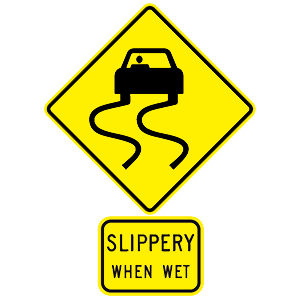
This sign means:
Slippery when wet.
Watch for drunk drivers.
Dangerous curve ahead.
Bump in the road ahead.
Q.11.
When changing lanes, you can check your blind spot by:
Using the inside rearview mirror.
Turning your head and looking over your shoulder.
Using your side mirror.
Q.12.
When you are parallel parking, it is usually best to:
Give a right signal on the approach, drive past the space and stop, then back into the space.
Park your vehicle within 18 inches of the curb or edge of the road.
Center your vehicle inside the space to give surrounding cars room to maneuver.
All of the above.
Q.13.
Nighttime is the safest time for cyclists to ride their bikes.
TRUE
FALSE
Q.14.
Large vehicles have blind spots that can extend up tofeet directly behind the vehicle.
TRUE
FALSE
Q.15.
Which of the following statements is true?
Driving too slowly is not an unsafe practice.
Driving too slowly on certain highways can be dangerous.
The speed at which you drive a vehicle does not affect safety.
Q.16.
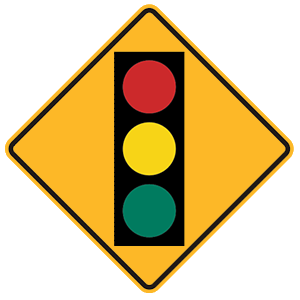
This sign means:
Continue at your current speed.
You must stop ahead.
Speeding is not allowed.
There is a traffic signal ahead.
Q.17.
When approaching a traffic signal displaying a steady green arrow, drivers:
Should merge into a lane in the direction of the arrow.
Should slow to a stop, if it is safe to do so.
May turn in the direction of the arrow after yielding to traffic and pedestrians already in the intersection.
May drive straight through the intersection.
Q.18.
Which of the following about winter driving is not true?
Winter is the most difficult driving season.
Checking your vehicle's antifreeze and windshield washer fluid levels is especially important during the winter.
Using cruise control in winter weather is a safe thing to do.
It is best to use snow tires on your vehicle.
Q.19.
If you park facing uphill on a street with a curb, set the parking brake and:
Turn the wheels toward the curb.
Turn the wheels away from the curb.
Leave the wheels pointing straight.
Q.20.
Where is it illegal to pass another vehicle?
On a hill or curve
At a street crossing or highway intersection
At any railroad crossing
All of the above
Q.21.
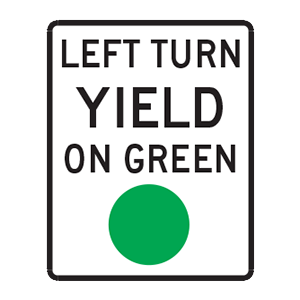
This sign means:
Left turn yield on green.
One-way.
Cattle crossing.
Two-way left turn.
Q.22.
If a crossing guard is directing traffic in a school zone, you must:
Follow the directions given by the crossing guard.
Copy what surrounding traffic is doing, despite the crossing guard's instructions.
Assume the guard is not supposed to be directing traffic.
Follow rules that would be in place if no children were present.
Q.23.
When passing another vehicle on a road with two lanes traveling in opposite directions, you should:
Return to the driving lane when there's enough room between you and the vehicle you passed.
Remain in the left lane if you intend to turn left.
Return to the right side of the roadway immediately.
Drive in either lane.
Q.24.
If you are driving and a tire suddenly goes flat, you should:
Rapidly pump the brake pedal several times.
Slow down gradually and not brake.
Press down on the brake pedal as hard as you can.
Q.25.
You must yield to children playing in the streets.
True
False
Q.26.
You are driving on a busy street and your vehicle’s accelerator sticks open. You should:
Blow your horn.
Slam on your brakes.
Turn on your four-way flashers.
Turn off your ignition, taking care not to engage the steering wheel locking mechanism.
Q.27.
Before turning left, it is important to:
Sound your horn.
Yield to oncoming vehicles.
Swing to the right side of your lane.
Wait until oncoming traffic has a red light.
Q.28.
The driver ahead of you stops at a crosswalk. What should you do?
Cautiously pass the vehicle at 10 mph or slower.
Stop, proceeding only when all the pedestrians have crossed.
Change lanes, look carefully, and pass the stopped vehicle.
Q.29.
If you have a sudden tire blowout:
Use the brakes lightly.
Pump the brakes.
Apply the brakes firmly.
Q.30.
A broken yellow line beside a solid yellow line indicates that:
Passing is permitted from the lane next to the solid yellow line.
Passing is not permitted from either direction.
Passing is permitted from the lane next to the broken yellow line.
Support mcqgeeks.com by disabling your adblocker.
×
Please disable the adBlock and continue.
Thank you.
Reload page