MCQGeeks
CBSE
JEE
NTSE
NEET
English
UK Quiz
Quiz
Driving Test
Practice
Games
Driving Test
South Carolina
South Carolina Motorcycle Driving Permit Test-10
Answers
Q.1.
If a dog is chasing your motorcycle, you should:
Swerve around the dog.
Slow down, let the dog approach, and accelerate away from the animal.
Park and wait for the dog to lose interest.
Q.2.
For motorcycle operators, eye protection is:
Required.
Not required, but recommended.
Not recommended.
Q.3.
To safely cross railroad tracks that are angled across your lane, you should:
Ride straight within your lane.
Turn your motorcycle to take them at a 90-degree angle.
Speed up.
Q.4.
The risk of a head or neck injury is reduced:
By wearing a helmet.
By riding more slowly.
By reading the owner’s manual.
Q.5.
As your motorcycle accelerates, you will need to:
Shift to a higher gear.
Shift to a lower gear.
Put the bike in neutral.
Q.6.
When traveling in a group, riders should generally be:
In a single-file formation.
Paired up.
In a staggered formation.
Q.7.
How should a group of motorcyclists pass another vehicle?
In a staggered formation
In pairs
One at a time
Q.8.
Which brake is more powerful on a motorcycle?
The front brake
The rear brake
Both brakes are equally powerful.
Q.9.
Use your mirrors when stopping at an intersection:
To determine if drivers behind you are aware that you are stopping.
To watch for pedestrians ahead.
To look for dark clouds that may indicate poor weather conditions.
Q.10.
When riding with a passenger on your motorcycle, you should instruct the passenger to:
Get on the motorcycle before the engine starts.
Sit as far back as possible on the bike.
Not talk or move unnecessarily.
Q.11.
Under normal riding conditions, one of the best ways to help others see your motorcycle is:
To flash your lights.
To keep your high beam headlight turned on.
To ensure that your motorcycle is painted a dark color.
Q.12.
Long-term exposure to wind noise:
Is not a danger.
Can cause irreversible hearing damage.
Is just part of riding a motorcycle.
Q.13.
When riding a motorcycle, your feet should be:
On the footrests for balance.
Pointed with your toes aiming downward.
Relaxed.
Q.14.
You should conduct a safety inspection of your motorcycle:
Before every ride.
Every week.
Once a month.
Q.15.
If riding during the day, you should wear:
Clothing with reflective material.
A short-sleeved shirt.
Darkly-colored clothing.
Q.16.
You should flash your brake light to:
Tell other motorists that you are riding near them.
Help other motorists see your motorcycle while traveling in slow traffic.
Tell other motorists that you are going to slow down or stop where they don't expect you to do so.
Q.17.
If you need to react to a hazard in the road, do not:
Avoid communicating with other drivers.
Adjust your speed accordingly.
Make your presence known by sounding your horn and/or using lights or signals.
Q.18.
Unlike other substances, alcohol:
Is very quickly absorbed into the bloodstream.
Needs to be digested to enter the bloodstream.
Can improve your riding ability.
Q.19.
When approaching a blind intersection, riders should:
Stop at the stop line before moving forward to improve their view of cross traffic.
Ignore the stop line and move forward to get a better look.
Stop at the stop line then proceed through the intersection.
Q.20.
The formation you should take when riding in a group:
Is always single-file.
Depends on the situation.
Is always staggered.
Q.21.
To control a motorcycle well, you should:
Use your arms to hold yourself up.
Keep your knees against the gas tank.
Sit so your arms are straight when reaching for the handlebars.
Q.22.
A motorcycle’s brake light is _________ a passenger vehicle’s brake light.
More noticeable than
Just as noticeable as
Not as noticeable as
Q.23.
A plastic, shatter-resistant face shield:
Protects your face, but not your eyes.
Protects your eyes, but not your whole face.
Helps protect your whole face.
Q.24.
When you are being passed, you should:
Ride in the left portion of the lane.
Ride in the center portion of the lane.
Ride in the right portion of the lane.
Q.25.
When the lights on this sign are flashing, what should you do?
Stop and wait until the train passes.
Proceed with caution.
Turn around and find an alternate route.
Q.26.
When crossing angled railroad tracks, it is usually best to:
Use the shoulder of the road to slow down before crossing the tracks.
Walk your motorcycle across the tracks.
Continue straight within your lane to cross the tracks.
Q.27.
To be effective, eye or face shield protection must:
Fasten securely.
Restrict your vision to the sides so you can focus on the road ahead.
Not allow eyeglasses or sunglasses to be worn.
Q.28.
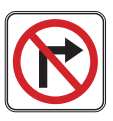
What does this sign mean?
No left turn
No U-turn
No right turn
Q.29.
When looking through a turn, you should:
Turn your head and shoulders.
Turn just your head.
Turn your head, shoulders, and torso.
Q.30.
A good defensive driver:
Travels slowly at all times.
Looks out for the actions of other drivers.
Travels at a constant speed.
Only rides in familiar areas.
Support mcqgeeks.com by disabling your adblocker.
×
Please disable the adBlock and continue.
Thank you.
Reload page