MCQGeeks
CBSE
JEE
NTSE
NEET
English
UK Quiz
Quiz
Driving Test
Practice
Games
Driving Test
South Carolina
South Carolina Motorcycle Driving Permit Test-14
Answers
Q.1.
When a motorcyclist needs to stop quickly, they should:
Apply both brakes at the same time.
Use only the front brake.
Use only the rear brake.
Q.2.
When being passed from behind, which portion of the lane should you ride in?
Right
Center
Left
Q.3.
If your motorcycle starts to weave while riding over uneven metal bridge gratings, you should:
Downshift immediately to a lower gear.
Proceed in a zigzag pattern until you cross the bridge.
Relax and steer straight.
Q.4.
To make a quick stop on wet pavement, you should:
Use only the front brake.
Use only the rear brake.
Use both brakes.
Q.5.
When making a U-turn:
The front and rear brakes need to be used at the same time.
Do not use the front brake because it could cause the bike to tip over.
Use the front brake to increase stability of the motorcycle.
Q.6.
You will get the most protection from a helmet if it is all of the following, except:
U.S. DOT-compliant.
Loose-fitting.
Free of defects.
Q.7.
When riding in a group, the best formation for keeping riders together while maintaining adequate space cushions is generally:
A single-file formation.
Riding in pairs.
A staggered formation.
Q.8.
Taking over-the-counter medication before riding:
Is usually fine since over-the-counter medications are never very strong.
Is acceptable all the time.
May affect your riding abilities and should be done with caution.
Q.9.
Which of the following is not a potential problem?
An upcoming change in road surface characteristics
Surrounding traffic
Conditions that do not appear to change as you approach
Q.10.
As your motorcycle increases speed, you will:
Need to shift up through the gears.
Need to shift down through the gears.
Need to put the motorcycle into neutral.
Q.11.
When being passed, it is usually best for motorcyclists to be in which part of the lane?
The right
The center
The left
Q.12.
When nearing a blind intersection, you should:
Speed up.
Assume that other drivers will properly yield the right-of-way.
Change your lane position to become more visible to other drivers.
Q.13.
If wearing a jacket for protection while riding in hot weather, you should:
Take frequent breaks to cool off.
Remove the jacket to stay cool while in the sun.
Keep the jacket on to protect you from the heat.
Q.14.
Which of the following is an example of a potentially slippery surface?
A gravel road
A paved driveway
Dry pavement
Q.15.
In general, which position within a lane is the best to ride in?
The left position
The right position
There is no single best lane position.
Q.16.
When riding on a slippery surface, you should:
Not make sudden movements, if possible.
Handle your motorcycle roughly.
Use only your front brake.
Q.17.
It can be difficult to ride right after it starts raining because:
Some other drivers may not react quickly enough to the rain.
Pavement will be especially slippery.
Other drivers do not drive fast enough in wet weather.
Q.18.
There is the greatest potential for conflict between a motorcycle and other traffic:
On the highway.
At intersections.
On rural roads.
Q.19.
When being passed by another vehicle, you should travel in:
The left portion of the lane.
The center portion of the lane.
The right portion of the lane.
Q.20.
To lessen the chances of a crash occurring, you should:
Not use turn signals.
Use proper lane positions.
Follow other vehicles closely.
Q.21.
When entering a turn, it is best to:
Change gears before the turn.
Change gears during the turn.
Take the motorcycle out of gear.
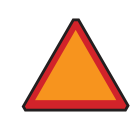
Q.22.
What does this sign mean?
Yield
Slow-moving vehicle
Railroad crossing
Q.23.
The best way to avoid fatigue when riding your motorcycle on a long trip is to:
Take frequent breaks to rest.
Ride as fast as possible.
Take artificial stimulants.
Q.24.
If your front wheel locks while you are braking, you should:
Keep the tire locked up, as it will help you stop more quickly.
Release the front brake and only use the rear brake.
Release the front brake immediately and re-apply it.
Q.25.
If you get a flat tire while riding, you should:
Hold the handle grips firmly and stay off the brakes.
Shift your weight toward the good wheel and brake normally.
Brake on the good wheel while immediately pulling off the road.
Q.26.
A motorcyclist should continually scan the road ahead for:
Road conditions.
Traffic conditions.
Escape routes.
All of the above.
Q.27.
Your lane position should do all of the following, except:
Provide you with an escape route.
Help you receive wind blasts.
Communicate your intentions to other drivers.
Q.28.
A motorcyclist should not rely only on their mirrors because:
Sometimes mirrors can be dirty, limiting the motorcyclist's view.
Mirrors are always unreliable.
Motorcycles have blind spots.
Q.29.
Stopping in a turn can be difficult because:
There is decreased traction available for stopping while the bike is leaning.
The rider is usually focused on the turn and not on the braking.
The brake controls do not work in turns.
Q.30.
When passing a vehicle, you:
May exceed the speed limit by 10 mph.
Must not exceed the speed limit.
Are required to ride faster than the speed limit.
Support mcqgeeks.com by disabling your adblocker.
×
Please disable the adBlock and continue.
Thank you.
Reload page