MCQGeeks
CBSE
JEE
NTSE
NEET
English
UK Quiz
Quiz
Driving Test
Practice
Games
Driving Test
South Carolina
South Carolina Motorcycle Driving Permit Test-3
Answers
Q.1.
To minimize the potential for fatigue on a long trip, you should:
Drink coffee.
Limit your riding per day.
Play loud music.
Q.2.
A plastic, shatter-resistant face shield:
Protects your face, but not your eyes.
Protects your eyes, but not your whole face.
Helps protect your whole face.
Q.3.
If your rear wheel locks up while you are stopping on a straightaway:
You can usually maintain control of the motorcycle.
You will likely lose control of the motorcycle.
You will need to release the rear brake to regain control of the motorcycle.
Q.4.
Which lane position is usually best for minimizing the risk of other vehicles sharing your lane?
The left portion of the lane
The center portion of the lane
The right portion of the lane
Q.5.
When stopping, you should:
Use both brakes.
Use the front brake only.
Use the rear brake only.
Q.6.
When approaching an uneven surface, such as a bump or pothole, you should rise slightly off of your seat:
So you can jump off the motorcycle if you need to.
So your legs can absorb the shock.
So other drivers can see you better.
So you can get a better view of the uneven surface.
Q.7.
When riding at night, you should:
Move closer to the vehicle in front of you so you can use its lights to see farther down the road.
Keep riding at your normal speed to lower the risk of being struck from behind.
Reduce your speed and increase your following distance.
Q.8.
When riding in a group on a straight road, motorcyclists should:
Ride in a single-file formation.
Pair up.
Stagger their formation.
Q.9.
If you are passing a row of parked vehicles to your right and there is no oncoming traffic to your left, you should ride:
In the left portion of your lane.
In the right portion of your lane.
In the center of your lane.
Q.10.
To properly control a motorcycle, you should:
Allow your feet to hang off the footrests.
Sit so your arms hold up your body.
Keep your knees against the gas tank.
Q.11.
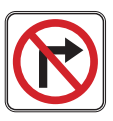
What does this sign mean?
No left turn
No U-turn
No right turn
Q.12.
When attempting to pass another vehicle, you should:
Ride within the posted speed limits.
Exceed the posted speed limit to complete the pass, but not by more than 10 mph.
Pass more than one vehicle at a time.
Q.13.
A motorcyclist should attempt to avoid obstacles on the roadway. If avoiding an obstacle is not possible, the motorcyclist should:
Speed up before coming into contact with the object.
Stay seated so the seat can cushion some of the impact.
Try to approach the obstacle at as close to a 90-degree angle as possible.
Q.14.
Hearing protection is:
Not recommended.
Recommended only for long rides.
Recommended for all rides.
Q.15.
When sitting on a motorcycle, you should:
Use your arms to hold up your body.
Sit at an angle so your arms can support your weight.
Sit so you can use your arms to control the motorcycle.
Q.16.
To help others see your motorcycle, you should:
Use your headlight.
Weave in your lane.
Maintain eye contact with other road users.
Q.17.
If you get a flat tire while riding, you should:
Hold the handle grips firmly and stay off the brakes.
Shift your weight toward the good wheel and brake normally.
Brake on the good wheel while immediately pulling off the road.
Q.18.
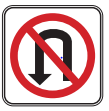
What does this sign mean?
No right turn
No left turn
No U-turn
Q.19.
An engine will seize due to:
A lack of oil.
A lack of fuel.
Improper tire inflation.
Q.20.
When stopping your motorcycle while carrying a passenger, you should:
Ride a little faster than you normally would.
Start slowing earlier than you normally would.
Merge into smaller gaps of traffic than you normally would.
Q.21.
Motorcycles may pass on the right:
If there is at least eight feet of unobstructed pavement.
By riding on the shoulder of the road.
By riding on the grass, if it is level.
Q.22.
When riding near a truck:
If you cannot see the truck’s mirrors, the driver cannot see you.
You should not be able to see the truck’s mirrors.
You should concentrate on operating your motorcycle and not worry about the truck’s mirrors.
Q.23.
When you are being passed, you should:
Ride in the left portion of the lane.
Ride in the center portion of the lane.
Ride in the right portion of the lane.
Q.24.
Oil drippings and debris often collect in ______ of a lane.
The left portion
The middle portion
The right portion
Q.25.
Riding gloves should be made of:
Leather.
Wool.
Any soft material.
Q.26.
When passing a row of parked cars, you should:
Ride on the left side of the lane.
Ride wherever you are most comfortable.
Ride in the right portion of the lane.
Q.27.
Which of the following surfaces provides the best traction for a motorcycle?
A gravel road
Dry pavement
Mud
Lane markings
Q.28.
Reflective, brightly-colored helmets and clothing:
Should only be worn when riding at night.
Can help motorcycle riders be more visible.
Do not increase a motorcycle rider's safety.
Q.29.
When riding a motorcycle, you should:
Always wear a jacket.
Only wear a jacket at night.
Only wear a jacket if it is cold outside.
Q.30.
You will get the most protection from a helmet if it is all of the following, except:
U.S. DOT-compliant.
Loose-fitting.
Free of defects.
Support mcqgeeks.com by disabling your adblocker.
×
Please disable the adBlock and continue.
Thank you.
Reload page