MCQGeeks
CBSE
JEE
NTSE
NEET
English
UK Quiz
Quiz
Driving Test
Practice
Games
Driving Test
South Dakota
South Dakota Car Driving Permit Test-5
Answers
Q.1.
Backing your vehicle is:
Always dangerous.
Dangerous if you have a helper.
Only dangerous in large vehicles.
Q.2.
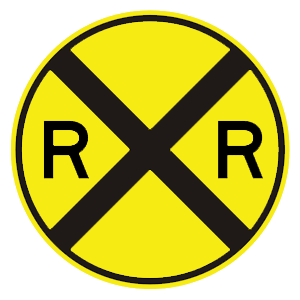
This sign indicates a:
Railroad crossing.
Pedestrian crossing.
No passing zone.
Q.3.
South Dakota law requires ____ to use safety belts in a moving vehicle.
Only operators
Only children
Children, front seat passengers, and operators
Q.4.
When a bicyclist is making a left turn:
They may use the left lane.
They may cut through all lanes.
They may wait on the side of the road.
Q.5.
You should use your horn when:
Another vehicle is in your way.
It may help prevent a collision.
Another driver makes a mistake.
Q.6.
What should you do with loose objects in your motor vehicle?
Place them on the floor near the driver's seat.
Secure them to avoid additional driving hazards.
Place them on the dashboard.
Q.7.
It is legal to make a left turn at a red traffic light after stopping only if:
You are traveling on a two-way street and turning onto a two-way street.
You are traveling on a one-way street and turning onto another one-way street.
You yield to all other traffic at the intersection.
Q.8.
When used on roadways, bicycles are considered:
Hazards.
Vehicles.
Dangerous.
Q.9.
When driving under snowy or icy conditions:
It is safe to use your cruise control.
Make speed and directional changes more gradually than you would otherwise.
Drive as you would under normal conditions.
Q.10.
Work zone barriers, drums, cones, and signs are used to:
Make drivers angry about slow traffic.
Inconvenience drivers.
Keep traffic out of hazardous work zones.
Q.11.
Double solid yellow line markings down the center of a road indicate that passing is:
Allowed from both directions.
Allowed only from your direction of travel.
Not allowed from either direction.
Q.12.
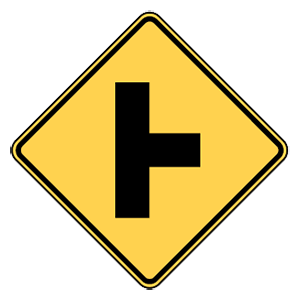
This road sign means:
All traffic must turn right.
All traffic must go straight.
A side road intersects ahead.
Q.13.
Which of the following is a dangerous habit when driving in work zones?
Tailgating another vehicle
Failing to carefully watch for workers and moving equipment
Both of the above
Q.14.
Before changing lanes or attempting to pass another vehicle, you should:
Check your blind spots and mirrors.
Signal your intention before changing lanes.
All of the above.
Q.15.
If you are driving and a tire suddenly goes flat, you should:
Rapidly pump the brake pedal several times.
Slow down gradually and not brake.
Press down on the brake pedal as hard as you can.
Q.16.
When entering or exiting a driveway, drivers:
Have the right-of-way.
Should yield to pedestrians.
Should honk at pedestrians to get them to move more quickly.
Q.17.
Stopping distances and severity of crashes:
Decrease as vehicle speed increases.
Are not affected by vehicle speed.
Increase as vehicle speed increases.
Q.18.
If you come to a railroad crossing with lowered gates and flashing warning lights, you should:
Drive around the crossing gates if you can't see a train.
Come to a complete stop well behind the gates, wait for the tracks to clear, and proceed once the gates are lifted.
Slow down and drive around the gates.
Q.19.
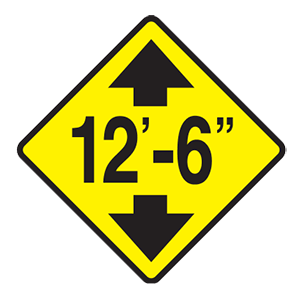
This sign indicates:
The distance from road surface to a bridge or overpass.
The maximum legal height of a vehicle allowed in this state.
The maximum width of a vehicle allowed on the highway.
Q.20.
When driving down a long or steep hill, you should:
Check your mirrors for speeding traffic behind you.
Assume all traffic is maintaining a consistent speed.
Hold down your brake pedal to control the speed of surrounding traffic.
Q.21.
Slowing down just to look at collisions or anything else out-of-the-ordinary:
Causes traffic congestion.
Prevents rear-end collisions.
Improves traffic flow by preventing collisions.
Q.22.
When driving under low-visibility conditions due to fog, you should:
Turn on your high beam headlights.
Slow down and use your low beam headlights.
Increase your speed so you do not cause an accident.
Q.23.
When turning left at an intersection:
You should always yield to oncoming traffic and pedestrians.
Oncoming traffic and pedestrians should yield to you.
You should never yield to oncoming traffic and pedestrians.
Q.24.
You may pass a vehicle when:
You are on a hill or curve.
You are on a road with a solid line next to your lane.
You are on a road with a broken line next to your lane.
Q.25.
When you are merging onto the freeway, you should be driving:
At or near the speed of traffic on the freeway.
Five to 10 mph slower than the speed of traffic on the freeway.
The posted speed limit for freeway traffic.
Support mcqgeeks.com by disabling your adblocker.
×
Please disable the adBlock and continue.
Thank you.
Reload page