MCQGeeks
CBSE
JEE
NTSE
NEET
English
UK Quiz
Quiz
Driving Test
Practice
Games
Driving Test
South Dakota
South Dakota Motorcycle Driving Permit Test-3
Answers
Q.1.
The best footwear for motorcyclists are:
Sneakers.
Sturdy boots.
Sandals.
Q.2.
Hearing protection is:
Not recommended.
Recommended only for long rides.
Recommended for all rides.
Q.3.
When stopping, you should:
Use both brakes.
Use the front brake only.
Use the rear brake only.
Q.4.
What does a flashing red traffic light mean?
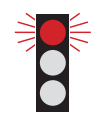
Come to a complete stop and proceed when it is safe to do so.
Only stop to yield to other traffic.
Vehicles will be entering the roadway.
Q.5.
If your front wheel locks while you are braking, you should:
Keep the tire locked up, as it will help you stop more quickly.
Release the front brake and only use the rear brake.
Release the front brake immediately and re-apply it.
Q.6.
If passing another vehicle:
You may exceed the speed limit until the pass is complete.
You may disregard no passing zone markings if you began the pass in a passing zone.
You must observe the posted speed limit.
Q.7.
If wearing a jacket for protection while riding in hot weather, you should:
Take frequent breaks to cool off.
Remove the jacket to stay cool while in the sun.
Keep the jacket on to protect you from the heat.
Q.8.
If you have only one drink before riding:
You cannot be arrested for drinking and riding.
Your riding skills will not be affected.
It can affect your ability to operate a motorcycle.
Q.9.
When positioning your body on the motorcycle:
You should hold yourself up with your arms.
Your arms should be used to steer the motorcycle.
You should have to stretch to reach the handgrips.
Q.10.
To reduce the chances of a collision, a motorcycle rider should:
Maintain an adequate space cushion.
Ride very slowly.
Ride the centerline.
Q.11.
Under normal riding conditions, one of the best ways to help others see your motorcycle is:
To flash your lights.
To keep your high beam headlight turned on.
To ensure that your motorcycle is painted a dark color.
Q.12.
When passing a truck on a two-lane road, you should:
Not return to your original lane until you can see the front of the truck in your rearview mirror.
Return to your original lane as soon as the truck is behind you.
Return to your original lane when you feel you have enough space.
Q.13.
When you are being passed on the left, you should:
Speed up.
Ride in the right portion of the lane.
Ride in the center portion of the lane.
Q.14.
The normal recommended following distance should be extended if:
The pavement is slippery.
The sun is shining.
You believe stopping will be routine.
Q.15.
A passenger on a motorcycle should:
Put their feet on the ground when the motorcycle is stopped.
Not ride without a back rest.
Sit as far forward as possible without crowding the operator.
Q.16.
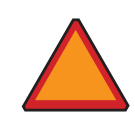
What does this sign mean?
Yield
Slow-moving vehicle
Railroad crossing
Q.17.
Using all three lane positions is:
Not encouraged because then you can never get used to any part of a lane.
Discouraged because it confuses other motorists.
Wise if you are adapting to changing conditions.
Q.18.
When riding at night, you should:
Move closer to the vehicle in front of you so you can use its lights to see farther down the road.
Keep riding at your normal speed to lower the risk of being struck from behind.
Reduce your speed and increase your following distance.
Q.19.
If you approach an uncontrolled intersection at the same time as another vehicle:
The vehicle on the left should yield to the vehicle on the right.
You should flash your headlight to signal that the other vehicle should proceed.
You should continue through the intersection and expect the other vehicle to stop.
Q.20.
When taking a curve while riding in a group, you should be in:
A single-file formation.
Pairs.
A staggered formation.
Q.21.
If you get a flat tire while riding, you should:
Hold the handle grips firmly and stay off the brakes.
Shift your weight toward the good wheel and brake normally.
Brake on the good wheel while immediately pulling off the road.
Q.22.
When changing lanes:
Your mirrors can adequately show you your surroundings.
Do a head check in addition to using your mirrors.
Activate your turn signal and immediately move to the right or left.
Q.23.
When other vehicles are slowed or stopped:
A motorcyclist should not weave between lanes of traffic.
It is acceptable for a motorcyclist to weave in and out of traffic lanes.
A motorcyclist should ride in a straight line between two lanes.
Q.24.
When slowing or stopping a motorcycle, you should:
Not change gears.
Shift up through the gears.
Shift down through the gears.
Q.25.
If your front wheel locks while you are stopping, you should:
Continue to apply the front brake.
Release the front brake and only use the rear brake.
Immediately release the front brake, then re-apply the brake firmly.
Support mcqgeeks.com by disabling your adblocker.
×
Please disable the adBlock and continue.
Thank you.
Reload page