MCQGeeks
CBSE
JEE
NTSE
NEET
English
UK Quiz
Quiz
Driving Test
Practice
Games
Driving Test
Tennessee
Tennessee Car Driving Permit Test-10
Answers
Q.1.
This road sign means:
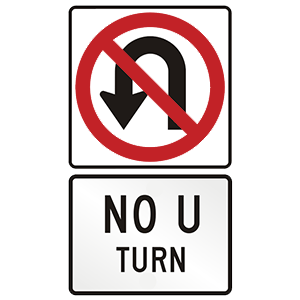
No parking.
Do not enter.
No U-turn.
Q.2.
If a vehicle is equipped with airbags:
Seat belts should still be worn.
Seat belts do not need to be worn.
Seat belts should be worn behind the back.
Q.3.
Unless otherwise posted, the speed limit on primary and secondary state and federal highways is:
55 mph.
45 mph.
65 mph.
Q.4.
On a multilane road, a dashed yellow line next to a solid yellow line means:
Passing is prohibited from both directions.
Passing is permitted from both directions.
Passing is permitted only from the direction next to the dashed line.
Q.5.
When changing lanes, you should never:
Cross the centerline in an intersection.
Check your blind spots by looking over your left or right shoulder.
Check for other drivers moving into the same lane.
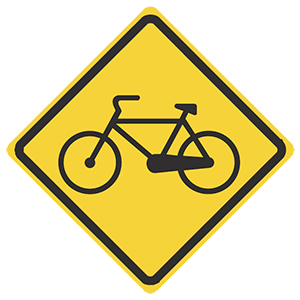
Q.6.
This sign means:
Watch for bicycles.
Bicycles not allowed.
Bicycle repair shop ahead.
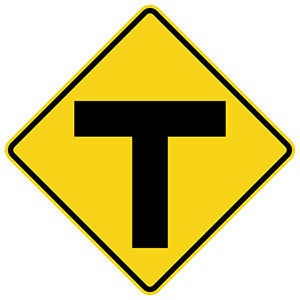
Q.7.
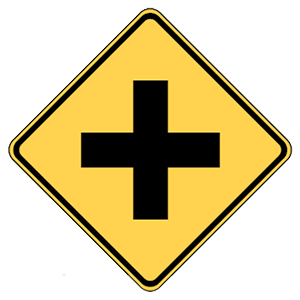
This sign shows one type of:
Right turn.
Intersection.
Lane change.
Q.8.
What is the purpose of rumble strips?
They alert drivers to potential tire problems.
They test a vehicle's shock absorbers.
Through vibration and sound, they alert inattentive drivers to the fact that their vehicles have left the travel lane.
Q.9.
It is unlawful to:
Pass another vehicle in any marked no passing zone.
Pass another vehicle over a railroad crossing.
Both of the above.
Q.10.
Construction zone signs are generally:
Square or rectangular with white and red coloring.
Round or octagonal with black and yellow coloring.
Diamond-shaped or rectangular with orange and black coloring.
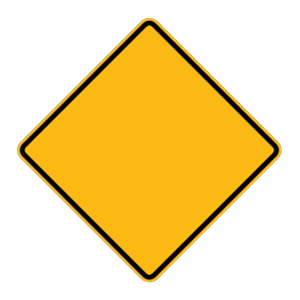
Q.11.
A diamond-shaped sign means:
Yield.
Stop.
Warning.
Q.12.
What is the only medically proven method of removing alcohol or other drug combinations from your system?
Breathe in some fresh air.
Give your body time.
Drink coffee.
Q.13.
If you find that the roadway ahead of you is flooded, you should:
Slam on the brakes.
Not drive through the flooded area. Turn around and find another route.
Drive only in the center of the roadway.
Q.14.
The best thing to do if you become tired while driving is to:
Stop to rest or change drivers.
Drink coffee.
Open a window.
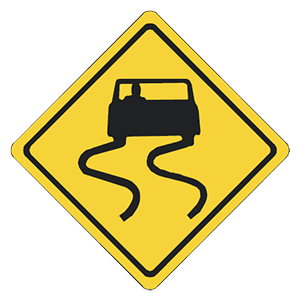
Q.15.
This sign means:
Slippery when wet.
Stop sign ahead.
No U-turn.
Q.16.
When driving at night, you should:
Always use your high beams.
Look directly at the headlights of an oncoming vehicle.
Increase your following distance.
Q.17.
When entering the interstate on a short entrance ramp where there is no acceleration lane, you should:
Immediately enter the far-right traffic lane on the interstate and speed up to match the flow of traffic.
Use the shoulder of the main road to get up to the speed of traffic.
Speed up and enter the interstate only after you have identified a gap in traffic.
Q.18.
A flashing yellow light at an intersection means you should:
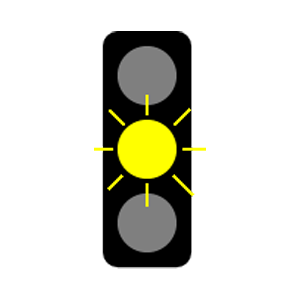
Slow down and proceed with caution.
Come to a complete stop as quickly as possible.
Stop and proceed only when the intersection is clear.
Q.19.
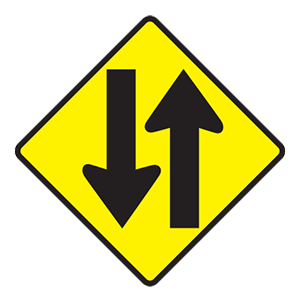
This sign means:
You can travel in either direction in this lane.
There is two-way traffic.
You are approaching a divided highway.
Q.20.
Trucks' blind spots are:
Directly behind the body.
On the immediate left of the cab.
Both on the immediate left of the cab and directly behind the body.
Q.21.
This road sign means:
Hospital.
Upcoming intersection.
Railroad crossing.
Q.22.
To know where traffic is behind you:
Frequently check your rearview mirror.
Turn and look out your back window.
Keep other vehicles out of your blind spots.
Q.23.
Before changing lanes or attempting to pass another vehicle, you should:
Check your blind spots and mirrors.
Signal your intention before changing lanes.
All of the above.
Q.24.
Which of the following describes the thinking of defensive drivers?
They know other drivers will do the right thing.
They consider what other drivers might do and are prepared to react.
They expect no breaks and give none.
Q.25.
In inclement weather, you should:
Steer off the road.
Drive in a low gear.
Steer and brake smoothly.
Q.26.
Children on bicycles should be given extra space by motor vehicle operators because:
They do not have the same physical reflexes as adults.
They are smaller and more difficult to see than adults.
Both of the above.
Q.27.
Which statement is true?
You should put on your cruise control near a railroad crossing to maintain a constant speed.
You must stop at a railroad crossing when directed to do so by a flagger or stop sign.
You have the right-of-way at a railroad crossing and do not need to stop.
Q.28.
If you are being followed too closely on a two-lane road:
Reduce your speed slowly to encourage the tailgater to drive around you.
Speed up to increase the distance between you and the other car.
Apply your brakes to slow down, then resume your original speed.
Q.29.
Excessive speed:
Saves time so you can get to your destination more quickly.
Helps you maneuver around obstacles.
Increases the likelihood of serious bodily injury and death.
Q.30.
When merging onto the freeway, you should be driving:
At or near the speed of the freeway traffic.
At the legal speed limit.
More slowly than the freeway traffic.
Support mcqgeeks.com by disabling your adblocker.
×
Please disable the adBlock and continue.
Thank you.
Reload page