MCQGeeks
CBSE
JEE
NTSE
NEET
English
UK Quiz
Quiz
Driving Test
Practice
Games
Driving Test
Tennessee
Tennessee Car Driving Permit Test-12
Answers
Q.1.
Blind spots are:
Spots in your vision when you become fatigued.
Areas of the road that cannot be seen in a vehicle's mirrors.
Traffic control devices.
Q.2.
If you approach a stopped school bus that has its lights flashing and signal arm extended, you should:
Stop.
Proceed at 15 mph if no children are present.
Proceed at normal speed, but watch for children.
Q.3.
You want to turn left at an upcoming corner. Yield the right-of-way to:
Oncoming vehicles also turning left.
All approaching vehicles.
Pedestrians on the sidewalk waiting for a "Walk" signal.
Q.4.
When driving on an interstate, to avoid traffic merging from on-ramps to your right, the best thing to do is to:
Change lanes to the left.
Slow down.
Maintain your speed and position.
Q.5.
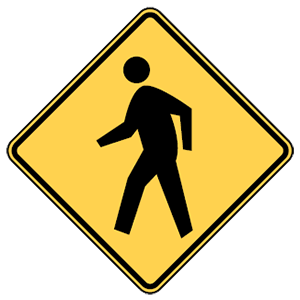
This road sign means:
Pedestrian crossing.
School crossing.
Jogging trail.
Q.6.
Before switching on the ignition, you should:
Buckle your safety belt.
Be sure all passengers have buckled their safety belts.
Both of the above.
Q.7.
A driver should use the proper turn signal ____ before beginning a turn.
50 feet
75 feet
25 feet
Q.8.
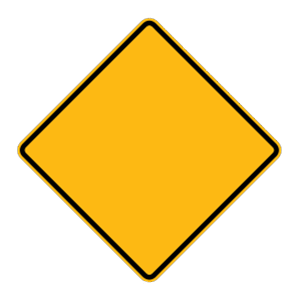
Signs with orange backgrounds are:
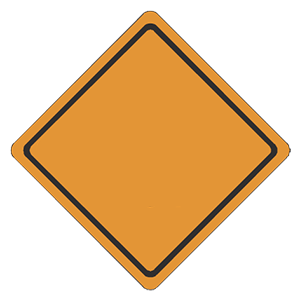
General warning signs.
Construction and maintenance warning signs.
Regulatory signs.
Q.9.
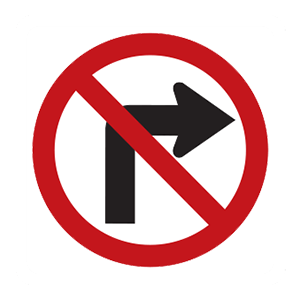
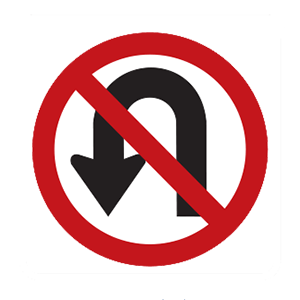
This road sign means:
No right turn.
No U-turns.
No left turn.
Q.10.
If you approach a flashing red traffic light, you:
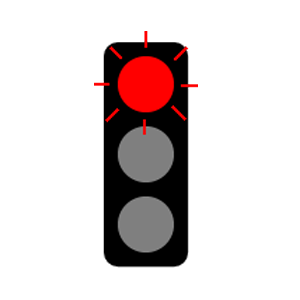
Are traveling in the wrong direction.
Must treat the intersection as if it is controlled by a stop sign.
May not proceed until it changes to green.
Q.11.
When driving at night, you should:
Always use your high beams.
Look directly at the headlights of an oncoming vehicle.
Increase your following distance.
Q.12.
The child restraint law requires all children under the age of ____ to be placed in an approved child restraint device while in a moving vehicle.
Three
Two
Four
Q.13.
This is the shape and color of a ____ sign.
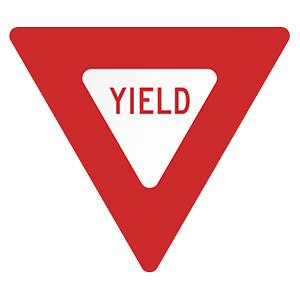
Stop
Wrong way
Yield
Q.14.
When you want to change lanes, you should never:
Move into another lane while within an intersection.
Check your blind spot by looking over your shoulder.
Check for other drivers moving into the same lane.
Q.15.
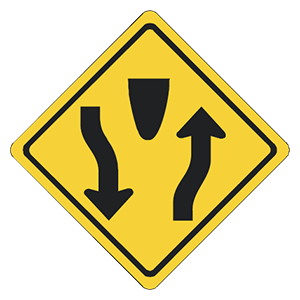
This sign means:
Divided highway.
Railroad warning.
No passing zone.
Q.16.
When passing another vehicle, you should return to your original lane when:
You can see both headlights of the passed vehicle in your rearview mirror.
You have cleared the front bumper of the passed vehicle.
You are 50 feet in front of the passed vehicle.
Q.17.
Interstate driving requires drivers to:
Have the ability to safely drive at increased speeds.
Be constantly alert.
Both of the above.
Q.18.
If your car becomes disabled while on the highway, you should:
Stop in the right lane.
Park with all four wheels off the traveled highway, if possible.
Stop where you are.
Q.19.
At intersections with a "Yield" sign, you must:
Yield the right-of-way to cross traffic that is near enough to cause conflict.
Yield the right-of-way only to vehicles on your right.
Always slow down and proceed without stopping.
Q.20.
This red and white sign means you should:
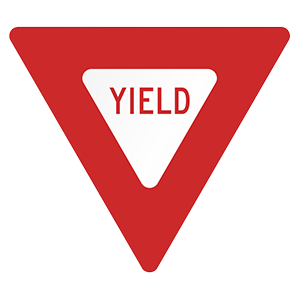
Stop and check for traffic coming from both directions before proceeding.
Give the right-of-way to traffic on the road you wish to enter or cross.
Maintain a steady speed and check for traffic coming from all directions.
Q.21.
What should you do when you see this sign?
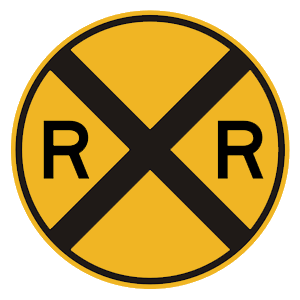
Look for a train station ahead.
Signal before going any further.
Slow down and yield to trains.
Q.22.
When taking any medicine, you should:
Consult your doctor about the effects before driving.
Have someone follow you home.
Keep your window open and drive more slowly.
Q.23.
When adjusting the driver’s seat for good driving posture, set the seat in an upright position with your body about how far from the steering wheel?
Six to eight inches.
10 to 12 inches.
18 to 24 inches.
Q.24.
You are driving on a city street and see an emergency vehicle with flashing lights behind you. What should you do?
Drive to the right edge of the road and slow down.
Drive to the right edge of the road and stop.
Stay in your lane, slow down, and let it pass.
Q.25.
If there is no crosswalk and you see a pedestrian crossing your lane, you should:
Make sure the pedestrian can see you before proceeding.
Cautiously drive around the pedestrian.
Stop and let the pedestrian finish crossing.
Q.26.
This sign is a:
Service sign.
Regulatory sign.
Warning sign.
Q.27.
A driver should:
Stare directly in front of their car.
Only focus on the middle of the road.
Watch beside, ahead, and to the rear of their car.
Q.28.
It is very foggy. You should slow down and:
Turn on your emergency flashers.
Turn your lights to their high beam setting.
Turn your lights to their low beam setting.
Q.29.
This road sign means:
Do not enter.
Roundabout ahead.
No U-turns.
Q.30.
When double solid yellow lines separate lanes of traffic:
Passing is permitted from the left.
Passing is permitted from the right.
Passing is not permitted from either direction.
Support mcqgeeks.com by disabling your adblocker.
×
Please disable the adBlock and continue.
Thank you.
Reload page