MCQGeeks
CBSE
JEE
NTSE
NEET
English
UK Quiz
Quiz
Driving Test
Practice
Games
Driving Test
Tennessee
Tennessee Car Driving Permit Test-14
Answers
Q.1.
This sign means:
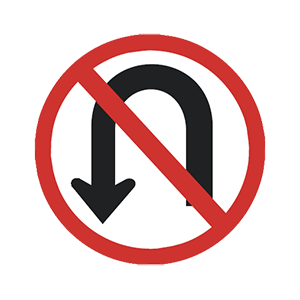
No U-turn.
Traffic signal ahead.
Railroad ahead.
Q.2.
Work zone barriers, drums, cones, and signs are used to:
Make drivers angry about slow traffic.
Inconvenience drivers.
Keep traffic out of hazardous work zones.
Q.3.
This sign means you are approaching a railroad crossing that does not have a signal. You should:
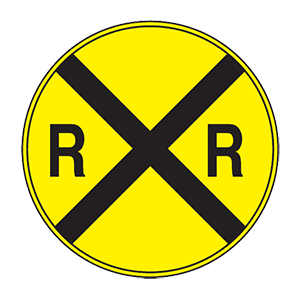
Come to a complete stop.
Proceed at a consistent speed while looking and listening for approaching trains.
Slow down, look both ways, listen for any trains, and be prepared to stop if any trains are nearby.
Q.4.
If you park facing uphill where there is no curb, set the parking brake and:
Turn your wheels toward the edge of the road.
Turn your wheels away from the edge of the road.
Keep your wheels facing straight.
Q.5.
You exit the freeway on a ramp that curves downhill. You should:
Slow to a safe speed before the curve.
Slow to the posted speed limit for the freeway.
Wait until you have entered the curve to begin braking.
Q.6.
You should yield to a pedestrian:
Only if they are in a crosswalk.
At all times, even if the pedestrian is not obeying traffic laws.
Only if the traffic lights are in the pedestrian's favor.
Q.7.
Adjust your rearview and side mirrors:
Before you start driving.
Whenever you need to use them.
Before you get into the car.
Q.8.
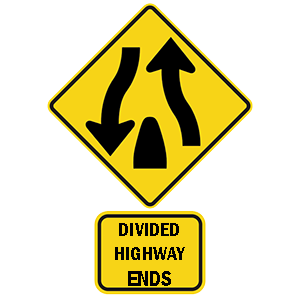
This sign means:
Curves ahead.
Divided highway starts.
Divided highway ends.
Q.9.
Which of these statements is true about roadwork zones?
Fines are the same for violations committed in work zones as they are under normal traffic conditions.
You must "Slow for the Cone Zone."
Slow down only if you think workers are present.
Q.10.
A blood alcohol concentration of 0.percent:
Won't have any effect on your driving.
Won't put other drivers at risk.
Will double your chances of having an accident.
Q.11.
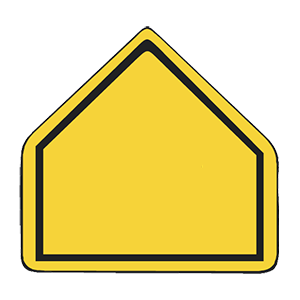
A pentagon-shaped sign is a:
Stop sign.
Regulatory sign.
School zone or school crossing sign.
Q.12.
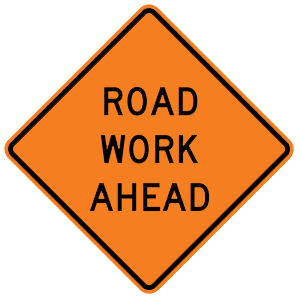
This road sign means:
Watch for people crossing your path.
No passing zone.
Work zone ahead.
Q.13.
When are you permitted to double park?
Never.
On a four-lane street only.
To load or unload passengers.
Q.14.
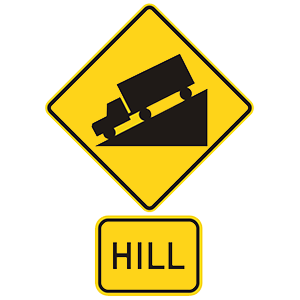
This road sign means:
Intersection ahead.
Steep grade ahead.
Winding road.
Q.15.
Which of the following are factors commonly contributing to traffic crashes?
Exceeding the posted speed limit and driving too fast for conditions or circumstances.
Getting adequate rest and staying alert.
Scanning the environment and staying focused on the driving task.
Q.16.
The driver should drive with both hands on the steering wheel, approximately in the:
9 o’clock and 3 o’clock positions.
11 o’clock and 6 o’clock positions.
7 o’clock and 5 o’clock positions.
Q.17.
Before returning to your original lane after passing another vehicle, you should:
Beep your horn.
See both headlights of the passed vehicle in your rearview mirror.
Flash your headlights.
Q.18.
Continuous hard braking on ice and snow often:
Helps you stop faster.
Locks the front wheels of a vehicle, causing a loss of steering.
Keeps the brakes from freezing.
Q.19.
This road sign means:
Cars in the right lane must slow down.
No left turn.
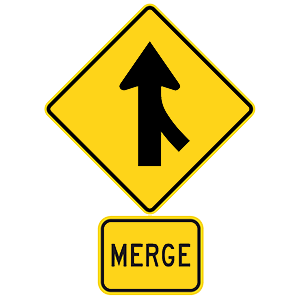
Merge.
Q.20.
To prevent yourself from becoming an aggressive driver:
Relax and concentrate on driving.
Drive above the posted speed limit.
Tailgate the driver in front of you.
Q.21.
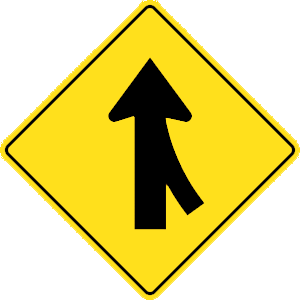
This yellow sign means:
One lane ahead.
Merging traffic ahead.
Lane ends ahead.
Q.22.
The Implied Consent Law means that:
If asked, you will take a test to determine the alcohol or drug content of your blood.
Traffic laws apply at an intersection, even without any signs, markings, or signals present.
If asked, you don't have to agree to a test to determine the alcohol or drug content of your blood.
Q.23.
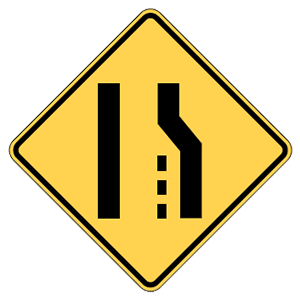
This road sign means:
Highway entrance ramp.
Road widens.
Right lane ends.
Q.24.
Driving more slowly than surrounding traffic is:
A good idea if the weather is bad.
Appropriate if you don’t know the speed limit.
Often a hazard because other drivers may become frustrated and try to pass you.
Q.25.
If it feels like your tires have lost contact with the surface of the road, you should:
Slow down by shifting into a lower gear.
Ease your foot off the gas pedal.
Slow down by pumping the brakes quickly and firmly.
Q.26.
A driver should use the proper turn signal ____ before beginning a turn.
50 feet
75 feet
25 feet
Q.27.
If you are driving and the rear end of your car starts skidding to the left, you should:
Steer to the right.
Steer to the left.
Tap your brakes lightly and shift into neutral.
Q.28.
When taking any medicine, you should:
Consult your doctor about the effects before driving.
Have someone follow you home.
Keep your window open and drive more slowly.
Q.29.
If your car's suspension is bad, it can cause:
Vehicle control problems.
Squealing brakes.
Slack in the steering.
Q.30.
Interstate driving requires drivers to:
Have the ability to safely drive at increased speeds.
Be constantly alert.
Both of the above.
Support mcqgeeks.com by disabling your adblocker.
×
Please disable the adBlock and continue.
Thank you.
Reload page