MCQGeeks
CBSE
JEE
NTSE
NEET
English
UK Quiz
Quiz
Driving Test
Practice
Games
Driving Test
Tennessee
Tennessee Car Driving Permit Test-5
Answers
Q.1.
If you want to pass a pedestrian who is walking along the roadway and an oncoming vehicle is approaching, you should:
Slow down and let the oncoming vehicle pass before you pass the pedestrian.
Keep driving at a steady speed. The oncoming vehicle must stop for you.
Honk your horn to get the pedestrian to move over.
Q.2.
If your wheels drop off the roadway or pavement edge, you should:
Wait until it is safe to do so, then gradually re-enter the roadway.
Turn back onto the roadway immediately.
Stop.
Q.3.
Which of the following are factors commonly contributing to traffic crashes?
Exceeding the posted speed limit and driving too fast for conditions or circumstances.
Getting adequate rest and staying alert.
Scanning the environment and staying focused on the driving task.
Q.4.
You are approaching an intersection with a steady yellow traffic light. If you have not already entered the intersection, you should:
Speed up to beat the red light.
Reduce you speed and proceed carefully through the intersection.
Come to a safe stop.
Q.5.
Changing from one lane to another is best done:
Quickly and often.
When a car is in your blind spot.
Gradually and carefully.
Q.6.
You are coming to an intersection with a flashing red light. You should:
Slow down and yield the right-of-way.
Slow down and drive carefully through the intersection.
Come to a complete stop, check the traffic, and go when it is safe to do so.
Q.7.
When driving in fog, you should:
Slow down and use your low beam headlights.
Slow down and use your high beam headlights.
Turn your lights on and off to warn other drivers.
Q.8.
On a freeway, you should look farther ahead than you would on a city street:
In order to see potential hazards early.
Because it takes a quarter of a mile to stop your vehicle completely.
Because it helps you keep up with traffic.
Q.9.
Drivers are required to obey instructions from:
Security guards patrolling parking lots.
Other drivers whose vehicles are broken down on the roadway.
Flaggers (signal persons) at construction sites.
Q.10.
It is more dangerous to drive at night than during the day because:
You cannot see as far ahead at night.
The road is always more slippery at night.
Your reaction time is slower at night.
Q.11.
A curb painted red means:
Loading zone.
The area is reserved for picking up or dropping off passengers.
No parking, standing, or stopping.
Q.12.
When driving on a slippery surface, such as snow or ice:
Shift to a low gear before going down steep hills.
Maintain traction by following other vehicles closely.
Pump your brakes to keep them from freezing.
Q.13.
If you are driving and the rear end of your car starts skidding to the left, you should:
Steer to the right.
Steer to the left.
Tap your brakes lightly and shift into neutral.
Q.14.
A conviction of driving under the influence (DUI) is determined by a blood alcohol concentration of:
0.05 percent.
0.08 percent.
50 percent.
Q.15.
It is illegal to park:
Within 15 feet of a fire hydrant.
Within 50 feet of a railroad crossing.
Both of the above.
Q.16.
When parking next to a curb, you should use your turn signals:
Only when pulling away from the curb.
When pulling next to, but not away from, the curb.
When pulling next to or away from the curb.
Q.17.
A U-turn is not permitted:
In a parking lot.
On or near any curve or hill.
On a straight roadway with a clear view for 500 feet in both directions.
Q.18.
Give the right-of-way to any pedestrian who is:
In a marked crosswalk.
In any crosswalk or intersection.
Crossing any street.
Q.19.
If a child is about to run into the street, you should:
Start to prepare to slow down.
Flash your headlights.
Sound a sharp blast of your horn.
Q.20.
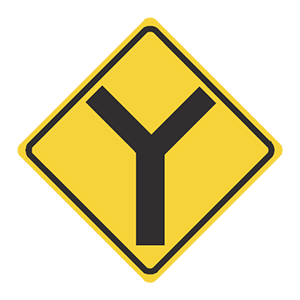
This road sign means:
The roadway ends ahead.
Drivers must bear either right or left.
A four-way intersection is ahead.
Q.21.
What message will be found on this yellow pennant-shaped sign?

Right turns only.
Right turns permitted.
No passing zone.
Q.22.
As your speed increases, it is important to:
Change lanes frequently.
Turn on your headlights.
Look well ahead of your vehicle.
Q.23.
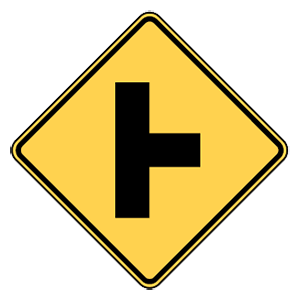
This road sign means:
All traffic must turn right.
All traffic must go straight.
A side road intersects ahead.
Q.24.
Which of the following driving skills are affected by the use of alcohol and/or drugs?
Alertness and concentration.
Reaction time and coordination.
All of the above.
Q.25.
"No zones" are areas around trucks where cars:
Disappear into blind spots or are so close that they restrict the truck driver's ability to stop and maneuver safely.
Have sufficient space to travel behind the truck.
Have several car lengths between their vehicle and the truck.
Q.26.
Remove all snow, frost, and ice from:
Just the windshield.
All windows.
Just the windshield and passenger window.
Q.27.
The Implied Consent Law means that:
If asked, you will take a test to determine the alcohol or drug content of your blood.
Traffic laws apply at an intersection, even without any signs, markings, or signals present.
If asked, you don't have to agree to a test to determine the alcohol or drug content of your blood.
Q.28.
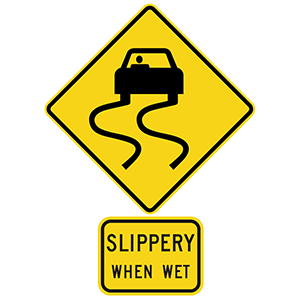
This sign means:
Do not drink and drive.
Slippery when wet.
Road curves ahead.
Q.29.
A sign with this shape means:
No passing zone.
Right turn permitted on red.
Yield right-of-way.
Q.30.
To be able to turn quickly, your hands must be:
On opposite sides of the steering wheel.
Next to each other on the top of the steering wheel.
On the top and bottom of the steering wheel.
Support mcqgeeks.com by disabling your adblocker.
×
Please disable the adBlock and continue.
Thank you.
Reload page