MCQGeeks
CBSE
JEE
NTSE
NEET
English
UK Quiz
Quiz
Driving Test
Practice
Games
Driving Test
Tennessee
Tennessee Car Driving Permit Test-6
Answers
Q.1.
Check your rearview mirrors:
Often to see how traffic is moving behind you.
To see if a vehicle is in your blind spot.
Only when you are slowing down.
Q.2.
When turning left at an intersection:
You should always yield to oncoming traffic and pedestrians.
Oncoming traffic and pedestrians should yield to you.
You should never yield to oncoming traffic and pedestrians.
Q.3.
When driving under snowy or icy conditions:
It is safe to use your cruise control.
Make speed and directional changes more gradually than you would otherwise.
Drive as you would under normal conditions.
Q.4.
If there is a deep puddle on the road ahead, you should:
Maintain the posted speed to make it through the water.
Avoid the puddle if possible.
Shift into neutral as you drive through the water.
Q.5.
The best way to avoid a dangerous situation while driving is to:
Know what is happening around your vehicle.
Turn off the radio.
Always keep your eyes focused ahead of your car.
Q.6.
Only ____ can lower blood alcohol concentration (BAC) and reduce alcohol's effects on a body.
Drinking caffeine
Eating foods high in fat
Time
Q.7.
Continuous hard braking on ice and snow often:
Helps you stop faster.
Locks the front wheels of a vehicle, causing a loss of steering.
Keeps the brakes from freezing.
Q.8.
If you drive faster than other vehicles on a road with one lane moving in each direction and continually pass the other cars, you will:
Get you to your destination much more quickly and safely.
Increase your chances of an collision.
Help prevent traffic congestion.
Q.9.
It is illegal to make a U-turn near a curve or hill when the driver cannot:
Make the turn within 30 seconds.
See at least 500 feet in each direction.
Drive on the shoulder of the road.
Q.10.
When driving in fog, it is best to drive with:
High beam headlights.
Low beam headlights.
Four-way flashers.
Q.11.
A broken yellow line beside a solid yellow line indicates that passing is:
Permitted from the side next to the solid yellow line.
Not permitted from either direction.
Permitted from the side next to the broken yellow line.
Q.12.
When stopping on snow or ice, drivers who are operating vehicles equipped with an Anti-Lock Braking System (ABS) should:
Pump the brakes.
Press and hold the brake pedal firmly.
Stay off the brakes and wait for the car to drift to a stop.
Q.13.
If you have a sudden tire blowout:
Use the brakes lightly.
Pump the brakes.
Apply the brakes firmly.
Q.14.
Double solid yellow line markings down the center of a road indicate that passing is:
Allowed from both directions.
Allowed only from your direction of travel.
Not allowed from either direction.
Q.15.
How far in advance should you signal your intention to turn?
At least 50 feet.
As soon as you decide to turn.
At least 100 feet.
Q.16.
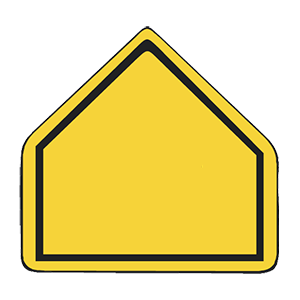
This sign means:
School zone or crossing.
Pedestrian crossing.
Railroad ahead.
Q.17.
You hit a parked vehicle and can't find the owner. What must you do?
Call your insurance company when you get home.
Wait for the owner to return.
Leave a note with your name and address on the parked vehicle.
Q.18.
To avoid hydroplaning while driving in rainy conditions, you should:
Drive at a speed appropriate for ideal conditions.
Apply your brakes as soon as your car starts to skid.
Slow down.
Q.19.
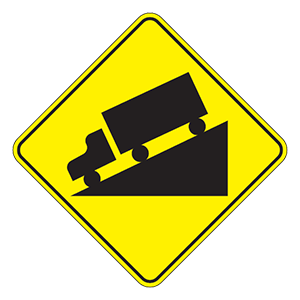
This sign means:
Trucks entering.
Truck exit only.
Steep downgrade ahead.
Q.20.
Yellow lines separate:
Traffic lanes on one-way streets.
Traffic moving in opposite directions on two-way roads.
All carpool lanes from regular traffic lanes.
Q.21.
If you encounter an aggressive driver, you should:
Challenge them.
Get out of their way.
Speed up.
Q.22.
Blue traffic signs offer information on:

Motorist services.
Construction and maintenance.
Mileage information, such as distances to specific locations.
Q.23.
While driving on a roadway with a single broken white centerline:
You must stay within your lane.
You may cross the centerline to change lanes.
You may change lanes only from the left lane.
Q.24.
If the rear of your vehicle is skidding to the left, you should:
Not turn your steering wheel.
Turn your steering wheel to the left to correct the skid.
Turn your steering wheel to the right to correct the skid.
Q.25.
If the traffic signal turns red while you are in the middle of an intersection waiting to turn left, you should:
Stop until the light changes to green.
Back out of the intersection, if possible.
Complete the turn when traffic clears.
Q.26.
When a pedestrian guided by a dog or carrying a white cane is crossing the street:
You must always yield the right-of-way.
You must tell them where to cross the street.
You only have to yield the right-of-way if you are at a corner.
Q.27.
In rainy weather, you should be most careful when turning or stopping:
After it has been raining all day.
One half hour after it stops raining.
During the first half hour of rain.
Q.28.
You are approaching an intersection at the posted speed limit when the signal turns yellow. You should:
Slow down and proceed through the intersection without caution.
Speed up to cross the intersection before the light turns red.
Stop before entering the intersection, if you can do so safely.
Q.29.
You are driving on the freeway behind a large truck. You should drive:
Closer behind the truck than you would if following a passenger vehicle.
Farther behind the truck than you would if following a passenger vehicle.
To the right side of the truck and wait to pass.
Q.30.
You should increase the distance between your vehicle and the vehicle ahead when you:
Are following a small passenger vehicle.
Are being tailgated by another driver.
Are driving more slowly than the posted speed limit.
Support mcqgeeks.com by disabling your adblocker.
×
Please disable the adBlock and continue.
Thank you.
Reload page