MCQGeeks
CBSE
JEE
NTSE
NEET
English
UK Quiz
Quiz
Driving Test
Practice
Games
Driving Test
Tennessee
Tennessee Motorcycle Driving Permit Test-10
Answers
Q.1.
Which of the following is an example of a potentially slippery surface?
A gravel road
A paved driveway
Dry pavement
Q.2.
If using saddlebags to carry a load, you should:
Load the bags as evenly as possible.
Unevenly distribute weight into the saddlebags.
Place as much weight as possible into one saddlebag.
Q.3.
Where is the greatest potential for conflict between you and other vehicles?
At intersections
On the highway
On any road
Q.4.
How many alcoholic drinks need to be consumed before the drinker's riding ability is affected?
One
Two
Three
Q.5.
When being passed by another vehicle, you should travel in:
The left portion of the lane.
The center portion of the lane.
The right portion of the lane.
Q.6.
If you must stop quickly, you should:
Use the front brake only.
Use the front brake first.
Use the front brake at the same time as the rear brake.
Q.7.
After riding over an object on the road, you should:
Continue riding because the danger has passed.
Pull to the side of the road and check your tires and rims for damage.
Stop to remove the object from the road.
Q.8.
Since most crashes happen in daylight, you:
Do not need to wear brightly-colored clothing during the day.
Should wear brightly-colored clothing during the day.
Should wear dark clothing during the day.
Q.9.
Of the following, which is not a reason to keep a cushion of space between your motorcycle and the vehicle in front of you?
It allows you more time to respond to hazards.
It prevents you from finding an escape route.
It provides space to maneuver your motorcycle.
Q.10.
If you get a flat tire while riding, you should:
Hold the handle grips firmly and stay off the brakes.
Shift your weight toward the good wheel and brake normally.
Brake on the good wheel while immediately pulling off the road.
Q.11.
Whichever style of helmet you choose, you will get the most protection by ensuring that your helmet:
Fits snugly.
Is clean.
Looks cool.
Q.12.
When it starts to rain, it is usually best to:
Ride in the center of the lane.
Ride in the tire tracks left by cars.
Pull to the side of the road until the rain stops.
Q.13.
When riding at night, you should:
Increase your speed.
Increase your following distance.
Decrease your following distance.
Q.14.
A plastic, shatter-resistant face shield:
Protects your face, but not your eyes.
Protects your eyes, but not your whole face.
Helps protect your whole face.
Q.15.
When riding, your feet should be:
On the gas tank.
Hanging loosely.
On the footrests.
Q.16.
When it starts raining, it is best to:
Get off the road.
Ride in the tire tracks left by other vehicles.
Ride in the center portion of the lane.
Q.17.
Which of the following is not a method used to maintain control of a motorcycle in a turn?
Accelerate through the turn.
Reduce your speed before turning.
Lean into the turn.
Q.18.
If you accidentally lock your rear brake on a good traction surface, you should:
Let go of the rear brake.
Keep the rear brake locked until you stop.
Release the rear brake and only use the front brake.
Q.19.
Unlike other substances, alcohol:
Is very quickly absorbed into the bloodstream.
Needs to be digested to enter the bloodstream.
Can improve your riding ability.
Q.20.
When riding over grooved pavement in a work zone, you should:
Look down to watch for changes in the road surface.
Keep your head and eyes up.
Move to the edge of the roadway.
Q.21.
A motorcycle’s brake light is _________ a passenger vehicle’s brake light.
More noticeable than
Just as noticeable as
Not as noticeable as
Q.22.
When a motorcyclist needs to stop quickly, they should:
Apply both brakes at the same time.
Use only the front brake.
Use only the rear brake.
Q.23.
Which of the following is not a potential problem?
An upcoming change in road surface characteristics
Surrounding traffic
Conditions that do not appear to change as you approach
Q.24.
When positioning your body on the motorcycle:
You should hold yourself up with your arms.
Your arms should be used to steer the motorcycle.
You should have to stretch to reach the handgrips.
Q.25.
When stopping your motorcycle while carrying a passenger, you should:
Ride a little faster than you normally would.
Start slowing earlier than you normally would.
Merge into smaller gaps of traffic than you normally would.
Q.26.
Hearing protection is:
Not recommended.
Recommended only for long rides.
Recommended for all rides.
Q.27.
When riding at night:
Only ride in the left portion of the lane to better see around other vehicles ahead.
Ride closely to the vehicle in front of you to most effectively use their headlights.
Reduce your speed to increase your chances of avoiding an unexpected hazard.
Q.28.
What does a flashing red traffic light mean?
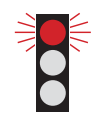
Come to a complete stop and proceed when it is safe to do so.
Only stop to yield to other traffic.
Vehicles will be entering the roadway.
Q.29.
When riding ________, you are facing the greatest potential for conflict between you and other vehicles.
On the expressway
Near an intersection
In a group
Q.30.
Where should you position your motorcycle when entering a curve?
The outside of the curve
The inside of the curve
Wherever traffic and road conditions require
Support mcqgeeks.com by disabling your adblocker.
×
Please disable the adBlock and continue.
Thank you.
Reload page