MCQGeeks
CBSE
JEE
NTSE
NEET
English
UK Quiz
Quiz
Driving Test
Practice
Games
Driving Test
Tennessee
Tennessee Motorcycle Driving Permit Test-8
Answers
Q.1.
When making a non-emergency stop on a motorcycle:
Only the front brake should be used.
The front and rear brakes should be applied at the same time.
Only the rear brake should be used.
Q.2.
When taking a curve while riding in a group, you should be in:
A single-file formation.
Pairs.
A staggered formation.
Q.3.
Motorcycles may pass on the right:
If there is at least eight feet of unobstructed pavement.
By riding on the shoulder of the road.
By riding on the grass, if it is level.
Q.4.
When riding at night, maintain a minimum following distance of:
Two seconds.
Three seconds.
Four seconds.
Q.5.
When turning, you should:
Move your knees away from the gas tank.
Turn just your head, not your shoulders, to look through the turn.
Turn your head and shoulders to look through the turn.
Q.6.
Goggles, glasses with impact-resistant lenses, or a helmet with a face shield:
Must be worn if your motorcycle does not have a windshield.
Are optional if your motorcycle does not have a windshield.
Must be worn if you are under 21 years of age.
Q.7.
To be effective, eye or face shield protection must:
Fasten securely.
Restrict your vision to the sides so you can focus on the road ahead.
Not allow eyeglasses or sunglasses to be worn.
Q.8.
When riding behind another vehicle, you should position yourself:
To be seen in the vehicle’s side mirror.
To be seen in the vehicle’s rearview mirror.
To be seen through the vehicle's passenger window.
Q.9.
If you borrow a motorcycle, you should:
Assume all controls are in the same location as they are on your motorcycle.
Immediately take it out on the highway.
Get familiar with it in a controlled area.
Q.10.
When you must brake and swerve to avoid a hazard, you should:
Perform both actions at the same time.
Only brake.
Perform one action, then the other.
Q.11.
The best lane position for a motorcycle:
Is in the left part of a lane, next to the centerline.
Is in the right part of a lane, next to the curb.
Can vary depending on road and traffic conditions.
Q.12.
You have an improved chance of avoiding serious injury in a crash if you wear:
Face or eye protection.
A baseball cap.
Sneakers.
Q.13.
All motorcycles must have:
A rearview mirror mounted on the left handlebar.
A rearview mirror mounted on the right handlebar.
A rearview mirror, but only if the operator is under the age of 21.
Q.14.
You should pick a lane position that:
Best increases your visibility and allows for a safe cushion of space.
You like, without regard to others.
Gets you close to other vehicles.
Q.15.
There is the greatest potential for conflict between a motorcycle and other traffic:
On the highway.
At intersections.
On rural roads.
Q.16.
When riding a motorcycle, it is important to:
Focus only on what is in front of you.
Focus only on what is behind you.
Know what’s happening both in front of and behind you.
Q.17.
The proper action to take when riding an unfamiliar motorcycle for the first time is to:
Just start riding. There is no better way to learn than by doing.
Just start riding. Most bikes are similar, so you don’t have to take the time to identify safety features.
Work the throttle, clutch, and brakes before riding to learn the bike's gear pattern.
Q.18.
In the center of a traffic lane, there is usually an oily strip. Motorcyclists should:
Avoid riding on the oil and grease buildup.
Not worry about the oil and grease buildup.
Search for the lane with the smallest amount of oil and grease buildup.
Q.19.
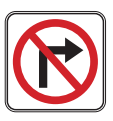
What does this sign mean?
No left turn
No U-turn
No right turn
Q.20.
To control a motorcycle well, you should:
Use your arms to hold yourself up.
Keep your knees against the gas tank.
Sit so your arms are straight when reaching for the handlebars.
Q.21.
When being followed by a tailgater, you should:
Allow them to pass.
Speed up.
Not change how you are riding.
Q.22.
If vehicles are present on both sides of you motorcycle, which lane position is usually the best option?
Left
Right
Center
Q.23.
When cars are merging from an entrance ramp:
A motorcyclist should assume the entering drivers see them.
A motorcyclist should never assume the entering drivers see them.
A motorcyclist should stop.
Q.24.
In general, which position within a lane is the best to ride in?
The left position
The right position
There is no single best lane position.
Q.25.
When riding a motorcycle, you should:
Always wear a jacket.
Only wear a jacket at night.
Only wear a jacket if it is cold outside.
Q.26.
To reduce the chances of a collision, a motorcycle rider should:
Maintain an adequate space cushion.
Ride very slowly.
Ride the centerline.
Q.27.
Reflective clothing:
Should be worn only at night.
Should be worn only during the day.
Should be worn both day and night.
Q.28.
If possible, do not ride directly next to another vehicle because:
Another driver may want to use your lane to pass.
You may be in the vehicle’s blind spot.
You may have access to escape routes.
Q.29.
You have an improved chance of avoiding serious injury in a crash if you wear all of the following, except:
A DOT-compliant helmet.
A leather jacket.
A sweatshirt.
Q.30.
A sign that your rear tire has suddenly gone flat is that:
The back of your motorcycle is swaying from side to side.
You heard a loud noise.
A discharge of air can be seen.
Support mcqgeeks.com by disabling your adblocker.
×
Please disable the adBlock and continue.
Thank you.
Reload page