MCQGeeks
CBSE
JEE
NTSE
NEET
English
UK Quiz
Quiz
Driving Test
Practice
Games
Driving Test
Tennessee
Tennessee Motorcycle Driving Permit Test-9
Answers
Q.1.
To minimize the potential for fatigue, you should:
Turn on the radio.
Take frequent rest breaks.
Drink caffeine.
Q.2.
When entering a turn, you should:
Slow down.
Speed up.
Come to a complete stop.
Q.3.
When carrying a passenger, a motorcycle responds to directional changes:
More slowly than usual.
More quickly than usual.
Normally.
Q.4.
Which of the following is not a benefit of maintaining a space cushion between your motorcycle and other vehicles?
You will have time to react to hazards.
You will have space to maneuver.
You will have more time to accelerate when entering a curve.
Q.5.
When passing a row of parked cars, you should:
Ride on the left side of the lane.
Ride wherever you are most comfortable.
Ride in the right portion of the lane.
Q.6.
Hearing protection:
Is not needed when the rider is wearing a helmet.
Is only recommended for long trips.
Should be used on all rides.
Q.7.
You should conduct a safety inspection of your motorcycle:
Before every ride.
Every week.
Once a month.
Q.8.
The normal recommended following distance should be extended if:
The pavement is slippery.
The sun is shining.
You believe stopping will be routine.
Q.9.
Where is the greatest potential for conflict between you and other vehicles?
At an intersection
On the highway
On any road
Q.10.
The gearshift is located:
By the left footrest.
By the right footrest.
By the right handle grip.
Q.11.
Your lane position should do all of the following, except:
Increase your ability to be seen.
Help you avoid surface hazards.
Invite other road users into your lane.
Q.12.
Before starting a turn, a motorcyclist should change gears to:
Prevent a change in power in the middle of the turn.
Be able to keep both hands on the handle grips during the turn.
Prevent the motorcycle from slowing down.
Q.13.
When riding on a slippery surface, you should:
Avoid making sudden moves, as doing so could cause a skid.
Travel on the shoulder to be out of the way of traffic.
Use only the rear brake because the front brake is ineffective on slippery surfaces.
Q.14.
You will get the most protection from a helmet if it is all of the following, except:
U.S. DOT-compliant.
Loose-fitting.
Free of defects.
Q.15.
Improper braking:
Usually has no consequences.
Is a significant contributing factor to many motorcycle crashes.
Should not be a concern, since the motorcycle has two brakes.
Q.16.
When riding near a truck:
If you cannot see the truck’s mirrors, the driver cannot see you.
You should not be able to see the truck’s mirrors.
You should concentrate on operating your motorcycle and not worry about the truck’s mirrors.
Q.17.
Reflective clothing:
Should be worn only at night.
Should be worn only during the day.
Should be worn both day and night.
Q.18.
A good way to handle a tailgater is to:
Encourage the tailgater to pass by slowing down or changing lanes.
Speed up to put distance between you and the tailgater.
Ignore the tailgater.
Q.19.
As you approach a blind intersection, you should:
Move into the part of the lane that allows other drivers to most easily see you.
Move into the part of the lane closest to the traffic control device.
Move into the outside edge of the lane.
Q.20.
Usually a good way to handle tailgaters is to:
Get off the roadway.
Change lanes and let them pass.
Ride faster.
Q.21.
Wearing which of the following colors will make you less visible to other motorists?
Orange
Yellow
Brown
Q.22.
For motorcycle operators, eye protection is:
Required.
Not required, but recommended.
Not recommended.
Q.23.
A plastic, shatter-resistant face shield:
Is not necessary if you have a windshield.
Only protects your eyes.
Helps protect your whole face.
Q.24.
Riding gloves should be made of:
Leather.
Wool.
Any soft material.
Q.25.
Which of the following is not a factor in determining a person's blood alcohol content (BAC)?
The amount of alcohol consumed
How quickly the alcohol is consumed
How often the person consumes alcohol
Q.26.
Your lane position should:
Allow you to blend in with traffic.
Provide an escape route.
Encourage others to use your lane.
Q.27.
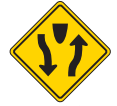
What does this sign mean?
Signal ahead
Crossroad ahead
Divided roadway ahead
Q.28.
If vehicles are present on both sides of you motorcycle, which lane position is usually the best option?
Left
Right
Center
Q.29.
Which of the following is not recommended as protective apparel for motorcycle users?
Long pants
Gloves
A baseball cap
Q.30.
Which lane position is usually best for minimizing the risk of other vehicles sharing your lane?
The left portion of the lane
The center portion of the lane
The right portion of the lane
Support mcqgeeks.com by disabling your adblocker.
×
Please disable the adBlock and continue.
Thank you.
Reload page