MCQGeeks
CBSE
JEE
NTSE
NEET
English
UK Quiz
Quiz
Driving Test
Practice
Games
Driving Test
Texas
Texas Car Driving Permit Test-11
Answers
Q.1.
When driving in bad weather, drivers should:
Increase their speed to reach their final destination more quickly.
Decrease their following distance.
Increase their following distance.
None of the above.
Q.2.
What are the colors of signs that tell you the distance to the next exit on a highway?
Yellow with black letters
Black with white letters
Red with white letters
Green with white letters
Q.3.
A speed limit is:
The maximum or minimum legal speed you can travel on a road under dangerous conditions.
The maximum or minimum legal speed you can travel on a road under ideal conditions.
The suggested speed to travel on a road under ideal conditions.
None of the above.
Q.4.
A solid white line down the center of a two-lane road indicates:
Lanes are moving in opposite directions and drivers are not permitted to pass.
Lanes are moving in opposite directions and drivers are permitted to pass when it is safe to do so.
Lanes are moving in the same direction and drivers are not permitted to pass.
Lanes are moving in the same direction and drivers are permitted to pass when it is safe to do so.
Q.5.
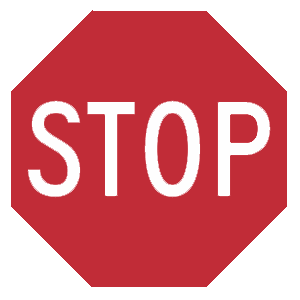
This road sign means:
Slow down or stop.
Stop, if necessary.
You must come to a complete stop.
Drive with caution and be ready to stop.
Q.6.
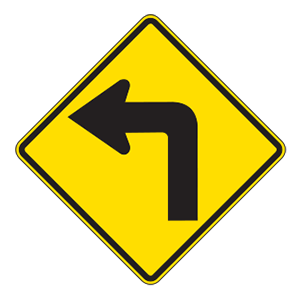
This sign means:
Sharp turn ahead, slow down.
Work crew ahead.
Side road.
Playground ahead.
Q.7.
If your turn signals fail, you should use ____ to indicate that you are turning.
Your horn
Your headlights
Hand signals
Your emergency flashers
Q.8.
When merging onto a freeway, it is usually best to:
Proceed slowly while waiting for an opening.
Accelerate to a speed that is faster than the speed of traffic.
Turn on your hazard lights until safely on the freeway.
Accelerate to the speed of freeway traffic.
Q.9.
If you want to get off the freeway but you have missed your exit, you should:
Go to the next exit.
Make a U-turn through the median.
Pull onto the shoulder and back your car to the exit.
Flag down a police officer for an escort back to your exit.
Q.10.
Do not pass:
On a hill.
In a curve in the roadway.
In an area where visibility is limited.
All of the above.
Q.11.
The consumption of alcohol while taking drugs can:
Decrease the effects of the drugs and alcohol.
Increase the effects of both the drugs and alcohol.
Help cure your illness.
Improve your driving ability.
Q.12.
When should you turn off your turn signal?
Before beginning a turn.
In the middle of completing a turn.
After completing a turn.
If there is no traffic surrounding you.
Q.13.
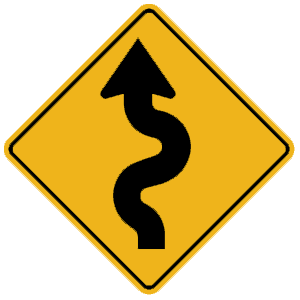
This sign tells you that:
No turns are allowed on this road.
The road narrows ahead.
There are a series of curves ahead.
The road may be slippery when wet.
Q.14.
Bicycles on the road:
Must always yield the right-of-way to motor vehicles.
Do not follow specific rules of the road.
Are considered vehicles with the same rights and responsibilities as motor vehicles.
Are nothing to worry about.
Q.15.
A driver entering interstate traffic from an entrance or acceleration ramp:
Should yield to drivers already on the interstate.
Has the right-of-way.
May force their way into traffic.
Can assume that other drivers will change lanes to make room.
Q.16.
If a vehicle using high beams comes toward you, you should look toward ____ of the road.
Either side
The center
The right side
The left side
Q.17.
Reasonable assistance to those injured in a collision includes:
Calling for medical personnel.
Applying pressure or bandaging to wounds.
Arranging transportation for the injured.
All of the above.
Q.18.
When approaching a school bus stopped with its stop arm extended, drivers should:
Come to a complete stop and wait to proceed.
Honk their horn before passing the bus on its left.
Continue driving when they think most kids are probably done exiting the bus.
Pass the bus before its door opens.
Q.19.
How can you lower the risk of hydroplaning?
Do not speed when the roads are wet.
Use tires with proper air pressure.
Replace tires with bad tread.
All of the above.
Q.20.
An "End school zone" sign indicates:
That the speed limit is 20 mph.
The beginning of a reduced speed zone.
The increased possibility of encountering pedestrians.
The end of a reduced speed zone.
Q.21.
A red traffic signal light means that you must:
Stop at the stop line.
Stop before entering any crosswalk.
Stop before entering the intersection.
All of the above.
Q.22.
If you are driving on a one-way street and an emergency vehicle using its flashing lights approaches your vehicle, you must:
Drive with your flashers turned on.
Drive toward the nearest roadside and stop.
Speed up and take the nearest exit.
Slow down until the vehicle passes you.
Q.23.
What might a flag on the back of a bicycle indicate?
The operator will be making frequent stops.
The operator drives above the speed limit.
The operator is hearing impaired.
The bicycle is broken.
Q.24.
A flashing yellow light at an intersection means that you should:
Slow down and proceed with care.
Continue normally through the intersection.
Stop and proceed when a green light appears.
Stop and proceed when the way is clear.
Q.25.
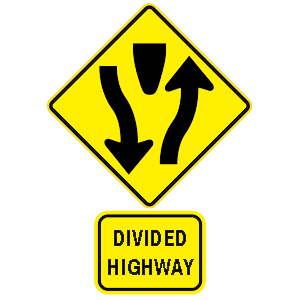
This sign means:
One-way traffic.
Divided highway ahead.
Two-way traffic.
Keep left.
Q.26.
To avoid carbon monoxide poisoning, drivers should:
Have their exhaust system checked regularly to be sure it does not leak.
Keep their car turned off when it is enclosed in a garage.
Close vents when following closely behind another car.
All of the above.
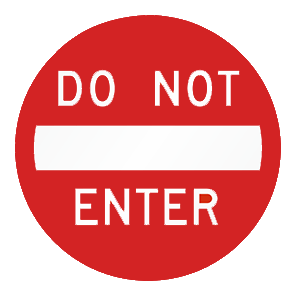
Q.27.
This sign means:
Stop.
No U-turn.
Yield.
Do not enter.
Q.28.
You may drive around the gates at a railroad crossing:
When the train has passed.
Under no circumstances.
When the lights have stopped flashing.
When other drivers drive around the gates.
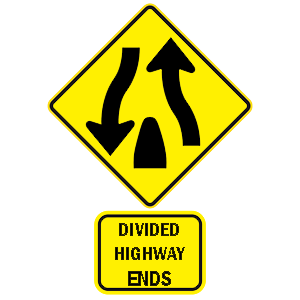
Q.29.
This sign means:
One-way traffic.
Divided highway ends.
Two-way traffic.
Keep left.
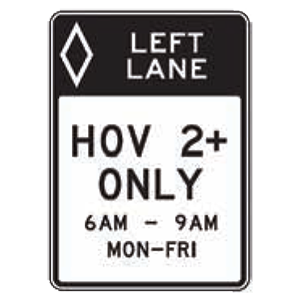
Q.30.
This road sign means:
The left lane is reserved for vehicles with a specific number of occupants.
Specific turning movements are allowed from specific lanes.
Do not enter.
Drivers in both lanes are responsible for merging smoothly.
Support mcqgeeks.com by disabling your adblocker.
×
Please disable the adBlock and continue.
Thank you.
Reload page