MCQGeeks
CBSE
JEE
NTSE
NEET
English
UK Quiz
Quiz
Driving Test
Practice
Games
Driving Test
Texas
Texas Car Driving Permit Test-17
Answers
Q.1.
This sign means:
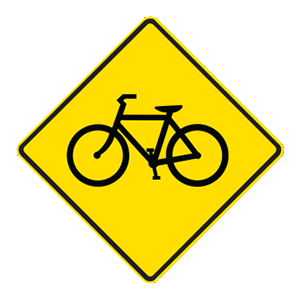
Bicycle crossing.
Stop.
Fines double in a work zone.
Stop ahead.
Q.2.
How may drivers fight oncoming "Highway hypnosis?"
Scanning the road, not staring.
Stopping every 100 miles.
Only driving a maximum of eight hours a day.
All of the above.
Q.3.
Which of the following influence(s) the effects of alcohol?
The amount of food in the stomach
The body weight of an individual
How much time passes between drinks
All three choices
Q.4.
You come to an intersection displaying a flashing red light. You should:
Come to a full stop and go when it is safe to do so.
Stop only if other cars are also approaching the intersection.
Stop only if other cars are already within the intersection.
Slow down and be prepared to stop, if necessary.
Q.5.
If a flagger is directing traffic in a construction zone, you must:
Follow the directions given by the flagger.
Copy what surrounding traffic is doing, despite the flagger's instructions.
Assume the flagger is not supposed to be directing traffic.
Follow the laws that would be in place if the area was not under construction.
Q.6.
When using a hand signal to indicate a turn, when should drivers stop holding the signal?
In the middle of the turn
After completing the turn
Immediately before making the turn
Three or four seconds before making the turn
Q.7.
If you are stopped by law enforcement, you should:
Stop in the middle of the roadway.
Pull to the right side of the road.
Pull to the left side of the road.
Stop where you are.
Q.8.
You may not cross a single broken white or yellow line:
When doing so would interfere with traffic.
When turning left into a driveway.
When the car in front of you is disabled.
When passing to the right on a one-way street.
Q.9.
To reduce the effects of headlight glare at night, you should look:
Straight ahead.
Over your shoulder.
At the center of the road
To the right edge of the road.
Q.10.
When driving to an unfamiliar area, you:
Should depend on road signs to find your way.
Should plan your trip in advance.
Only have to know generally where your destination is.
Should always choose the most direct route.
Q.11.
When traveling on a multilane roadway with traffic moving in opposite directions, how should drivers use the shared center lane?
To pass another vehicle
To slow down or stop before turning left
As a through-traffic lane when traffic is moving too slowly
As a parking lane
Q.12.
Leaving the scene of an accident involving injury or death will result in:
Only imprisonment.
Only a fine.
Imprisonment and a fine.
No negative consequences.
Q.13.
Another driver is trying to pass your car. You should:
Pull off the road.
Signal to the other driver when it is safe for them to pass.
Check for oncoming traffic and adjust your speed to allow safe passing.
Speed up.
Q.14.
Shared lanes may be used by:
Bicyclists.
Truck drivers.
Motorcyclists.
Passenger vehicle operators.
Q.15.
Which offense will cause a license to be automatically suspended?
Driving while intoxicated
Failure to stop and render aid
Driving with an invalid license
All of the above
Q.16.
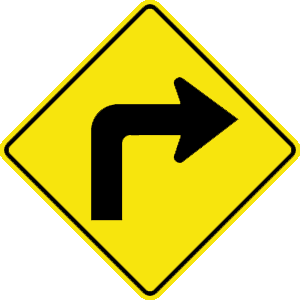
This road sign means:
One-way road.
No right turn.
Exit.
Sharp right turn in the road ahead.
Q.17.
Motorcycles are entitled to:
The bicycle lane.
The same full lane width as other motor vehicles.
Half the width of a lane.
The width of the sidewalk.
Q.18.
Which is the most common cause of traffic crashes?
New drivers
Human error
Bad weather
Bad roads
Q.19.
As you near an intersection, the traffic light changes from green to yellow. Your best action is to:
Speed up to beat the red light.
Apply the brakes sharply to stop.
Be prepared to stop in the center of the intersection.
Be prepared to stop before the intersection.
Q.20.
Street racing is legal:
During the night.
During periods of low traffic.
In clear weather.
Under no circumstances.
Q.21.
A good defensive driver:
Drives slowly at all times.
Looks out for the actions of other drivers.
Travels at a constant speed.
Only drives in familiar areas.
Q.22.
What is the meaning of this sign?
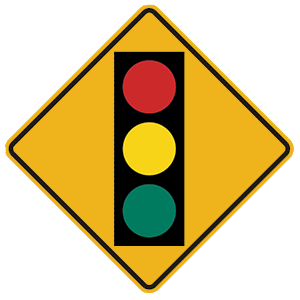
The traffic signal ahead is displaying a red light.
The traffic signal ahead is broken.
The traffic signal ahead is displaying a green light.
There is a traffic signal ahead.
Q.23.
When driving atmph, a driver's field of vision is:
Two-thirds of what it is when the vehicle is stationary.
One-fifth of what it is when the vehicle is stationary.
Three-fifths of what it is when the vehicle is stationary.
Four-fifths of what it is when the vehicle is stationary.
Q.24.
What should you do if your vehicle’s right wheels leave the pavement?
Stop quickly.
Immediately pull all the way off of the road and get back on when it is safe.
Accelerate and steer back on the road quickly.
Take your foot off the accelerator, slow down, then ease back onto the road when it is safe to do so.
Q.25.
A steady yellow traffic signal means that a ____ light will soon appear.
Flashing yellow
Steady green
Steady red
Flashing red
Q.26.
The driver's left arm and hand are extended downward. This hand signal means that the driver plans to:
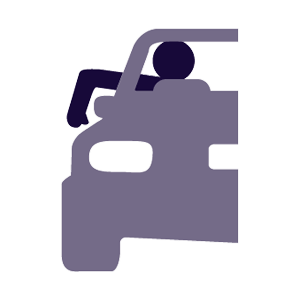
Turn left.
Turn right.
Stop.
Start up.
Q.27.
On a two-lane street, your vehicle is being followed by a fire engine that is not using its emergency signals. You should:
Continue to drive in a normal manner.
Stop as quickly as you can.
Speed up to get out of its way.
Slow down, move as far to the right as possible, and stop.
Q.28.
Alcohol causes:
Loss of concentration.
Poor coordination.
Slower judgment.
All of the above.
Q.29.
Blood alcohol content (BAC) depends on each of the following, except:
Your body weight.
How much you drink.
How much time passes between drinks.
How physically fit you are.
Q.30.
Look over your shoulder to check your blind spot when:
Pulling toward or away from a curb.
Turning left or right.
Changing lanes.
All of the above.
Support mcqgeeks.com by disabling your adblocker.
×
Please disable the adBlock and continue.
Thank you.
Reload page