MCQGeeks
CBSE
JEE
NTSE
NEET
English
UK Quiz
Quiz
Driving Test
Practice
Games
Driving Test
Texas
Texas Car Driving Permit Test-20
Answers
Q.1.
You are driving at night and another vehicle is approaching from the opposite direction. Your headlights:
Should be on their high beam setting.
Should be on their low beam setting.
Should be off. Use your parking lights.
May be on either their high or low beam setting.
Q.2.
When driving at speeds faster thanmph, keep a minimum following distance of:
One second.
Two seconds.
Three seconds.
Four seconds.
Q.3.
When should you slow down and increase your following distance?
When the road is wet.
When your visibility is limited.
When driving in heavy traffic.
All of the above.
Q.4.
When making a right turn, you should not:
Signal to other drivers.
Swing too wide for your lane.
Slow down.
Move to the far right lane.
Q.5.
If another driver cuts you off in traffic, you should:
Pull next to the driver and yell at them.
Let it go.
Flash your high beams at the driver.
Get back at the other driver by cutting them off.
Q.6.
To avoid collisions with vehicles in your blind spots, you should:
Quickly turn your head to see if your blind spot is clear before changing lanes.
Adjust your rearview mirrors every few minutes.
Honk your horn right before turning or changing lanes.
None of the above.
Q.7.
When approaching a stop line, where should drivers stop their car?
Before the stop line
On top of the stop line
Past the stop line
It does not matter
Q.8.
You must stop for a school bus:
That is parked on the shoulder of the road with no one in it.
When it approaches you, even if its lights are not flashing.
If you are both driving on a two-lane highway and its red lights are flashing.
Whenever the driver waves at you.
Q.9.
If a pedestrian hybrid beacon signal light is flashing yellow, it means:
Drivers may proceed with caution.
Drivers should slow down and be prepared to stop.
Drivers should come to a complete stop.
There are no pedestrians nearby.
Q.10.
A flashing red light on a traffic signal means:
The same thing as a stop sign.
The traffic signal is broken.
You do not have to come to a complete stop.
Driving conditions are dangerous.
Q.11.
If an aggressive driver cuts you off, you should:
Call the police immediately.
Stay calm and move out of the aggressive driver's way.
Flash your vehicle's lights to let the aggressive driver know he is wrong.
Use a driving action of your own to get back at the aggressive driver.
Q.12.
If you are being passed by a large truck, you should:
Speed up.
Slightly reduce your speed.
Crowd the truck.
Make it more difficult for the truck to pass you.
Q.13.
This road sign means:
Cars in right lane must slow down.
No left turn.
Merge.
Pass only in the right lane.
Q.14.
Traffic signals sometimes display arrows to control turns from specific lanes. A green arrow:
Is used only on one-way streets.
Has the same meaning as a circular green traffic light, but traffic must turn in the direction indicated by the arrow.
Means that you may proceed, but only if the green arrow is accompanied by a circular green light.
Points the way to an airport.
Q.15.
While driving, you come upon a sign displaying the words “Reduced speed,mph." This means:
That the new 35 mph speed limit begins at this sign.
That the new 35 mph speed limit begins at the next speed limit sign.
That you have plenty of time to slow down before the reduced speed zone.
That you should reduce your speed to 35 mph, but only under poor weather conditions.
Q.16.
To be safe when crossing a railroad, you should:
Look both ways, but only when the red light is flashing.
Listen, look both ways, and then proceed if it is safe to do so.
Cross especially quickly when a train is approaching.
Quickly pass under any lowering gates.
Q.17.
Who is required to wear a safety belt in a motor vehicle?
Only the driver
Only adult passengers
All of the vehicle's occupants
Only child passengers
Q.18.
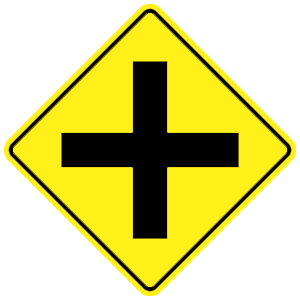
This sign means:
All traffic must turn.
Turn right at the intersection.
Parking area ahead.
Crossroad ahead. Watch for traffic.
Q.19.
If you come to a roadway covered in water, you should:
Drive until you think the water is too deep.
Drive through, as it is unlikely the standing water will become too deep.
Turn around and find another way to go.
Walk out into the water to determine its depth.
Q.20.
Roads freeze quickly when they are:
Flat.
Curvy.
In the sun.
Shaded.
Q.21.
When approached by an emergency vehicle that is using its siren and/or flashing lights, a driver must immediately:
Pull to the right and stop.
Pull to the right and slow down.
Pull to the right and turn on their vehicle's four-way flashers.
Stop and let the emergency vehicle pass.
Q.22.
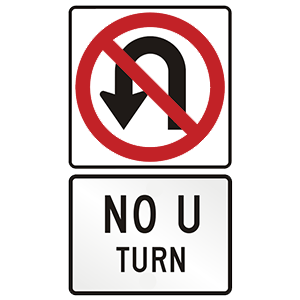
This sign means:
U-turns are prohibited.
U-turns are permitted.
Winding road ahead.
Sharp left turn ahead.
Q.23.
When exiting a highway, you should slow down:
On the main road, just before the exit lane.
Once you see a toll booth.
Once you have moved into the exit lane.
When you first see the exit sign.
Q.24.
Your brake lights tell other drivers that you:
Are making a turn.
Have your emergency brake on.
Are changing lanes.
Are slowing down or stopping.
Q.25.
From the center lane, which maneuver(s) can you perform?
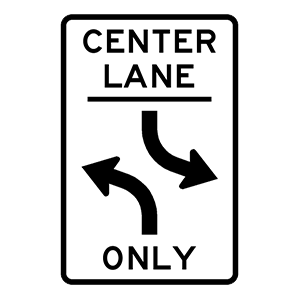
You may make left turns.
You may make U-turns.
You may pass slow-moving traffic.
All of the above.
Q.26.
If someone is driving aggressively behind you, you should:
Try to get out of the aggressive driver’s way.
Stare at the driver as he or she is passing you.
Speed up as he or she is passing you.
Block the passing lane.
Q.27.
What can you do to avoid the need to make emergency stops while driving in traffic?
Honk your horn to make others aware of your presence.
Look ahead and maintain a safe following distance.
Drive in the right lane only.
Drive more slowly than the flow of traffic.
Q.28.
When approaching a steady yellow traffic light, drivers should:
Accelerate to avoid a red light.
Continue driving, as they have the right-of-way.
Slow to a stop, unless they are already within the intersection.
Check to see what the cars next to them are doing.
Q.29.
To avoid road rage, it is a good idea to:
Allow extra time for your trip.
Begin your trip at the last possible moment.
Avoid planning your trip in advance.
Assume nothing will slow down your travel.
Q.30.
You come to an intersection with a flashing red light. You must:
Slow down and drive carefully through the intersection.
Turn either right or left, since the road is blocked ahead.
Stop at the intersection and wait for a flashing green light.
Stop at the intersection, then proceed as traffic allows.
Support mcqgeeks.com by disabling your adblocker.
×
Please disable the adBlock and continue.
Thank you.
Reload page