MCQGeeks
CBSE
JEE
NTSE
NEET
English
UK Quiz
Quiz
Driving Test
Practice
Games
Driving Test
Texas
Texas Car Driving Permit Test-23
Answers
Q.1.
This sign means:
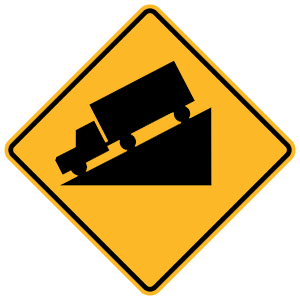
Trucks under 18,000 lbs. allowed.
Hill ahead.
Truck stop ahead.
No trucks allowed.
Q.2.
When changing lanes on a highway, you should:
Signal a lane change.
Check your rearview and outside mirrors.
Check your blind spot by glancing over your shoulder.
All of the above.
Q.3.
Taking drugs along with alcohol:
Increases the risk of causing a crash.
Is no more dangerous than consuming alcohol by itself.
Lessens the effect of alcohol on your ability to drive.
Has no effect on your general driving ability.
Q.4.
Which of the following is true regarding seat belts and child restraints in vehicles?
You should never place an infant or small child in the front seat of a vehicle with airbags.
An airbag can be dangerous to an infant or small child, even in a low-speed collision.
You should always make sure all your passengers are using a seat belt or child restraint.
All of the above.
Q.5.
When approaching an accident scene, you should:
Keep your attention on your driving.
Keep moving.
Stop if you are involved or if emergency help has not yet arrived.
All of the above.
Q.6.
You are waiting in the intersection to complete a left turn. You should:
Signal and keep your wheels turned to the left.
Signal and keep your wheels straight.
Flash your headlights so drivers will let you through.
Drive around the rear of a car if it blocks you.
Q.7.
When stopped behind a motorcycle, drivers should allow the rider a distance of at least:
One full vehicle length.
Three full vehicle lengths.
Two feet.
Four feet.
Q.8.
When parking your vehicle downhill on a two-way street:
Turn your wheels to the right.
Turn your wheels to the left.
Keep your wheels pointed straight ahead.
Leave your transmission in neutral.
Q.9.
You may park or stop along the shoulder of the freeway:
As long as you turn on your four-way (emergency) flashers.
If no part of your vehicle is on the road.
If you need to look at a map for directions.
Only if you have an emergency.
Q.10.
To pass a slower-moving vehicle on a two-lane, two-way road, you must:
Not cross the centerline.
Flash your lights at oncoming traffic.
Use the shoulder.
Use the lane that belongs to oncoming traffic.
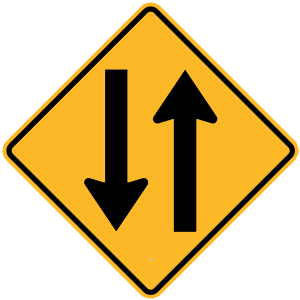
Q.11.
This sign means:
Four-lane traffic ahead.
Divided highway ahead.
Two-way traffic ahead.
Intersection ahead.
Q.12.
When may a driver stop on railroad tracks?
If they are crossing and their car is not yet able to entirely clear the tracks.
If it doesn't sound like there are any trains nearby.
Never.
If the gate is not lowered.
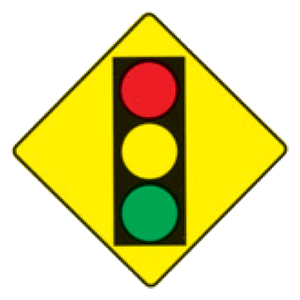
Q.13.
This sign means:
Stop sign ahead.
Lane closed ahead.
Railroad crossing ahead.
Traffic signal ahead.
Q.14.
When is it illegal to drive below the speed limit?
When driving slowly disrupts the normal flow of traffic
When in heavy traffic in a construction zone
Only when driving in rural areas.
When driving under adverse weather conditions
Q.15.
You should signal to turn ____ before beginning the turn.
100 feet
50 feet
20 feet
10 feet
Q.16.
What does a lane control signal with a green arrow above a reversible lane indicate?
The signal is about to change to a red X.
Drivers should not drive in this lane.
Drivers may use this lane only to make a left turn.
Drivers may drive normally in this lane.
Q.17.
You are involved in an accident and your vehicle is blocking traffic. You should:
Move your vehicle off the traveled portion of the roadway, if possible.
Not move your vehicle under any circumstances.
Wait until the police arrive before moving your vehicle.
None of the above.
Q.18.
When approaching a steady green traffic light, drivers should:
Continue driving, unless there are vehicles or pedestrians already in the intersection.
Stop if a police officer is nearby.
Treat the intersection like a four-way stop.
Come to a complete stop before proceeding.
Q.19.
To avoid carbon monoxide poisoning, drivers should:
Have their exhaust system checked regularly to be sure it does not leak.
Keep their car turned off when it is enclosed in a garage.
Close vents when following closely behind another car.
All of the above.
Q.20.
What might a flag on the back of a bicycle indicate?
The operator will be making frequent stops.
The operator drives above the speed limit.
The operator is hearing impaired.
The bicycle is broken.
Q.21.
When you drive through an area where children are playing, you should expect them:
To know when it is safe to cross the street.
To stop at the curb before crossing the street.
To run out in front of you without looking.
Not to cross the street unless they are with an adult.
Q.22.
When entering a street from a driveway, you:
Must drive slowly to allow approaching vehicles and pedestrians time to get out of your way.
Must honk your horn so approaching vehicles and pedestrians know to give you room.
Must stop and proceed only when there are no pedestrians or vehicles approaching.
Can disregard any pedestrians if there is no sidewalk.
Q.23.
If a pedestrian hybrid beacon signal light is a steady red, it means:
Drivers may proceed with caution.
Drivers should slow down and prepare to stop.
Drivers should come to a complete stop.
There are no pedestrians nearby.
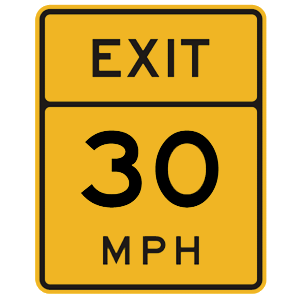
Q.24.
This road sign indicates:
The maximum safe speed for a residential area.
The maximum safe speed for an expressway exit.
The maximum safe speed for an expressway entrance.
The maximum safe speed for a work zone.
Q.25.
Defensive drivers should:
Always keep their eyes moving.
Look for developing trouble spots.
Have plans of action.
All of the above.
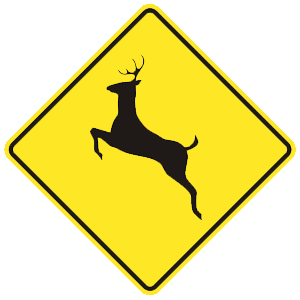
Q.26.
This road sign means:
Hunting area.
State park.
Deer crossing.
Wildlife preserve.
Q.27.
If you become stranded in a snowstorm, the best thing to do is to:
Get out of the car and go for help.
Lay down in your car and go to sleep.
Walk into the road and get the attention of other drivers.
Stay in the car, as you are most likely to be found when you stay in your vehicle.
Q.28.
You want to turn left at an intersection. The light is green but oncoming traffic is heavy. You should:
Use the next intersection.
Wait at the crosswalk for traffic to clear.
Wait in the center of the intersection for traffic to clear.
Take the right-of-way since you have a green light.
Q.29.
When approaching railroad tracks, you should:
Look, listen, slow down, and be prepared to stop.
Speed up to cross the tracks before the gate is lowered.
Try to drive around a lowered gate.
Not pay attention to how many tracks there are to cross.
Q.30.
When you are being tailgated:
Move over to the right, if there is an open lane to your right.
If there is not an open lane to your right, wait until the way is clear ahead and reduce your speed slowly to encourage the tailgater to drive around you.
Never slow down abruptly.
All of the above.
Support mcqgeeks.com by disabling your adblocker.
×
Please disable the adBlock and continue.
Thank you.
Reload page