MCQGeeks
CBSE
JEE
NTSE
NEET
English
UK Quiz
Quiz
Driving Test
Practice
Games
Driving Test
Texas
Texas Motorcycle Driving Permit Test-14
Answers
Q.1.
If you are riding over rain grooves or bridge gratings and your motorcycle begins to weave, you should:
Brake suddenly.
Steer in a weaving pattern.
Relax, maintain a steady speed, and ride straight across the grooves.
Move to the leftmost portion of the lane.
Q.2.
If you must brake and swerve to avoid a hazard, you should:
Either brake then swerve or swerve then brake.
Brake and swerve at the same time.
Choose to either brake or swerve.
Not swerve and only use the front brake to stop.
Q.3.
The effects of marijuana consumption can last for:
No more than 15 minutes.
About an hour.
About two hours.
More than six hours.
Q.4.
When riding at night, a motorcyclist should maintain a minimum following distance of:
Two seconds.
Three seconds.
Four seconds.
Five seconds.
Q.5.
The front brake is:
Too dangerous to be used by inexperienced operators.
Best when used by itself.
Meant to occasionally assist the rear brake.
To be used with the rear brake.
Q.6.
If you are riding in the right side of your lane while following a car:
You are likely riding in the best position to be seen.
You may not be seen unless the driver uses their side mirror.
The driver will most likely assume you are there.
You are discouraging other drivers from sharing your lane.
Q.7.
Riding directly alongside another vehicle is discouraged because:
You may have a difficult time getting to a highway exit.
You may be in the other vehicle’s blind spot.
You may block the driver's view.
It prevents other drivers from passing both of you.
Q.8.
When downshifting, you should:
Shift through multiple gears at a time.
Shift through one gear at a time.
Always shift all the way down to neutral first.
Accelerate.
Q.9.
In Texas, helmets are required to be used by:
Only motorcycle operators.
Only motorcycle passengers.
Only moped operators.
The operators and passengers of all types of motorcycles and mopeds.
Q.10.
When riding near stopped or slow-moving cars, a motorcyclist should:
Pull over and wait until traffic begins to move.
Ride on the shoulder to get through the area as quickly as possible.
Weave between the cars to get through the area as quickly as possible.
Not weave between the cars.
Q.11.
When riding, a cushion of space is helpful to:
Give you space to react to hazards.
Hide you from other drivers.
Prevent you from avoiding hazards.
Allow you to look at road signs.
Q.12.
When both braking and swerving must be done to avoid an unexpected hazard, a rider should:
Perform one action, then the other.
Perform both actions at the same time and apply extra braking pressure.
Perform both actions at the same time, but mainly focus on swerving.
Not perform either action.
Q.13.
Gloves can:
Make it difficult to control a motorcycle and should be avoided.
Help other drivers identify you.
Provide an improved grip on the handlebars.
Offer no protection.
Q.14.
If braking in a curve:
Only use the front brake.
It will be the same as braking on a straightaway.
You will have more traction as you lean into the curve.
You may have less traction as you lean into the curve.
Q.15.
When a group of riders is passing another vehicle on a two-lane road, the riders should:
Pass in pairs.
Pass in a staggered formation with several riders passing at the same time.
Pass one at a time.
Avoid passing.
Q.16.
When riding with a passenger, you should tell them to do all of the following, except:
Get on the motorcycle after the engine has been started.
Sit as far forward as they can without crowding you.
Hold firmly onto your waist, hips, or belt.
Feel free to talk whenever they want.
Q.17.
A helmet will not provide the best possible protection:
If it is certified by the DOT.
If it fits snugly.
If it is free of defects.
If it has cracks.
Q.18.
When an operator's left arm is extended straight out to the left, it means the operator:
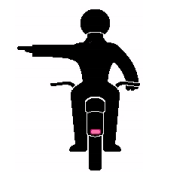
Plans to turn left.
Is about to stop.
Plans to turn right.
Is about to slow down.
Q.19.
Once a motorcycle helmet has been involved in a crash, it should be:
Inspected closely.
Replaced.
Sold to another rider.
Outfitted with a new chinstrap.
Q.20.
To lean a motorcycle when making a turn, you should:
Always press on the left handgrip.
Always press on the right handgrip.
Press on the handgrip in the direction opposite of the turn.
Press on the handgrip in the direction of the turn.
Support mcqgeeks.com by disabling your adblocker.
×
Please disable the adBlock and continue.
Thank you.
Reload page