MCQGeeks
CBSE
JEE
NTSE
NEET
English
UK Quiz
Quiz
Driving Test
Practice
Games
Driving Test
Utah
Utah Car Driving Permit Test-15
Answers
Q.1.
If you stop along the road at night:
Turn off all your lights.
Use your parking lights only.
Use your headlights only.
Turn on your emergency flashers and leave your low beams turned on.
Q.2.
A good rule to remember for passing is:
Pass on the right whenever possible.
Drive with the flow of traffic and pass only as needed.
Try to get to the front of any slow-moving traffic so that you can see better.
Always flash your lights and sound your horn to alert other drivers to your intentions.
Q.3.
Certain highway signs require drivers to obey an indicated instruction. Such signs are known as:
Regulatory signs.
Warning signs.
Information signs.
Guide signs.
Q.4.
Signaling your intentions before turning, changing lanes, or driving away from a curb:
Is necessary only if other traffic is present.
Is a good driving habit and is required by law.
Is necessary only during the maneuver, not before.
Is not necessary if the maneuver is done slowly.
Q.5.
If a transit vehicle is signaling to re-enter the main roadway following a stop, you must:
Honk to let them know you’re there.
Move to the left lane.
Yield.
Speed up to pass.
Q.6.
You are turning onto a two-lane road divided by a broken yellow line. You know immediately that:
You are on a two-way road.
You are on a one-way road.
The road is under repair.
You must stay to the left of the broken yellow lines.
Q.7.
Before passing another vehicle, you should signal:
Just before changing lanes.
At any time.
After changing lanes.
Early enough for others to know your plans.
Q.8.
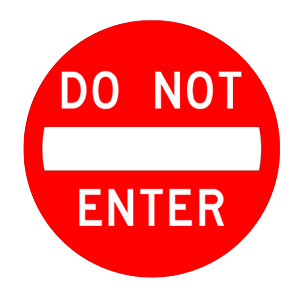
This sign means:
Heavy traffic ahead.
Do not enter.
Railroad crossing.
Yield.
Q.9.
A licensed driver under the age ofmay have passengers in their car when:
They obtain their license.
They have had their license for six months.
They reach the age of 17.
Traveling to or from school.
Q.10.
Children who are age ____ and younger should not sit in the front seat of a vehicle.
14
12
15
18
Q.11.
At dusk or on overcast days, you should:
Drive using your four-way flashers.
Drive using your parking lights.
Not turn on any vehicle lights.
Turn on your headlights.
Q.12.
A yellow light that flashes on and off means:
Stop and look for other vehicles, then go if there is no traffic.
Stop and wait for a green light.
Speed up to clear the intersection quickly.
Slow down and proceed with caution.
Q.13.
You are driving up a hill and are approaching a heavy truck from the rear. You should know that:
The truck may be traveling at a speed slower than the posted speed limit.
You may not be able to safely pass the truck.
You may not be able to legally pass the truck.
All of the above.
Q.14.
When you hear a fire engine siren behind you, you must:
Slow down until it passes you.
Drive with your flashers on.
Pull over to the side of the road and stop.
Speed up and take the nearest exit.
Q.15.
You need to use extra caution when driving near a pedestrian using a white cane because:
He or she is deaf.
He or she is a police officer.
He or she is blind.
He or she has poor balance.
Q.16.
It is important to slow down:
On narrow or winding roads.
At intersections or railroad crossings.
When the road is wet or slippery.
All of the above.
Q.17.
You should honk your horn when you:
Are traveling through an intersection.
Are passing a bicyclist.
See a child who is about to run into the street.
Are parallel parking.
Q.18.
Before switching on the ignition, you should:
Be sure only backseat passengers have buckled their seat belts.
Be sure only adult passengers have buckled their seat belts.
Be sure only child passengers have buckled their seat belts.
Be sure all of the vehicle's occupants have buckled their seat belts.
Q.19.
Which of the following influence(s) the effects of alcohol?
The amount of food in the stomach
The body weight of an individual
How much time passes between drinks
All three choices
Q.20.
A "Merging lanes" sign means drivers should be prepared to change lanes or allow other traffic to come into their lane.
True
False
Q.21.
You may drive around or under a gate that is being lowered or raised at a railroad crossing:
As long as an approaching train is not too close.
If your vehicle can do so without damaging the gate.
If you first look carefully in both directions.
Under no circumstances.
Q.22.
Before turning, you should:
Use your signal.
Turn the wheel.
Increase your speed.
Change lanes.
Q.23.
During school hours, the speed limit in a school zone is:
15 mph.
20 mph.
25 mph.
30 mph.
Q.24.
Traffic signals sometimes display arrows to control turns from specific lanes. A solid yellow arrow:
Is never used as a traffic signal.
Has the same meaning as a circular yellow traffic light.
Means that drivers may turn in the direction indicated by the arrow.
Tells drivers that a green arrow is about to be shown.
Q.25.
A Class D license allows a driver to operate a vehicle that weighs up to:
36,000 pounds.
40,000 pounds.
33,000 pounds.
26,000 pounds.
Support mcqgeeks.com by disabling your adblocker.
×
Please disable the adBlock and continue.
Thank you.
Reload page