MCQGeeks
CBSE
JEE
NTSE
NEET
English
UK Quiz
Quiz
Driving Test
Practice
Games
Driving Test
Utah
Utah Car Driving Permit Test-18
Answers
Q.1.
Compared to driving during the day, driving at night is:
Less dangerous.
No more or less dangerous.
More dangerous.
Easier on your eyes.
Q.2.
If traffic signals at an intersection are not functioning due to a power outage:
Park your vehicle as far off the road as possible and wait for power to be restored.
Use hand signals to indicate your intentions to other drivers.
Turn on your hazard lights and proceed through the intersection without stopping.
Treat the intersection as a four-way stop.
Q.3.
If your car breaks down on a highway, you should:
Sit in your car and wait for help.
Use your four-way flashers to warn other drivers.
Sound your horn at passing motorists.
Flash your headlights at oncoming traffic.
Q.4.
What color are pavement markings that separate traffic lanes moving in opposite direction?
Yellow
White
Yellow and white
Yellow, white, and black
Q.5.
The posted speed limit shows:
Only a recommended driving speed.
The exact speed at which you must travel to avoid a ticket.
The maximum safe driving speed under ideal road and weather conditions.
The maximum safe driving speed under all road conditions.
Q.6.
When driving under snowy or icy conditions, it is safe to use your cruise control as long as your speed is reduced.
True
False
Q.7.
To be safe when crossing a railroad, you should:
Look both ways, but only when the red light is flashing.
Listen, look both ways, and then proceed if it is safe to do so.
Cross especially quickly when a train is approaching.
Quickly pass under any lowering gates.
Q.8.
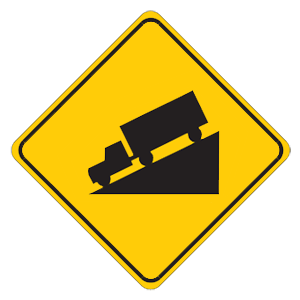
This sign indicates that:
There is a steep hill ahead.
No trucks are allowed on an upcoming hill.
A logging road is ahead.
There are trucks on an upcoming hill.
Q.9.
If a vehicle starts to skid on water, the driver should quickly apply the brakes.
True
False
Q.10.
The faster the speed of your vehicle, the longer it takes to stop when you must react to other drivers' unexpected movements.
TRUE
FALSE
Q.11.
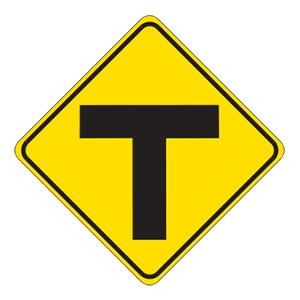
This sign means:
T intersection.
Lane shifting.
Side road.
Do not block intersection.
Q.12.
The driver's left arm and hand are extended upward. This hand signal means that the driver plans to:
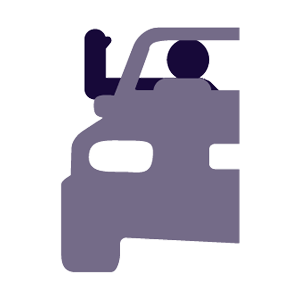
Turn left.
Turn right.
Come to a stop.
Go straight ahead.
Q.13.
You may cross solid yellow lines:
To pass traffic moving in the same direction.
During daylight hours only.
At any time.
When making turns.
Q.14.
Certain highway signs contain information about hazardous conditions. Such signs are known as:
Regulatory signs.
Warning signs.
Information signs.
Guide signs.
Q.15.
If another car is in danger of hitting you, you should:
Sound your horn.
Wave your arms.
Use your emergency lights.
Flash your headlights.
Q.16.
Pedestrians in crosswalks and at intersections always have the right-of-way.
True
False
Q.17.
A driver entering interstate traffic from an entrance or acceleration ramp:
Should yield to drivers already on the interstate.
Has the right-of-way.
May force their way into traffic.
Can assume that other drivers will change lanes to make room.
Q.18.
To check your blind spot before changing lanes:
Look into the left side mirror.
Look into the right side mirror.
Look into the rearview mirror.
Look over your shoulder in the direction you plan to move.
Q.19.
Yield also means stop if you cannot merge safely into the flow of traffic.
True
False
Q.20.
Motorists should maintain a safe operating distance when driving near a cyclist.
TRUE
FALSE
Q.21.
From the center lane, which maneuver(s) can you perform?
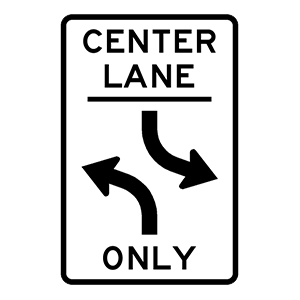
You may make left turns.
You may make U-turns.
You may pass slow-moving traffic.
All of the above.
Q.22.
A telltale sign of a drunk driver is:
They are weaving between lanes.
They are driving more slowly than the normal traffic flow.
They are making quick and sudden stops.
All of the above.
Q.23.
Look over your shoulder to check your blind spot when:
Pulling toward or away from a curb.
Turning left or right.
Changing lanes.
All of the above.
Q.24.
What should you do when you see this sign?
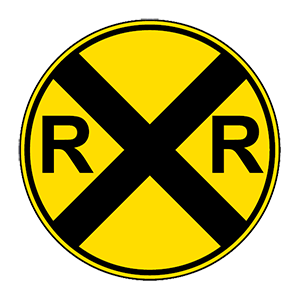
Look for a train station ahead.
Signal before going any further.
Slow down and yield for trains.
Stop.
Q.25.
____ greatly increase stopping distances and severity of crashes.
High speeds
Slow speeds
Night drives
Uphill inclines
Support mcqgeeks.com by disabling your adblocker.
×
Please disable the adBlock and continue.
Thank you.
Reload page