MCQGeeks
CBSE
JEE
NTSE
NEET
English
UK Quiz
Quiz
Driving Test
Practice
Games
Driving Test
Utah
Utah Car Driving Permit Test-24
Answers
Q.1.
Drivers must yield to a pedestrian:
Even if the pedestrian crosses the street carelessly.
Only when the pedestrian is in a crosswalk.
Only if the pedestrian is on the same side of the road as the driver.
If the pedestrian uses a hand signal to ask oncoming drivers to stop.
Q.2.
When driving in traffic, it is safest to:
Fluctuate your speed to keep alert.
Drive faster than the flow of traffic.
Drive slower than the flow of traffic.
Drive with the flow of traffic.
Q.3.
You may honk your horn when you:
Have to stop quickly.
Are passing another car.
Have lost control of your car.
Are passing a bicyclist.
Q.4.
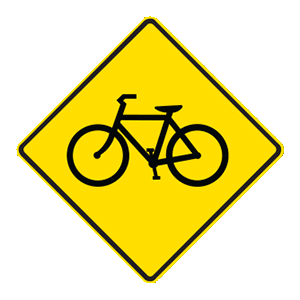
This sign means:
Bicycle crossing.
Stop.
Fines double in a work zone.
Stop ahead.
Q.5.
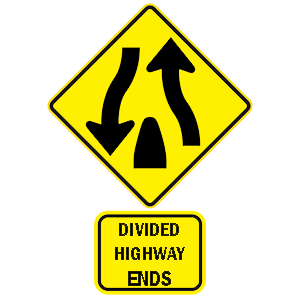
This sign means:
One-way traffic.
Divided highway ends.
Two-way traffic.
Keep left.
Q.6.
At a school crossing sign, you should:
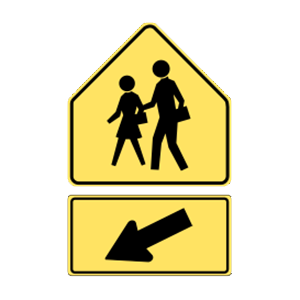
Always stop, whether there’s a stop sign or not.
Watch for children and be ready to stop.
Always sound your horn when you see children.
Be ready to help children crossing the street.
Q.7.
What may help drivers conserve gasoline?
Sitting in their driveways with their cars running.
Accelerating quickly.
Slowing down gradually.
Braking abruptly.
Q.8.
A speed limit is:
The maximum or minimum legal speed you can travel on a road under dangerous conditions.
The maximum or minimum legal speed you can travel on a road under ideal conditions.
The suggested speed to travel on a road under ideal conditions.
None of the above.
Q.9.
When two vehicles arrive to an intersection at the same time, which one has the right-of-way when no signs or signals indicate rules?
The car approaching from the right has the right-of-way.
The car approaching from the left has the right-of-way.
The car in which the driver sounds his horn first has the right-of-way.
The car that is traveling the fastest has the right-of-way.
Q.10.
Many crashes are caused by:
Drivers traveling too fast for conditions.
Drivers consistently checking their mirrors and blind spots.
Drivers yielding the right-of-way.
Drivers maintaining a four-second following distance.
Q.11.
To avoid collisions with vehicles in your blind spots, you should:
Quickly turn your head to see if your blind spot is clear before changing lanes.
Adjust your rearview mirrors every few minutes.
Honk your horn right before turning or changing lanes.
None of the above.
Q.12.
An intersection has no traffic signs or signals. You arrive at the same time as a vehicle to your right. You should:
Speed up and get through the intersection.
Slow down and yield to the vehicle on your right.
Drive into the intersection and make the other vehicle stop.
Honk your horn and drive through the intersection.
Q.13.
A slow-moving vehicle emblem is:
A rectangular red sign.
A circular green sign.
A diamond-shaped yellow sign.
A triangular orange sign.
Q.14.
A fully loaded tractor-trailer traveling atmph could take up to ____ to come to a complete stop.
50 feet
125 feet
400 feet
750 feet
Q.15.
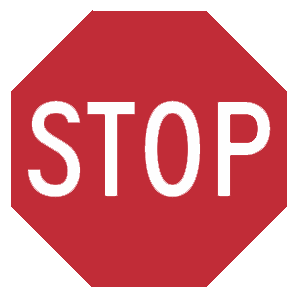
When you see this sign, you must:
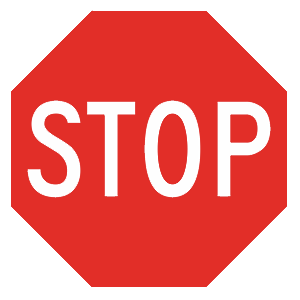
Stop completely and check for pedestrians and cross traffic.
Slow down without coming to a complete stop.
Stop completely and wait for a green light.
Slow down and check for traffic.
Q.16.
This green arrow on a lane use control signal means:
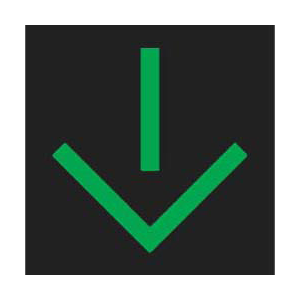
You may use this lane.
No traffic is allowed in this lane.
You have the right-of-way.
You must merge into this lane.
Q.17.
This road sign means:
Slow down or stop.
Stop, if necessary.
You must come to a complete stop.
Drive with caution and be ready to stop.
Q.18.
When driving on roads that may be slippery:
Always drive at the maximum speed limit.
Use cruise control to maintain a steady speed.
Reduce your following distance.
Do not make any sudden changes in speed or direction.
Q.19.
There may be times whenmph is too fast for drivers to safely operate their vehicles.
True
False
Q.20.
Drive below the posted speed limit when:
Anything makes conditions less than perfect.
You see a police car.
Entering a highway where there are other cars.
You are on a four-lane road.
Q.21.
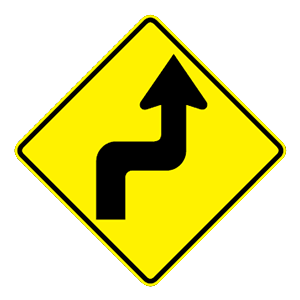
This road sign means:
The road ahead turns sharply right, then left.
The road ahead turns sharply left, then right.
The road ahead curves to the left.
Construction ahead.
Q.22.
This sign means:
You must drive slowly and sound your horn.
A bus stop is ahead.
You are entering a school's parking lot.
A school zone is ahead.
Q.23.
Distracted driving is:
Very uncommon.
Extremely risky behavior.
Nothing to be concerned about.
No less safe than driving under any other conditions.
Q.24.
Which of the following is true about driving on a wet roadway?
As you drive faster, your tires become less effective.
Water does not affect cars with good tires.
Deep water is less dangerous than shallow water.
As you decrease your speed, the roadway becomes more slippery.
Q.25.
Drivers are always required to stop for a stopped school bus when driving on a two-lane road.
TRUE
FALSE
Support mcqgeeks.com by disabling your adblocker.
×
Please disable the adBlock and continue.
Thank you.
Reload page