Q.1.
A pre-ride inspection usually takes:
Q.2.
What can help reduce the risk of a head or neck injury in the event of a crash?
Q.3.
Making eye contact with other drivers:
Q.4.
To lessen your chances of being involved in an accident, you should:
Q.5.
When you are being passed, you should:
Q.6.
What does this signal mean?
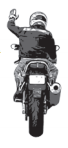
Q.7.
When being passed, do not move into the portion of the lane farthest from the passing vehicle because:
Q.8.
It is important to flash your brake light when:
Q.9.
A three-wheeled motorcycle:
Q.10.
A properly-fitted motorcycle:
Q.11.
Before changing lanes, motorcycle riders should turn their heads to look over their shoulders because:
Q.12.
When it starts to rain, it is usually best to:
Q.13.
Smoothly downshifting on motorcycles:
Q.14.
Motorists entering a highway from an entrance ramp to your right may not see your motorcycle. To help the entering drivers, you should:
Q.15.
To be effective, a face shield should not:
Q.16.
Riding at night:
Q.17.
To reduce your reaction time, you should:
Q.18.
A pre-ride inspection should:
Q.19.
Increase your following distance if:
Q.20.
When approaching an intersection, you should:
Q.21.
Motorcycle headlights are:
Q.22.
A face shield:
Q.23.
Before carrying a passenger in traffic for the first time, you should:
Q.24.
If the road is wet, you should avoid:
Q.25.
Many over-the-counter drugs: