MCQGeeks
CBSE
JEE
NTSE
NEET
English
UK Quiz
Quiz
Driving Test
Practice
Games
Driving Test
Vermont
Vermont Car Driving Permit Test-8
Answers
Q.1.
Before passing another vehicle, you should signal:
Just before changing lanes.
At any time.
After changing lanes.
Early enough for others to know your plans.
Q.2.
On a freeway, you realize you missed your turn or exit. You should:
Make the turn quickly from your lane of travel.
Stop and back up.
Continue driving until you reach the next turn, exit, or other location where you can safely turn around.
Signal other drivers to stop so you can turn.
Q.3.
When driving on roads that may be slippery:
Always drive at the maximum speed limit.
Use cruise control to maintain a steady speed.
Reduce your following distance.
Do not make any sudden changes in speed or direction.
Q.4.
A driver entering public traffic from a driveway or private road:
Has the right-of-way.
Should yield to drivers already on the public road.
May force their way into traffic.
Can assume that other drivers will change lanes to make room.
Q.5.
Which of the following does not happen after drinking?
Your reflexes and reaction time slow down.
Your judgement of speed and distance is distorted.
You are less alert.
You calm down and can concentrate better.
Q.6.
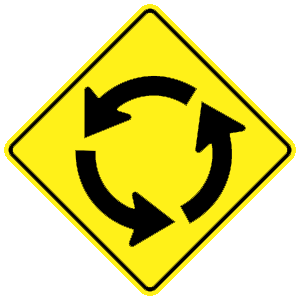
This sign means:
Roundabout ahead.
Lane ends, merge left.
Turn around.
Curve ahead.
Q.7.
To reduce the effects of headlight glare at night, you should look:
Straight ahead.
Over your shoulder.
At the center of the road
To the right edge of the road.
Q.8.
You come to an intersection with a flashing red light. You must:
Slow down and drive carefully through the intersection.
Turn either right or left, since the road is blocked ahead.
Stop at the intersection and wait for a flashing green light.
Stop at the intersection, then proceed as traffic allows.
Q.9.
When you see an emergency vehicle with flashing lights, you must:
Slow down and keep moving in your lane.
Keep driving in your lane.
Pull to the right curb and stop.
Stop exactly where you are.
Q.10.
Which of the following statements is true?
It is okay for drivers of other vehicles to follow motorcycles closely.
A motorcycle with two people on it is more balanced than a motorcycle with just one rider.
The driver of a passenger vehicle must change lanes completely when passing a motorcycle.
Drivers of other vehicles can expect a motorcycle's brake lights to turn on when the motorcyclist slows down.
Q.11.
What is the only way to reduce your blood alcohol concentration (BAC)?
Drink coffee.
Exercise.
Allow your body time to get rid of the alcohol.
Take a cold shower.
Q.12.
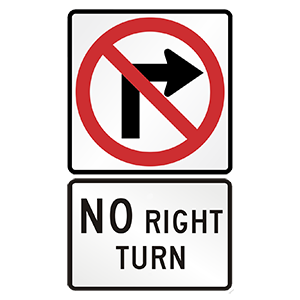
This sign means:
No right turns.
Right turns are permitted.
Stop before turning right.
Sharp curve ahead.
Q.13.
As you near an intersection, the traffic light changes from green to yellow. Your best action is to:
Speed up to beat the red light.
Apply the brakes sharply to stop.
Be prepared to stop in the center of the intersection.
Be prepared to stop before the intersection.
Q.14.
The most common color of warning signs is:
Red.
Yellow.
Green.
Blue.
Q.15.
Which of the following is true?
Headlights are required to be used a half hour after sunset until a half hour before sunrise.
Driving while using low beam headlights during the daytime can reduce the risk of head-on collisions.
When snow, rain, or fog lowers visibility, you must turn on your headlights.
All of the above.
Q.16.
Look over your shoulder to check your blind spot when:
Pulling toward or away from a curb.
Turning left or right.
Changing lanes.
All of the above.
Q.17.
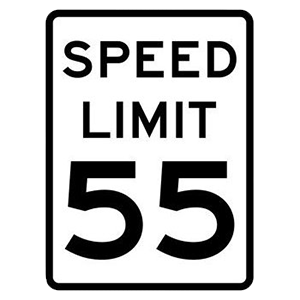
This road sign means:
You must travel at the speed indicated.
The maximum legal speed on the roadway is 55 mph.
You must travel through the intersection at the posted speed.
None of the above.
Q.18.
You are driving on a busy street and your vehicle’s accelerator sticks open. You should:
Blow your horn.
Slam on your brakes.
Turn on your four-way flashers.
Turn off your ignition, taking care not to engage the steering wheel locking mechanism.
Q.19.
When turning or changing lanes, you must:
Always signal your intentions, even when no visible traffic is present.
Signal only if there is visible traffic.
Signal only when driving at night.
Signal only when driving in heavy traffic at night.
Q.20.
Compared to driving during the day, driving at night is:
Less dangerous.
No more or less dangerous.
More dangerous.
Easier on your eyes.
Support mcqgeeks.com by disabling your adblocker.
×
Please disable the adBlock and continue.
Thank you.
Reload page