MCQGeeks
CBSE
JEE
NTSE
NEET
English
UK Quiz
Quiz
Driving Test
Practice
Games
Driving Test
Virginia
Virginia Motorcycle Driving Permit Test-8
Answers
Q.1.
A benefit of keeping a cushion of space between you and surrounding vehicles is that:
You are better able to draft off of other vehicles.
You will be able to stop quickly.
You will have more time to react to the movements of other drivers.
Q.2.
If you must brake and swerve to avoid danger, you should:
Use only the front brake while swerving.
Brake and swerve at the same time.
Either brake then swerve or swerve then brake.
Q.3.
The human body removes alcohol at a rate of:
About one drink per hour.
About two drinks per hour.
About three drinks per hour.
Q.4.
Before every ride, you should:
Make sure your bike's brake lights work properly.
Make sure the paint on the bike is not peeling.
Make sure your bike is completely clean.
Q.5.
When traveling at night, it is:
Easier to judge distances than it is during the day.
About as easy to judge distances as it is during the day.
More difficult to judge distances than it is during the day.
Q.6.
When you must brake and swerve to avoid a hazard, you should:
Perform both actions at the same time.
Only brake.
Perform one action, then the other.
Q.7.
When it starts raining, it is best to:
Get off the road.
Ride in the tire tracks left by other vehicles.
Ride in the center portion of the lane.
Q.8.
When riding behind a car, traveling in the left third of the lane allows the driver to see you in their side mirror. What is a downside to this?
Most people don’t use their side mirrors as often as they use their rearview mirror.
The wind may prevent the use of a side mirror.
Side mirrors should not be used by motorists.
Q.9.
When parked on the road, a motorcycle should:
Create an angle with the curb that is between 45 and 90 degrees.
Be parked without a wheel or fender touching the curb.
Be parked parallel to the curb.
Q.10.
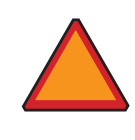
What does this sign mean?
Yield
Slow-moving vehicle
Railroad crossing
Q.11.
Mirrors on motorcycles:
Have blind spots, just like cars.
Do not have blind spots.
Are not required.
Q.12.
When riding ________, you are facing the greatest potential for conflict between you and other vehicles.
On the expressway
Near an intersection
In a group
Q.13.
Most motorcycle/automobile accidents occur:
At intersections.
On the open road.
In parking lots.
Q.14.
If possible, do not ride directly next to another vehicle because:
Another driver may want to use your lane to pass.
You may be in the vehicle’s blind spot.
You may have access to escape routes.
Q.15.
In which of the following situations should you increase your following distance to four seconds?
The pavement is slippery from rain or snow.
The roadway has more than one lane.
There is very little traffic.
Q.16.
Part of your normal scanning routine while riding should include:
Constantly looking in the rearview mirror.
Frequent rearview mirror checks.
Not using the rearview mirror.
Q.17.
If passing another vehicle:
You may exceed the speed limit until the pass is complete.
You may disregard no passing zone markings if you began the pass in a passing zone.
You must observe the posted speed limit.
Q.18.
You should maintain an increased following distance:
If the pavement is slippery.
If traffic is light.
If you can see through the vehicles in front of you to determine traffic conditions.
Q.19.
You have an improved chance of avoiding serious injury in a crash if you wear:
Face or eye protection.
A baseball cap.
Sneakers.
Q.20.
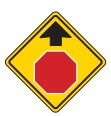
What does this sign mean?
Stop.
Yield to other drivers.
A stop sign is ahead.
Q.21.
When changing lanes:
Your mirrors can adequately show you your surroundings.
Do a head check in addition to using your mirrors.
Activate your turn signal and immediately move to the right or left.
Q.22.
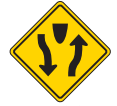
What does this sign mean?
Signal ahead
Crossroad ahead
Divided roadway ahead
Q.23.
In areas where dangers could be present, a motorcyclist should:
Maintain their speed.
Assume they will be safe.
Cover the clutch and both brake levers to reduce their reaction time.
Q.24.
When riding with a passenger on your motorcycle, you should instruct the passenger to:
Get on the motorcycle before the engine starts.
Sit as far back as possible on the bike.
Not talk or move unnecessarily.
Q.25.
Where is the greatest potential for conflict between you and other vehicles?
At an intersection
On the highway
On any road
Support mcqgeeks.com by disabling your adblocker.
×
Please disable the adBlock and continue.
Thank you.
Reload page