MCQGeeks
CBSE
JEE
NTSE
NEET
English
UK Quiz
Quiz
Driving Test
Practice
Games
Driving Test
Washington
Washington Car Driving Permit Test-18
Answers
Q.1.
You may continue carefully through an intersection with a yellow light if:
There is an emergency vehicle crossing your lane.
There are pedestrians crossing.
You are turning right.
You are already within the intersection when the light changes to yellow.
Q.2.
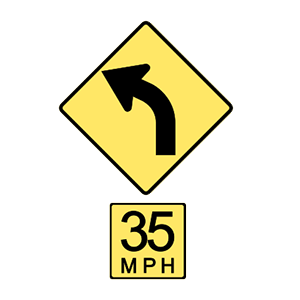
This sign means:
There is a 35 mph speed zone after the curve ahead.
Drive no less than 35 mph around the curve ahead.
Curve ahead, speeds of 35 mph or slower are recommended.
Stay in the right-hand lane if not driving over 35 mph.
Q.3.
If two drivers arrive at the same time to a four-way intersection controlled by stop signs:
The driver on the right has the right-of-way.
The driver on the left has the right-of-way.
One driver may continue driving without stopping.
One driver should honk to indicate that they are giving up the right-of-way.
Q.4.
If you refuse to take a test determining your blood alcohol content (BAC), you will lose your driver license for:
90 days.
Six months.
At least one year.
At least two years.
Q.5.
You must dim your high beam lights when within:
100 feet of an oncoming vehicle.
250 feet of an oncoming vehicle.
300 feet of an oncoming vehicle.
500 feet of an oncoming vehicle.
Q.6.
When driving on roads that may be slippery:
Always drive at the maximum speed limit.
Use cruise control to maintain a steady speed.
Reduce your following distance.
Do not make any sudden changes in speed or direction.
Q.7.
The effect that lack of sleep has on your safe driving ability is the same as:
The effect that alcohol has.
The effect that amphetamines have.
The effect that anger has.
The effect that driving with teenagers has.
Q.8.
If a vehicle using high beams comes toward you, you should look toward ____ of the road.
Either side
The center
The right side
The left side
Q.9.
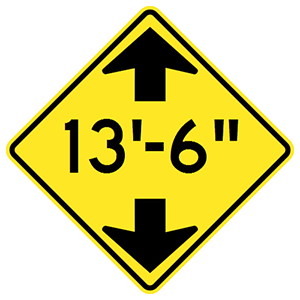
This road sign means:
Divided highway begins.
A steep grade is ahead.
The overpass ahead has a low clearance.
Two lanes of traffic moving in opposite directions are about to merge.
Q.10.
When the driver behind you wants to pass, you should:
Speed up.
Go the same speed.
Slow down to allow room in front of your vehicle for the other driver to complete the pass easily.
Change lanes.
Q.11.
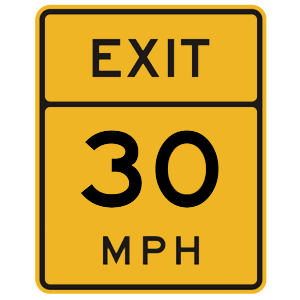
This road sign indicates:
The maximum safe speed for a residential area.
The maximum safe speed for an expressway exit.
The maximum safe speed for an expressway entrance.
The maximum safe speed for a work zone.
Q.12.
When you see an emergency vehicle with flashing lights, you must:
Slow down and keep moving in your lane.
Keep driving in your lane.
Pull to the right curb and stop.
Stop exactly where you are.
Q.13.
When changing lanes you should not:
Check your side and rearview mirrors.
Give a turn signal to signal your intentions.
Check for other drivers who may be moving into the same lane as you.
Use your cell phone to contact the police to determine if the road ahead is clear.
Q.14.
A yellow and black diamond-shaped sign:
Warns you about conditions on or near the road.
Helps direct you to cities and towns ahead.
Tells you about traffic laws and regulations.
Tells you about road construction ahead.
Q.15.
A broken yellow line alongside a solid yellow line means:
Passing on the left is permitted from either direction.
Passing is permitted from the lane next to the broken line.
Passing is permitted from the lane next to the solid line.
Passing is not allowed from either direction.
Q.16.
If you are involved in a serious motor vehicle crash:
Stop.
Call the police.
Determine if anyone is injured.
All of the above.
Q.17.
At dusk or on overcast days, you should:
Drive using your four-way flashers.
Drive using your parking lights.
Not turn on any vehicle lights.
Turn on your headlights.
Q.18.
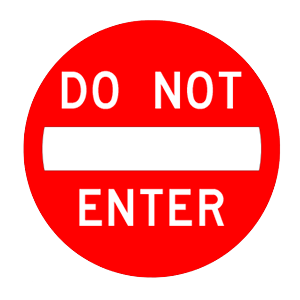
This sign means:
Heavy traffic ahead.
Do not enter.
Railroad crossing.
Yield.
Q.19.
If another driver cuts you off in traffic, you should:
Pull next to the driver and yell at them.
Let it go.
Flash your high beams at the driver.
Get back at the other driver by cutting them off.
Q.20.
You are driving in the left lane and want to move into the right lane. You should:
Check your mirrors, signal, and look over your left shoulder for other vehicles before changing lanes.
Check your mirrors, signal, and look over your right shoulder for other vehicles before changing lanes.
Check your mirrors, signal, and look over both shoulders for other vehicles before changing lanes.
Check your mirrors, signal, and change lanes.
Q.21.
Using a hand-held cell phone to make a phone call while driving:
Is safer than using a hands-free cell phone.
May only be done by teenage drivers.
Is illegal.
Is recommended.
Q.22.
Generally, how many alcoholic drinks will the human body get rid of each hour?
Half a drink.
One drink.
Two drinks.
Three drinks.
Q.23.
When you see or hear an emergency vehicle coming, you should:
Stop immediately and let the vehicle pass.
Drive as far toward the right side of the road as is safe and stop.
Proceed slowly and permit the vehicle to pass.
Keep moving slowly, staying to the right side of the road.
Q.24.
To help relieve fatigue on a long trip, it is a good idea to:
Stop and rest every two hours.
Do arm exercises every hour.
Drive with one eye open at a time.
Change feet on the gas pedal.
Q.25.
When entering traffic from a private driveway:
You must yield to vehicles already on the main road.
You have the right-of-way over other traffic.
Enter only if there is a traffic light.
Have someone stop the traffic on the road you’re entering.
Support mcqgeeks.com by disabling your adblocker.
×
Please disable the adBlock and continue.
Thank you.
Reload page