MCQGeeks
CBSE
JEE
NTSE
NEET
English
UK Quiz
Quiz
Driving Test
Practice
Games
Driving Test
Washington
Washington Car Driving Permit Test-2
Answers
Q.1.
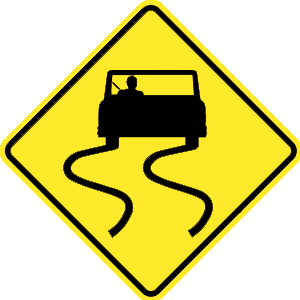
This sign means:
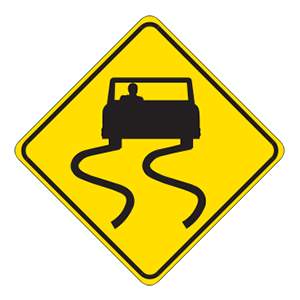
Slippery when wet.
Tow-away zone.
Steep downgrade.
Roadwork ahead.
Q.2.
Blood alcohol content (BAC) depends on each of the following, except:
Your body weight.
How much you drink.
How much time passes between drinks.
How physically fit you are.
Q.3.
Texting while driving is:
Always legal, but not recommended.
Illegal.
A safe activity.
Legal if the driver is using voice-to-text technology.
Q.4.
To turn right, you should be in:
The left lane.
The center lane.
The lane that’s closest to the direction you want to go.
Any one of the lanes.
Q.5.
As you drive, you're required to stop your vehicle:
At an intersection with a stop sign.
Where there is a red light.
When a traffic officer orders you to stop.
All of the above.
Q.6.
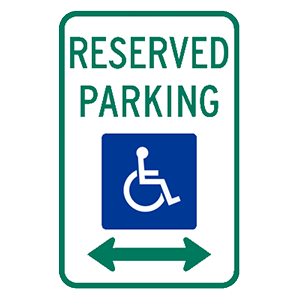
This road sign means:
Parking spaces are reserved for people with disabled parking permits.
A circular intersection is ahead.
Traffic in the lane must turn in the direction of the arrow.
Lanes are reserved for buses and vehicles with a driver and one or more passengers.
Q.7.
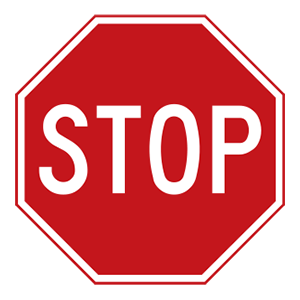
This sign means:
Stop.
Side road.
Two-way left turn.
Farm machinery.
Q.8.
When entering traffic from a private driveway:
You must yield to vehicles already on the main road.
You have the right-of-way over other traffic.
Enter only if there is a traffic light.
Have someone stop the traffic on the road you’re entering.
Q.9.
To turn right at an intersection with a steady red light, you should:
Slow down and look for traffic before turning.
Stop, signal, then turn when safe, if no sign prohibits the turn.
Signal and wait to turn until the light turns green.
Wait until you have a green turn arrow before turning.
Q.10.
A bicyclist who doesn’t obey traffic laws:
Is in the right because bicyclists don’t have to obey traffic laws.
Can be ticketed.
Will always receive a warning from law enforcement.
Will have their bicycle impounded.
Q.11.
You are driving on a busy street and your vehicle’s accelerator sticks open. You should:
Blow your horn.
Slam on your brakes.
Turn on your four-way flashers.
Turn off your ignition, taking care not to engage the steering wheel locking mechanism.
Q.12.
To check your blind spot when changing lanes to the left, you should glance:
Over your right shoulder.
At your side mirror.
Over your left shoulder.
At your rearview mirror.
Q.13.
Before turning left, it is important to:
Sound your horn.
Yield to oncoming vehicles.
Swing to the right side of your lane.
Wait until oncoming traffic has a red light.
Q.14.
When encountering an aggressive driver, you should:
Avoid eye contact, slow down, and let them pass.
Cut them off to slow them down.
Retaliate by tailgating them.
Make sure they know you disapprove of their behavior.
Q.15.
This road sign means:
When pavement is wet, reduce your speed.
The road ahead winds a series of turns or curves.
Traffic increases ahead.
Steep grade ahead.
Q.16.
When approaching a traffic signal displaying a steady green arrow, drivers:
Should merge into a lane in the direction of the arrow.
Should slow to a stop, if it is safe to do so.
May turn in the direction of the arrow after yielding to traffic and pedestrians already in the intersection.
May drive straight through the intersection.
Q.17.
If you are driving on the interstate and pass your exit, you should:
Quickly cut across traffic to make your turn.
Make a U-turn to go back to the exit.
Continue driving and use the next exit.
Put your vehicle in reverse to go back to the exit.
Q.18.
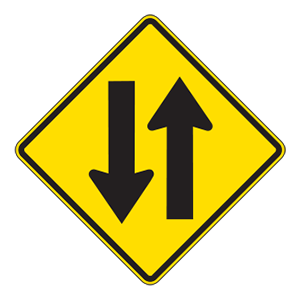
This sign means:
Four-lane traffic ahead.
Divided highway ahead.
Two-way traffic ahead.
Intersection ahead.
Q.19.
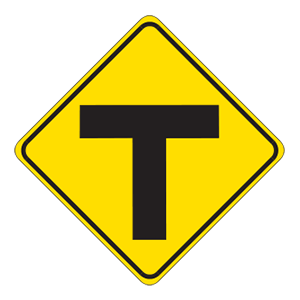
This sign means:
T intersection.
Lane shifting.
Side road.
Do not block intersection.
Q.20.
You come to an intersection with a flashing red light. You must:
Slow down and drive carefully through the intersection.
Turn either right or left, since the road is blocked ahead.
Stop at the intersection and wait for a flashing green light.
Stop at the intersection, then proceed as traffic allows.
Q.21.
What color are pavement markings that separate traffic lanes moving in opposite direction?
Yellow
White
Yellow and white
Yellow, white, and black
Q.22.
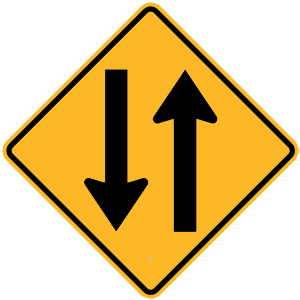
This sign means:
Two-way traffic.
Lane shifting.
Low clearance.
Added lane.
Q.23.
What does an orange-colored sign indicate?
The start of a no passing zone.
A railroad crossing is ahead.
A school zone is ahead.
The presence of construction work.
Q.24.
If you need to stop quickly and your vehicle is not equipped with an Anti-Lock Braking System (ABS), you should:
Hold down the brake pedal.
Firmly pump your brakes.
Lightly tap the brakes.
Release the brake pedal.
Q.25.
When approached by an emergency vehicle that is using its siren and/or flashing lights, a driver must immediately:
Pull to the right and stop.
Pull to the right and slow down.
Pull to the right and turn on their vehicle's four-way flashers.
Stop and let the emergency vehicle pass.
Support mcqgeeks.com by disabling your adblocker.
×
Please disable the adBlock and continue.
Thank you.
Reload page