MCQGeeks
CBSE
JEE
NTSE
NEET
English
UK Quiz
Quiz
Driving Test
Practice
Games
Driving Test
West Virginia
West Virginia Car Driving Permit Test-1
Answers
Q.1.
A funeral procession comes to an intersection where you are waiting. What should you do?
Expect the procession to yield the right-of-way.
Yield the right-of-way to the procession once the lead vehicle passes through the intersection.
Try to beat the lead vehicle through the intersection.
Enter the procession to pass through the intersection.
Q.2.
Fog can greatly reduce the visibility of other vehicles, pedestrians, and traffic signals. When driving in fog, you should:
Drive cautiously and reduce your speed.
Not use your high beam headlights.
Use low beam headlights to better illuminate the road and objects.
All of the above.
Q.3.
When driving in fog, you should use your:
Low beam headlights.
High beam headlights.
Parking lights.
Hazard flashers.
Q.4.
When sharing the road with a truck, it is important to remember that trucks generally:
Require longer distances to stop than smaller vehicles do.
Require less time to pass on a downgrade than smaller vehicles do.
Require a smaller turning radius than smaller vehicles do.
Require less time to pass on an incline than smaller vehicles do.
Q.5.
Drivers should not do which of the following?
Dim their headlights when within 200 feet of an oncoming vehicle.
Use their parking lights only while parked.
Dim their headlights when following within 200 feet of another vehicle.
Avoid being blinded by oncoming headlights by glancing toward the right edge of the roadway.
Q.6.
An arrow painted on the pavement means:
Drivers in the proper lane may make the movement indicated by the arrow, if they choose to do so.
Drivers in the proper lane must make the movement indicated by the arrow, but only if traffic lights are not working.
Drivers in the proper lane must always come to a complete stop before making the movement indicated by the arrow.
Drivers in the proper lane must make the movement indicated by the arrow while following directions indicated by traffic signals.
Q.7.
The consumption of alcohol while taking drugs can:
Decrease the effects of the drugs and alcohol.
Increase the effects of both the drugs and alcohol.
Help cure your illness.
Improve your driving ability.
Q.8.
Night driving can be more difficult than driving during the day because:
Cars overheat more quickly at night.
Visibility is reduced in the dark.
It is more likely to be raining at night.
You are more likely to encounter a motorcycle at night.
Q.9.
“Highway hypnosis” is a driving condition that can result from:
Staring at the roadway for long periods of time.
Frequent rest stops.
Too much sleep the night before your trip.
Short trips on expressways.
Q.10.
Don’t follow other cars too closely because:
You may not see the road between the cars.
You may not have time to stop if the vehicle in front of you slows or stops suddenly.
You may not see the vehicle's turn signals.
You may not see the other vehicle’s brake lights.
Q.11.
You are driving on a narrow road when you meet an oncoming vehicle. You must:
Pull completely off the road and stop.
Allow the oncoming vehicle at least one-half of the main-traveled portion of the road.
Demand the other vehicle pull over to make room.
Turn on your high beam headlights to make sure the other vehicle sees you.
Q.12.
Increasing your vehicle’s speed:
Increases your field of vision.
Decreases your field of vision.
Makes it easier to see cross traffic.
Has no effect on your field of vision.
Q.13.
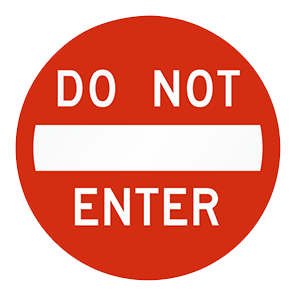
This road sign means:
Do not pass.
Do not enter.
No turn on red.
Keep right.
Q.14.
You are driving in the left lane and want to move into the right lane. You should:
Check your mirrors, signal, and look over your left shoulder for other vehicles before changing lanes.
Check your mirrors, signal, and look over your right shoulder for other vehicles before changing lanes.
Check your mirrors, signal, and look over both shoulders for other vehicles before changing lanes.
Check your mirrors, signal, and change lanes.
Q.15.
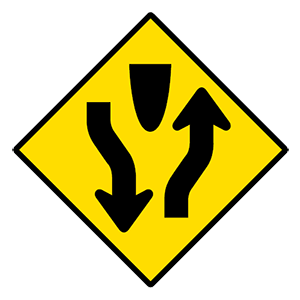
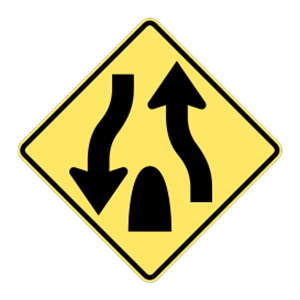
This sign means:
Curves ahead.
Divided highway starts.
Divided highway ends.
Bumps in the road.
Q.16.
This road sign means:
You are about to enter a one-way street from the wrong direction.
U-turns are prohibited.
You may proceed if the way is clear.
Come to a complete stop before proceeding.
Q.17.
You are approaching a railroad crossing that has no visible gates or flashing lights, but has a standard crossbuck. You should:
All of the above.
Approach all tracks with extreme caution and cross only when you know that there is no train coming.
Turn your radio down to hear if there may be an approaching train.
Only continue once cleared to do so by a flagger, if applicable.
Q.18.
To prepare for anything coming up on the road ahead, you should:
Continually scan the entire road and all roadsides.
Stare straight ahead at all times.
Drive with your left foot resting lightly on the brake pedal.
Maintain focus toward the middle of the road.
Q.19.
Crossbuck signs indicate:
Railroad crossings.
School zones.
No passing zones.
Hospitals.
Q.20.
When making a right turn at an intersection with a solid red light, you should:
Activate your turn signal and immediately turn.
Wait and turn right only after the light changes to green.
Come to a complete stop, yield the right-of-way to pedestrians and oncoming traffic, and turn right after the lane is clear.
Activate your hazard lights and turn right.
Q.21.
What might happen when alcohol is combined with another drug?
The effects of the alcohol and the drug may both be increased.
Nothing will happen.
The effects of the alcohol and the drug may both be reduced.
The effects of only the alcohol may be reduced.
Q.22.
Regulatory signs are usually ____ and should always be obeyed.
White
Blue
Green
Orange
Q.23.
When driving on wet pavement, it's important to remember:
That pavement is especially slippery right after it starts to rain.
That wet roads can cause hydroplaning.
To give yourself additional space when coming to a stop.
All of the above.
Q.24.
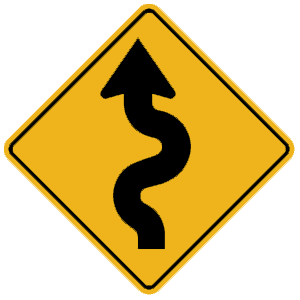
This sign tells you that:
No turns are allowed on this road.
The road narrows ahead.
There are a series of curves ahead.
The road may be slippery when wet.
Q.25.
Drowsy drivers:
Should drink strong black coffee to stay awake.
Can drive so poorly that they may appear to be drunk.
Can stay alert by opening a window and turning up the radio.
Are usually only older drivers.
Support mcqgeeks.com by disabling your adblocker.
×
Please disable the adBlock and continue.
Thank you.
Reload page