MCQGeeks
CBSE
JEE
NTSE
NEET
English
UK Quiz
Quiz
Driving Test
Practice
Games
Driving Test
West Virginia
West Virginia Car Driving Permit Test-18
Answers
Q.1.
When passing on a multilane highway:
Be sure the passing lane is clear.
Pass only on the right.
Watch for oncoming traffic.
There is no need to signal.
Q.2.
If one of your tires blows out as you are driving, you should:
Brake hard immediately.
Try to steer straight while gradually slowing by removing your foot from the gas pedal.
Maintain your current speed and steer straight.
Swerve back and forth to alert traffic behind you.
Q.3.
When merging onto a freeway, it is usually best to:
Proceed slowly while waiting for an opening.
Accelerate to a speed that is faster than the speed of traffic.
Turn on your hazard lights until safely on the freeway.
Accelerate to the speed of freeway traffic.
Q.4.
A steady green light at an intersection means that you:
Must slow down and prepare to stop.
Must stop and check for oncoming traffic before proceeding.
May drive through the intersection if the road is clear.
May not turn right.
Q.5.
You come to an intersection that is blocked by other traffic. You should:
Go slowly until the traffic ahead moves.
Get as close as possible to the car in front of you.
Stay out of the intersection until you can pass through.
Sound your horn to make the cars move up.
Q.6.
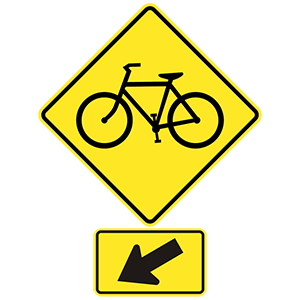
This road sign means:
Bicycle crossing.
Stop only if other cars are approaching.
Bicycle store.
Soft shoulders.
Q.7.
A regulatory sign containing a red circle with a slash through the middle indicates:
That drivers should come to a complete stop.
That an action is forbidden.
That some drivers should yield to other drivers.
That drivers should drive under the speed limit.
Q.8.
You are waiting in the intersection to complete a left turn. You should:
Signal and keep your wheels turned to the left.
Signal and keep your wheels straight.
Flash your headlights so drivers will let you through.
Drive around the rear of a car if it blocks you.
Q.9.
When passing other vehicles:
Check your mirrors and blind spots.
Honk your horn at least three times.
Re-enter your lane within 10 feet of the passed vehicle.
There is no need to signal.
Q.10.
What does a flashing yellow traffic light mean?
Merging traffic
Proceed with caution.
Pedestrian crossing
Come to a full stop.
Q.11.
You may park or stop along the shoulder of the freeway:
As long as you turn on your four-way (emergency) flashers.
If no part of your vehicle is on the road.
If you need to look at a map for directions.
Only if you have an emergency.
Q.12.
You are driving on a divided multilane highway and see or hear the signal of an approaching emergency vehicle. You should:
Disregard the signal if there are other lanes available for the emergency vehicle.
Stop as quickly as you can.
Slow down, move your vehicle to provide a clear path for the emergency vehicle, and stop.
Increase your speed to get out of the way of the emergency vehicle.
Q.13.
Stop lines are solid white lines painted across traffic lanes:
In curves and on hills.
Next to churches and schools.
At intersections and pedestrian crosswalks.
On freeway on-ramps.
Q.14.
If your car breaks down on a highway, you should:
Sit in your car and wait for help.
Use your four-way flashers to warn other drivers.
Sound your horn at passing motorists.
Flash your headlights at oncoming traffic.
Q.15.
If your car starts to skid, turn your steering wheel:
To keep the front wheels straight.
In the direction you want the vehicle to go.
In the opposite direction of the skid.
In any direction. It doesn't matter.
Q.16.
Is it legal cross a double solid yellow centerline to pass?
Yes.
No.
If there is no oncoming traffic.
If the vehicle ahead of you is driving under the speed limit.
Q.17.
A good rule to remember for passing is:
Pass on the right whenever possible.
Drive with the flow of traffic and pass only as needed.
Try to get to the front of any slow-moving traffic so that you can see better.
Always flash your lights and sound your horn to alert other drivers to your intentions.
Q.18.
Allow a larger space cushion than usual when stopping:
On an incline.
At an intersection.
At a stop sign.
At a toll plaza.
Q.19.
You are driving up a hill and are approaching a heavy truck from the rear. You should know that:
The truck may be traveling at a speed slower than the posted speed limit.
You may not be able to safely pass the truck.
You may not be able to legally pass the truck.
All of the above.
Q.20.
A pedestrian starts to cross in front of your vehicle. You should:
Flash your lights.
Slow down.
Speed up and pass in front of the pedestrian.
Stop and let the pedestrian cross.
Q.21.
You come to an intersection displaying a flashing red light. You should:
Come to a full stop and go when it is safe to do so.
Stop only if other cars are also approaching the intersection.
Stop only if other cars are already within the intersection.
Slow down and be prepared to stop, if necessary.
Q.22.
An "End school zone" sign indicates:
That the speed limit is 20 mph.
The beginning of a reduced speed zone.
The increased possibility of encountering pedestrians.
The end of a reduced speed zone.
Q.23.
When approaching a traffic signal displaying a steady green arrow, drivers:
Should merge into a lane in the direction of the arrow.
Should slow to a stop, if it is safe to do so.
May turn in the direction of the arrow after yielding to traffic and pedestrians already in the intersection.
May drive straight through the intersection.
Q.24.
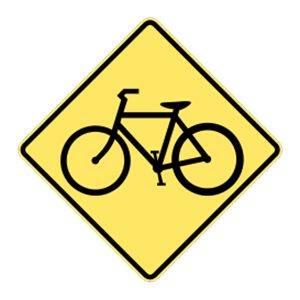
This sign means:
Watch for bicycles.
Bicycles not allowed.
Bicycle repair shop ahead.
Bicycles have the right-of-way.
Q.25.
When the driver behind you wants to pass, you should:
Speed up.
Go the same speed.
Slow down to allow room in front of your vehicle for the other driver to complete the pass easily.
Change lanes.
Support mcqgeeks.com by disabling your adblocker.
×
Please disable the adBlock and continue.
Thank you.
Reload page