MCQGeeks
CBSE
JEE
NTSE
NEET
English
UK Quiz
Quiz
Driving Test
Practice
Games
Driving Test
West Virginia
West Virginia Car Driving Permit Test-2
Answers
Q.1.
You approach an emergency vehicle that is stopped with its lights flashing. You must:
Slow down. If possible, change lanes so you will not drive next to the stopped emergency vehicle.
Drive to the right side of the road and stop.
Stay in your lane and continue to drive at the same speed.
Accelerate to quickly pass the stopped vehicle.
Q.2.
If your vehicle begins to skid, you should:
Overcorrect.
Turn your steering wheel into traffic.
Turn your steering wheel in the direction you want to go.
Release the steering wheel.
Q.3.
Distracted driving may be caused by:
Eating, drinking, or smoking.
Talking or texting on a cellular phone.
Changing a radio station or CD.
All of the above.
Q.4.
If you miss your exit on an interstate expressway:
Stop and make a U-turn.
Get off at the next exit and come back to the exit you missed.
Roll down your window and ask the driver next to you for help.
Back up on the highway.
Q.5.
Always signal when:
Changing lanes.
Pulling into or out of a parking space.
Pulling into traffic from a parking area or alley.
All of the above.
Q.6.
A flashing yellow light at an intersection means that you should:
Slow down and proceed with care.
Continue normally through the intersection.
Stop and proceed when a green light appears.
Stop and proceed when the way is clear.
Q.7.
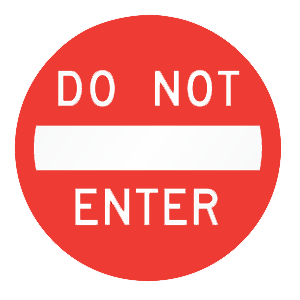
This sign is used to prevent:
Entrance to full parking lots.
Entrance to road construction areas.
Entrance to dead-end streets.
Entrances from the wrong direction on one-way streets and expressway ramps.
Q.8.
When changing lanes, you should:
Rely on your mirrors.
Begin signaling as you move into the next lane.
Signal at least 500 feet before your lane change when driving on residential streets.
Always check your blind spot.
Q.9.
You notice a vehicle defect which may affect the safe operation of your vehicle. You should:
Correct the defect as soon as possible.
Correct the defect when you can afford it.
Drive the vehicle at slower speeds.
Drive normally.
Q.10.
Emergency vehicles:
Have the right-of-way when using sirens, horns, and/or flashing lights.
May use a loudspeaker to give instructions.
May follow each other.
All of the above.
Q.11.
The best way to avoid hydroplaning is to:
Keep your tires properly maintained.
Slow down when roads are wet or slushy.
Watch out for standing water or puddles.
All of the above.
Q.12.
When a traffic signal light turns green, you should:
Yield the right-of-way to pedestrians.
Accelerate as quickly as possible.
Back up slowly.
Not move until another driver waves you on.
Q.13.
Guide signs are ____ signs that provide directional and mileage information to drivers.
Yellow
Red
Green
White
Q.14.
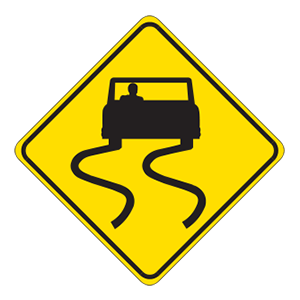
This sign means:
Slippery when wet.
Tow-away zone.
Steep downgrade.
Roadwork ahead.
Q.15.
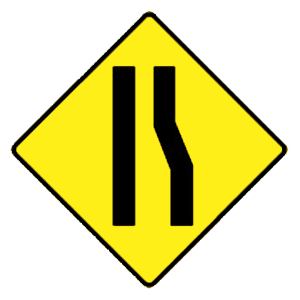
This road sign means:
Road widens ahead.
Lane reduction; the right lane ends soon.
Highway entrance ramp ahead.
Lane reduction; the left lane ends soon.
Q.16.
When driving on roads that may be slippery:
Always drive at the maximum speed limit.
Use cruise control to maintain a steady speed.
Reduce your following distance.
Do not make any sudden changes in speed or direction.
Q.17.
A red flashing traffic light has the same meaning as a:
Solid red light.
Stop sign.
Yield sign.
Caution sign.
Q.18.
To avoid being in a truck or bus driver’s blind spot, you should:
Never pass them.
Avoid driving alongside them and avoid tailgating.
Flash your lights at them.
Sound your horn.
Q.19.
What is a "No zone?"
A designated no passing zone
A one-way traffic area
The blind spot of a large vehicle
An area designated for motor vehicles
Q.20.
If a vehicle using high beams comes toward you, you should look toward ____ of the road.
Either side
The center
The right side
The left side
Q.21.
You are involved in an accident and another person is injured. You should:
Moved the injured away from the scene immediately.
Always leave the injured where they are.
Not move the injured unnecessarily. Keep the injured warm and administer first aid.
Stay away from the injured.
Q.22.
When driving past a vehicle that has just stopped in a parked position on the side of the road, you should:
Assume that the driver will open the car door as you approach.
Speed up.
Slam on your brakes.
Assume that the driver will wait for you to pass before opening the door.
Q.23.
If another vehicle is following you too closely, you should:
Press hard on your brakes.
Get behind them and turn on your high beam lights.
Tap your brakes gently, slow down, and let them pass.
Drive slowly and make sure they can’t pass you.
Q.24.
If you leave your vehicle unattended, you must:
Turn off the engine.
Lock the ignition and remove the key.
Set the parking brake.
All of the above.
Q.25.
A single broken yellow line down the center of a two-lane road indicates:
Lanes are moving in opposite directions and drivers are not permitted to pass.
Lanes are moving in opposite directions and drivers are permitted to pass when it is safe to do so.
Lanes are moving in the same direction and drivers are not permitted to pass.
Lanes are moving in the same direction and drivers are permitted to pass when it is safe to do so.
Support mcqgeeks.com by disabling your adblocker.
×
Please disable the adBlock and continue.
Thank you.
Reload page