MCQGeeks
CBSE
JEE
NTSE
NEET
English
UK Quiz
Quiz
Driving Test
Practice
Games
Driving Test
West Virginia
West Virginia Car Driving Permit Test-24
Answers
Q.1.
If you reach an intersection where you wish to turn but you are not in the proper lane, you should:
Quickly cut across traffic to make your turn.
Turn on your blinker and make the turn from your current lane.
Drive to the next intersection and make your turn then.
Safely change lanes then put your vehicle in reverse to go back to the intersection.
Q.2.
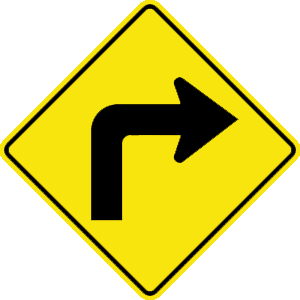
This road sign means:
One-way road.
No right turn.
Exit.
Sharp right turn in the road ahead.
Q.3.
If traffic signals at an intersection are not functioning due to a power outage:
Park your vehicle as far off the road as possible and wait for power to be restored.
Use hand signals to indicate your intentions to other drivers.
Turn on your hazard lights and proceed through the intersection without stopping.
Treat the intersection as a four-way stop.
Q.4.
Which of the following best ensures your safety and the safety of those around you when you are backing your vehicle?
Honk your horn right before shifting into reverse.
Check behind the vehicle before you get into the driver's seat.
Check your rearview mirrors to see what is behind you.
Turn up the car radio before backing up to get the attention of anyone who may be around you.
Q.5.
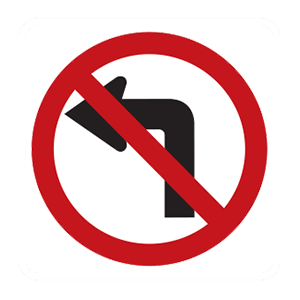
This sign means:
No left turn.
Flagger ahead.
Two-way left turn.
Turn right or go through.
Q.6.
When approaching railroad tracks, you should:
Look, listen, slow down, and be prepared to stop.
Speed up to cross the tracks before the gate is lowered.
Try to drive around a lowered gate.
Not pay attention to how many tracks there are to cross.
Q.7.
At dusk or on overcast days, you should:
Drive using your four-way flashers.
Drive using your parking lights.
Not turn on any vehicle lights.
Turn on your headlights.
Q.8.
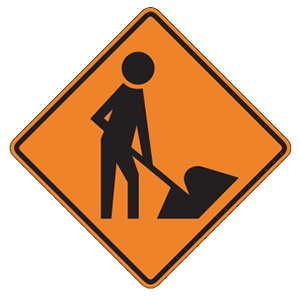
This sign means that:
A community service group is picking up trash along the highway ahead.
Workers are on or very close to the road in the work zone ahead.
Children are at play ahead.
There is a pedestrian crosswalk ahead.
Q.9.
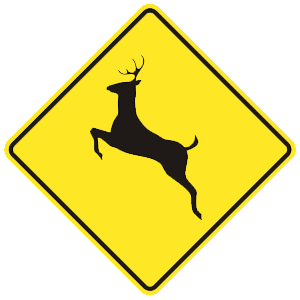
This road sign means:
Hunting area.
State park.
Deer crossing.
Wildlife preserve.
Q.10.
To help relieve fatigue on a long trip, it is a good idea to:
Stop and rest every two hours.
Do arm exercises every hour.
Drive with one eye open at a time.
Change feet on the gas pedal.
Q.11.
Before passing another vehicle, you should signal:
Just before changing lanes.
At any time.
After changing lanes.
Early enough for others to know your plans.
Q.12.
Before turning left, it is important to:
Sound your horn.
Yield to oncoming vehicles.
Swing to the right side of your lane.
Wait until oncoming traffic has a red light.
Q.13.
When you want to make a right turn, your car must be:
Near the center of the street.
Close to the left side of the street.
Close to the right side of the street.
Past the center of the intersection when you begin to turn.
Q.14.
You must pull over to the edge of the road and allow an emergency vehicle to pass:
Regardless of your direction.
Only if it is following you.
Only if it is approaching you from the opposite direction.
None of the above.
Q.15.
When approaching a traffic signal displaying a steady yellow arrow, drivers:
Should merge into a lane in the direction of the arrow.
Should slow to a stop, if it is safe to do so.
May turn left after yielding to oncoming traffic and pedestrians.
Have the right-of-way and may expect oncoming traffic to stop for them.
Q.16.
A stop sign is shaped like a(n):
Rectangle.
Square.
Circle.
Octagon.
Q.17.
When driving on an interstate:
Stop on the shoulder of the road if you are tired.
You should always use cruise control.
Signal, check mirrors, and check blind spots before changing lanes.
You should change lanes often.
Q.18.
Passing is prohibited:
In a curve.
Within 100 feet of an intersection.
If your lane is next to a solid yellow centerline.
All of the above.
Q.19.
You are driving on a busy street and your vehicle’s accelerator sticks open. You should:
Blow your horn.
Slam on your brakes.
Turn on your four-way flashers.
Turn off your ignition, taking care not to engage the steering wheel locking mechanism.
Q.20.
When changing lanes, you can check your blind spots by:
Using the inside rearview mirror.
Using the outside rearview mirror.
Using both inside and outside rearview mirrors.
Turning your head and looking over your shoulder.
Q.21.
The most effective thing you can do to reduce your risk of being injured or killed in a traffic crash is to:
Wear your seat belt.
Limit your driving to weekdays.
Stay in the right lane on multilane highways.
Limit your driving to hours between 3:00 p.m. and 6:00 p.m.
Q.22.
You have the right-of-way when turning left on which of the following traffic signals?
A solid green light
A flashing yellow light
A green arrow pointing left
A flashing red light
Q.23.
If you are driving on the interstate and pass your exit, you should:
Quickly cut across traffic to make your turn.
Make a U-turn to go back to the exit.
Continue driving and use the next exit.
Put your vehicle in reverse to go back to the exit.
Q.24.
If two vehicles arrive to a four-way stop at the same time:
The vehicle on the left must yield to the vehicle on the right.
The vehicle on the right must yield to the vehicle on the left.
Drivers must make hand motions to communicate with each other.
One driver should proceed without stopping.
Q.25.
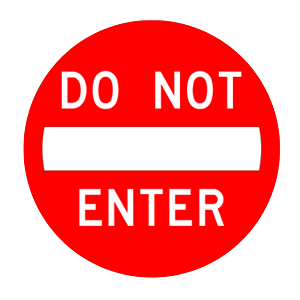
This sign means:
Heavy traffic ahead.
Do not enter.
Railroad crossing.
Yield.
Support mcqgeeks.com by disabling your adblocker.
×
Please disable the adBlock and continue.
Thank you.
Reload page