MCQGeeks
CBSE
JEE
NTSE
NEET
English
UK Quiz
Quiz
Driving Test
Practice
Games
Driving Test
West Virginia
West Virginia Car Driving Permit Test-4
Answers
Q.1.
Another driver is trying to pass your car. You should:
Pull off the road.
Signal to the other driver when it is safe for them to pass.
Check for oncoming traffic and adjust your speed to allow safe passing.
Speed up.
Q.2.
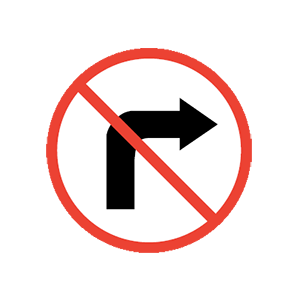
This road sign means:
Turn right after making a complete stop.
Right turns are not permitted.
Left turns are permitted.
None of the above.
Q.3.
You are coming to an intersection and have a green light. Pedestrians are crossing against the red. You should:
Honk your horn.
Speed up and pass in front of the pedestrians.
Stop to let the pedestrians cross safely.
Drive close to the pedestrians and frighten them so they’ll think twice before crossing against a red light.
Q.4.
If you are involved in a serious motor vehicle crash:
Stop.
Call the police.
Determine if anyone is injured.
All of the above.
Q.5.
Which of the following commonly causes traffic accidents?
Inattentive driving
Excessive speed under the driving conditions
Following other vehicles too closely
All of the above
Q.6.
Your body gets rid of approximately:
Three alcoholic drinks an hour.
One alcoholic drink an hour.
Two alcoholic drinks an hour.
None of the above.
Q.7.
On the freeway, you see a "Merging traffic“ sign. You should:
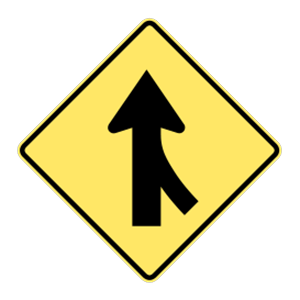
Honk at incoming traffic.
Always remain at your present speed.
Speed up to avoid congesting traffic.
Move to another lane, if safe, to let traffic enter.
Q.8.
To safely pass a bicycle, you should:
Honk at the bicyclist to let them know you're trying to pass.
Drive in the bicycle lane until you get a chance to pass.
Slow down and give them as much space as possible.
Rush ahead to pull in front of the bicyclist.
Q.9.
When driving near heavy trucks, other drivers and highway users must make allowances for:
The increased stopping distance required by large vehicles.
The decreased stopping distance required by large vehicles.
The decreased noise of larger vehicles.
The increased speed of larger vehicles.
Q.10.
Under ideal driving conditions, you should maintain a following distance of at least:
Three to four seconds.
Two seconds.
Five to seven seconds.
10 seconds.
Q.11.
If you are driving near a motorcycle, you must:
Allow the motorcycle to use a complete lane.
Drive on the shoulder beside the motorcycle.
Allow the motorcycle to use only half of a lane.
Pass using the same lane as the motorcycle.
Q.12.
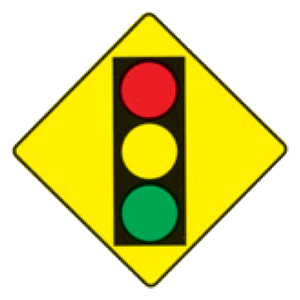
This sign means:
Stop sign ahead.
Lane closed ahead.
Railroad crossing ahead.
Traffic signal ahead.
Q.13.
Smoking and preparing to smoke while driving:
Are distracting activities.
Do not affect driving abilities.
Help maintain driver alertness.
Are not distracting activities.
Q.14.
Worn or bald tires:
Can make turning more difficult.
Are likely to hydroplane.
Can increase your stopping distance.
All of the above.
Q.15.
An intersection has no traffic signs or signals. You arrive at the same time as a vehicle to your right. You should:
Speed up and get through the intersection.
Slow down and yield to the vehicle on your right.
Drive into the intersection and make the other vehicle stop.
Honk your horn and drive through the intersection.
Q.16.
What should you do when an emergency vehicle is approaching while displaying flashing red or blue lights?
See if you can reach your destination before the emergency vehicle catches up to you.
Continue driving but try to stay out of its way.
Pull over to the side of the road and come to a complete stop.
Stop in the middle of an intersection.
Q.17.
At a light rail intersection, always:
Look both ways before crossing tracks.
Pay attention and obey all traffic signals.
Share the road with pedestrians and bicyclists.
All of these.
Q.18.
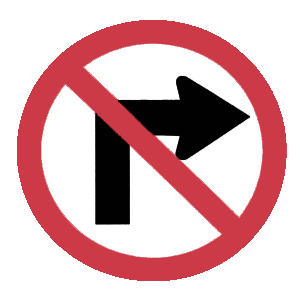
This road sign means:
No left turn.
No U-turns.
No exit.
No right turn.
Q.19.
You are driving on the roadway and hear a siren behind you. You should:
Stop where you are.
Pull over to the right and stop.
Speed up to get out of the way.
Slow down.
Q.20.
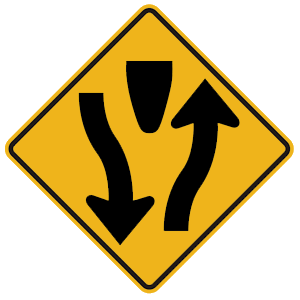
This sign means:
A divided highway ends.
A one-way street begins.
A one-way street ends.
A divided highway begins.
Q.21.
When passing a large vehicle, the driver of a small vehicle must be prepared for:
Loud noises.
Excess air pollution.
Wind gusts produced by the large vehicle.
Falling vehicle parts.
Q.22.
This sign is used to warn drivers:
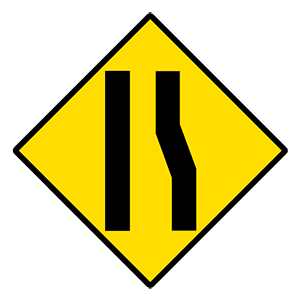
That the right lane ends and traffic should merge left.
That the road curves ahead.
About upcoming intersections.
About road construction.
Q.23.
What should you do if your accelerator sticks while you are driving?
Reach down and attempt to pull it up.
Shift to park.
Shift to neutral and apply steady pressure on the brake.
Turn the engine off.
Q.24.
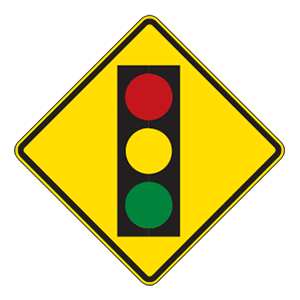
This sign means:
Traffic signal.
Fire station.
T intersection.
Left turn signal.
Q.25.
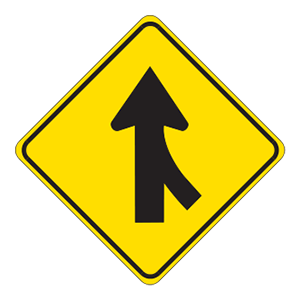
This sign means:
Merging traffic.
Multiple turns.
Lane shifting.
Do not block intersection.
Support mcqgeeks.com by disabling your adblocker.
×
Please disable the adBlock and continue.
Thank you.
Reload page