MCQGeeks
CBSE
JEE
NTSE
NEET
English
UK Quiz
Quiz
Driving Test
Practice
Games
Driving Test
West Virginia
West Virginia Motorcycle Driving Permit Test-14
Answers
Q.1.
When approaching an uneven surface, such as a bump or pothole, you should rise slightly off of your seat:
So you can jump off the motorcycle if you need to.
So your legs can absorb the shock.
So other drivers can see you better.
So you can get a better view of the uneven surface.
Q.2.
When applying the front brake, you should:
Apply the lever by squeezing firmly and progressively.
Grab at the brake with only two fingers.
Press down on the brake lever with your foot.
Stomp on the brake lever.
Q.3.
Generally, the body eliminates how many alcoholic drinks per hour?
One
Two
Three
Four
Q.4.
When planning a long group ride, which of the following ideas should not be implemented?
The lengths of travel segments should be based on the least experienced rider.
Breaks should be minimized so the riders can get to their destination as soon as possible.
Inexperienced riders should be placed behind the leaders.
The group should maintain a staggered riding formation.
Q.5.
For the best protection, jackets and pants:
Should cover your arms and legs completely.
Should be loose and flap in the wind while you are riding.
Should only partially cover your arms and legs.
Should be made of wool.
Q.6.
Where is the front brake lever usually located?
On the left handgrip
On the right handgrip
By the left foot peg
By the right foot peg
Q.7.
Before a ride, you should instruct a passenger to do all of the following, except:
Sit as far back as possible.
Get on the motorcycle only after the engine is started.
Hold firmly onto your waist, hips, or belt.
Avoid unnecessary talk or motion.
Q.8.
When riding a motorcycle, you should:
Always avoid the left portion of a lane.
Always avoid the right portion of a lane.
Always avoid the center portion of a lane.
Use whichever portion of the lane is safest.
Q.9.
Which of the following is not a piece of protective clothing for a motorcycle rider?
Jacket
Boots
Gloves
Sandals
Q.10.
The best way to handle tailgaters is to:
Change lanes and let them pass.
Use your horn and make obscene gestures.
Speed up to put distance between you and the tailgater.
Come to a complete stop.
Q.11.
Which of the following is a poor reason to sound your horn?
A driver in the lane next to you is too close to the vehicle ahead of them.
A parked car has a person in the driver’s seat.
You want people to look at your motorcycle.
You are passing someone who is in the street.
Q.12.
When you have mounted your motorcycle, you should do all of the following, except:
Make sure the mirrors are clean.
Make sure the horn works.
Close the fuel supply valve.
Make sure the clutch works smoothly.
Q.13.
What does this hand signal mean?
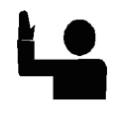
Slow or stop
Left turn
Right turn
Backing up
Q.14.
When approaching a blind intersection with a stop sign, riders should:
Stop at the stop sign then proceed through the intersection.
Ignore the stop sign and move forward to get a better look.
Stop at the stop sign before moving forward to improve their view of cross traffic.
Proceed through the intersection without stopping.
Q.15.
What should you do to maintain proper control of your motorcycle while turning?
Increase your speed before entering the turn.
Keep the motorcycle from leaning.
Look through the turn to anticipate the best course of action.
Come to a complete stop before entering the turn.
Q.16.
When riding at night, you should:
Be flexible about your lane position and adjust to changing conditions.
Travel at a faster speed than usual to get to your destination more quickly.
Always use your low beam headlight to see better.
Decrease your following distance so you can be as close as possible to the vehicle ahead.
Q.17.
When should the front brake be used?
Any time the rider is slowing or stopping
Only when slowing or stopping on slippery roads
Only when slowing or stopping in an emergency
Only when slowing or stopping in traffic
Q.18.
When passing another vehicle:
The pass may be completed in a no passing zone.
The rider may travel up to 10 mph over the speed limit to complete the pass.
The pass must be started and completed within a passing zone.
The pass must be completed on the shoulder, if one is present.
Q.19.
A proper lane position should do all of the following, except:
Increase your ability to see and be seen.
Help you avoid surface hazards.
Help you avoid traffic signals.
Communicate your intentions to other road users.
Q.20.
To swerve correctly, you should:
Shift your weight quickly.
Turn the handlebars quickly.
Press the handle grip in the direction you plan to swerve.
Press the handle grip in the direction opposite of where you plan to swerve.
Q.21.
What is often found in the center portion of the lane?
A landing strip
An oily or greasy strip
Lane markings
Ice
Q.22.
When preparing to pass another vehicle on the left, you should:
Ride in the right portion of the lane.
Ride in the left portion of the lane.
Get as close as possible to the vehicle in front of you.
Not signal your intentions, as that may distract the driver you are passing.
Q.23.
Where is the rear brake pedal usually located?
On the left handgrip
On the right handgrip
Near the left footrest
Near the right footrest
Q.24.
Taking a turn too fast:
Is acceptable as long as you stay under the speed limit.
Is safer on a motorcycle than in a car.
Is acceptable as long as no vehicles are near you.
Can cause you to end up in another lane or leave the road.
Q.25.
When riding a motorcycle, a jacket should be worn:
No matter the weather conditions.
Only on cool days.
Only on warm days.
Only if the ride will be longer than half an hour.
Support mcqgeeks.com by disabling your adblocker.
×
Please disable the adBlock and continue.
Thank you.
Reload page