MCQGeeks
CBSE
JEE
NTSE
NEET
English
UK Quiz
Quiz
Driving Test
Practice
Games
Driving Test
Wisconsin
Wisconsin Car Driving Permit Test-10
Answers
Q.1.
What does an orange-colored sign indicate?
The start of a no passing zone.
A railroad crossing is ahead.
A school zone is ahead.
The presence of construction work.
Q.2.
Having a driver license is a:
Requirement.
Privilege.
Right.
Q.3.
When driving in fog, rain, or snow, use:
Low beams.
High beams.
Fog lights only.
Q.4.
You want to park uphill on a two-way road and there is no curb. Which direction do you turn your front wheels?
Straight ahead
Right, toward the side of the road
Left, toward the center of the road
Q.5.
When you park uphill on a street with a curb:
Keep the front wheel straight and set the parking brake.
Turn the front wheels away from the curb.
Turn the front wheels toward the curb.
Turn the back wheels into the curb.
Q.6.
You must show proof of insurance to law enforcement:
Only if you are involved in a collision.
If you are involved in a collision or stopped for a citation.
Only if you are stopped and cited.
Q.7.
When approaching a flashing yellow light, drivers should:
Increase their speed.
Come to a complete stop.
Turn on their headlights.
Slow down and proceed with caution.
Q.8.
After stopping for a school bus that is unloading children:
Do not proceed until the children wave to you.
Watch for children walking along the side of the road.
Accelerate quickly.
Turn on your emergency flashers.
Q.9.
On the freeway, you see a "Merging traffic“ sign. You should:
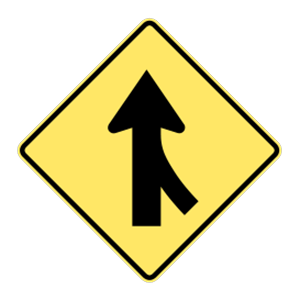
Honk at incoming traffic.
Always remain at your present speed.
Speed up to avoid congesting traffic.
Move to another lane, if safe, to let traffic enter.
Q.10.
A driver can legally pass on the right side of another vehicle:
If the vehicle is waiting to turn left and there is an available passing lane.
Even if it means driving off the pavement.
On a narrow bridge.
At any time.
Q.11.
A steady yellow light at an intersection means:
Go.
Yield to other cars.
Slow down and prepare to stop.
Stop.
Q.12.
If it is necessary to make an emergency stop while driving on an interstate, you should:
Sound your horn at passing cars to get their attention.
Get out of your vehicle and flag down the first vehicle that passes.
Pull off the road, turn on your emergency flashers, and stay in your vehicle, if you can.
Q.13.
When dealing with pedestrians, a driver must:
Make sure the pedestrian is aware of their vehicle.
Always yield the right-of-way, even if the pedestrian is in the wrong.
Yield the right-of-way only when the pedestrian is legally entitled to it.
Slow down and sound their horn near a crosswalk.
Q.14.
This sign is used to warn drivers about:
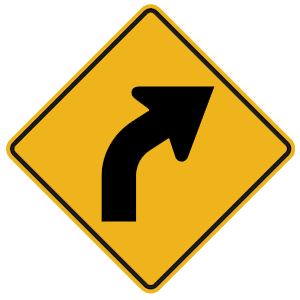
Upcoming intersections.
Road construction.
An upcoming curve in the road.
Changes in traffic lanes.
Q.15.
What is the first thing you should adjust, if needed, when you get into a car to drive?
Your seat belt
The steering wheel
Your rearview mirror
Your seat
Q.16.
When driving, how often should you check your rearview mirror for traffic behind you?
Every two to four seconds
Every four to six seconds
Every six to eight seconds
Every eight to ten seconds
Q.17.
This road sign means:
Keep right.
Keep left.
Pass with caution.
No passing.
Q.18.
Stopping distances and severity of crashes:
Decrease as vehicle speed increases.
Are not affected by vehicle speed.
Increase as vehicle speed increases.
Q.19.
To know where traffic is behind you:
Frequently check your rearview mirror.
Turn and look out your back window.
Keep other vehicles out of your blind spots.
Q.20.
Excessive speed:
Does not increase the chance of a crash.
Increases your ability to react to a hazard.
Often leads to high-risk decision-making.
Q.21.
When driving near a blind pedestrian who is carrying a white cane or using a guide dog, you should:
Slow down and be prepared to stop.
Take the right-of-way.
Proceed normally.
Drive away quickly.
Q.22.
When passing another vehicle on a road with two lanes traveling in opposite directions, you should:
Return to the driving lane when there's enough room between you and the vehicle you passed.
Remain in the left lane if you intend to turn left.
Return to the right side of the roadway immediately.
Drive in either lane.
Q.23.
Backing your vehicle is:
Always dangerous.
Dangerous if you have a helper.
Only dangerous in large vehicles.
Q.24.
If you are driving on a one-way street and an emergency vehicle using its flashing lights approaches your vehicle, you must:
Drive with your flashers turned on.
Drive toward the nearest roadside and stop.
Speed up and take the nearest exit.
Slow down until the vehicle passes you.
Q.25.
When exiting a highway, you should slow down:
On the main road, just before the exit lane.
Once you see a toll booth.
Once you have moved into the exit lane.
When you first see the exit sign.
Q.26.
Collisions are more likely to happen when:
All vehicles are traveling at about the same speed.
One lane of traffic is traveling faster than the other lanes.
One vehicle is traveling faster or slower than the flow of traffic.
Q.27.
Just like alcohol and other drugs, drowsiness can:
Help you to be a better driver.
Make you feel better.
Impair your judgment.
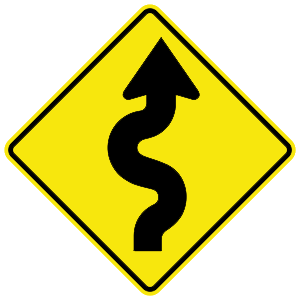
Q.28.
This road sign means:
Sharp turn to the right.
Double curve.
Winding road.
Pavement ends.
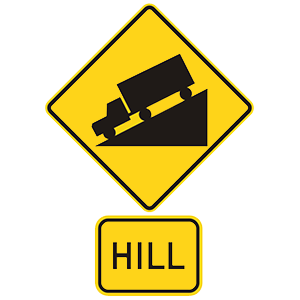
Q.29.
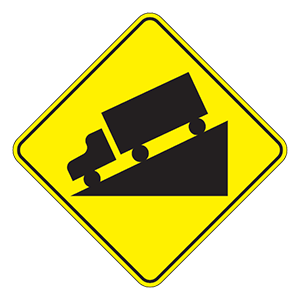
This sign means:
Trucks under 18,000 pounds are allowed.
Hill ahead.
Truck stop ahead.
Q.30.
When stopped at a red traffic light with a green arrow, you may proceed in the direction of the arrow if you:
First come to a complete stop.
Wait until the light changes.
Are in the proper lane and the intersection is clear.
Q.31.
A fully loaded tractor-trailer traveling atmph could take up to ____ to come to a complete stop.
50 feet
125 feet
400 feet
750 feet
Q.32.
When changing lanes, you can check your blind spots by:
Using the inside rearview mirror.
Using the outside rearview mirror.
Using both inside and outside rearview mirrors.
Turning your head and looking over your shoulder.
Q.33.
Drinking coffee after drinking alcohol:
Decreases blood alcohol concentration.
Cancels the effect of the alcohol.
Has no effect on blood alcohol concentration.
Increases blood alcohol concentration.
Q.34.
When parking next to a curb, you should use your turn signals:
Only when pulling away from the curb.
When pulling next to, but not away from, the curb.
When pulling next to or away from the curb.
Q.35.
The most effective thing you can do to reduce your risk of being injured or killed in a traffic crash is to:
Wear your seat belt.
Limit your driving to weekdays.
Stay in the right lane on multilane highways.
Limit your driving to hours between 3:00 p.m. and 6:00 p.m.
Q.36.
When approaching a railroad crossing, you should:
Slow down.
Look for a train.
Be ready to stop.
All of the above.
Q.37.
Which of the following blocks the smooth flow of traffic?
Slowing down to look at collision scene.
Avoiding unnecessary lane changes.
Using public transportation instead of your vehicle.
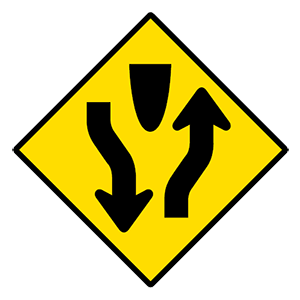
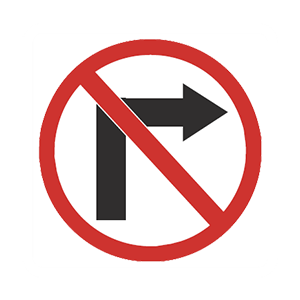
Q.38.
This sign means:
No right turn.
Stop sign ahead.
Divided highway.
Q.39.
Alcohol in any concentration is:
A stimulant.
A depressant.
Neither of the above.
Q.40.
This sign means:
Trucks entering.
Truck exit only.
Steep downgrade ahead.
Q.41.
If an officer is directing traffic at a working traffic light, drivers should:
Follow the directions indicated by the traffic light.
Follow the directions given by the officer.
Honk at the officer.
Check to see what the cars next to them are doing.
Q.42.
What is the maximum speed limit in residential and business areas where there are no posted speed limits?
15 mph
25 mph
35 mph
45 mph
Q.43.
Which of these statements is true about roadwork zones?
Fines are the same for violations committed in work zones as they are under normal traffic conditions.
You must "Slow for the Cone Zone."
Slow down only if you think workers are present.
Q.44.
A bicyclist who doesn’t obey traffic laws:
Is in the right because bicyclists don’t have to obey traffic laws.
Can be ticketed.
Will always receive a warning from law enforcement.
Will have their bicycle impounded.
Q.45.
When approaching a person who is crossing the street while using a white cane or guide dog, you should:
Stop until the person is well away from your path of travel.
Honk your horn as you proceed past them.
Carefully drive around them.
Q.46.
When parking your vehicle downhill on a two-way street:
Turn your wheels to the right.
Turn your wheels to the left.
Keep your wheels pointed straight ahead.
Leave your transmission in neutral.
Q.47.
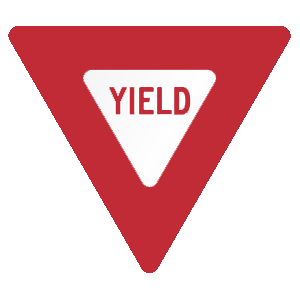
This road sign means:
Drive with caution and be ready to slow down.
Do not drive in this lane.
You must come to a complete stop and yield the right-of-way.
Slow down, be prepared to stop, and, if necessary, yield the right-of-way.
Q.48.
When approaching an uncontrolled intersection, a driver should:
Maintain their speed and proceed.
Stop at the intersection, check in all directions, and proceed.
Yield to all other drivers.
Be prepared to yield.
Q.49.
When sharing the road with a truck, it is important to remember that trucks generally:
Require longer distances to stop than smaller vehicles do.
Require less time to pass on a downgrade than smaller vehicles do.
Require a smaller turning radius than smaller vehicles do.
Require less time to pass on an incline than smaller vehicles do.
Q.50.
When you see this sign, it means:
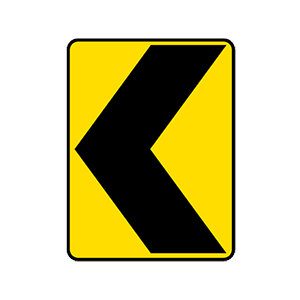
There is an object on the roadway.
Traffic is coming from the right.
The road is curving sharply to the left.
There is a merge point ahead.
Support mcqgeeks.com by disabling your adblocker.
×
Please disable the adBlock and continue.
Thank you.
Reload page