MCQGeeks
CBSE
JEE
NTSE
NEET
English
UK Quiz
Quiz
Driving Test
Practice
Games
Driving Test
Wisconsin
Wisconsin Car Driving Permit Test-11
Answers
Q.1.
When the road is marked with a solid yellow line and a broken yellow line, with the broken line next to your lane, you may pass:
Only in an emergency.
If you are on an expressway.
If traffic is clear.
Only at an intersection.
Q.2.
This sign means:
Sharp turn ahead, slow down.
Work crew ahead.
Side road.
Playground ahead.
Q.3.
Distracted driving is:
Very uncommon.
Extremely risky behavior.
Nothing to be concerned about.
No less safe than driving under any other conditions.
Q.4.
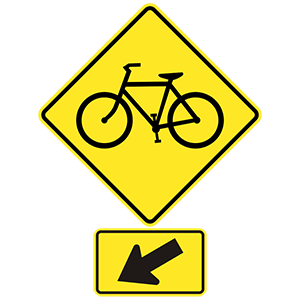
This road sign means:
Bicycle crossing.
Stop only if other cars are approaching.
Bicycle store.
Soft shoulders.
Q.5.
If worried, nervous, angry, or crying, a driver:
Will drive no differently than they would if they were thinking more clearly.
Can drive faster because they are more in touch with their senses.
Should take the time to focus on driving before starting the engine.
Should call a friend to vent while driving.
Q.6.
When a car with bright headlights drives toward you at night, you should:
Stop until the other driver passes.
Look below their headlights.
Glance toward the right edge of your lane.
Q.7.
Changing from one lane to another is best done:
Gradually and carefully.
Quickly and often.
When a car is in your blind spot.
Q.8.
When approaching a traffic signal displaying a flashing yellow arrow, drivers:
Should merge into a lane in the direction of the arrow.
Should come to a complete stop.
May turn left after yielding to oncoming traffic and pedestrians.
Have the right-of-way and may expect oncoming traffic to stop for them.
Q.9.
The blind spot behind a large truck can extend for up to:
80 feet.
100 feet.
150 feet.
200 feet.
Q.10.
To avoid collisions with vehicles in your blind spots, you should:
Quickly turn your head to see if your blind spot is clear before changing lanes.
Adjust your rearview mirrors every few minutes.
Honk your horn right before turning or changing lanes.
None of the above.
Q.11.
You are approaching a railroad crossing that has no visible gates or flashing lights, but has a standard crossbuck. You should:
Approach all tracks with extreme caution and cross only when you know that there is no train coming.
Turn your radio down to hear if there may be an approaching train.
Only continue once cleared to do so by a flagger, if applicable.
All of the above.
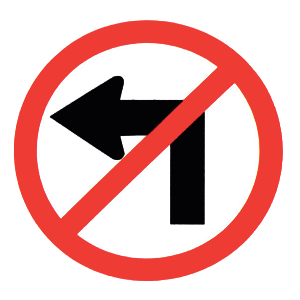
Q.12.
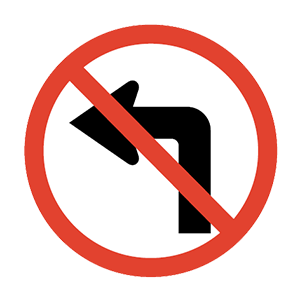
This sign means:
All traffic must turn left.
No left turn.
No U-turn.
Q.13.
A solid yellow line next to a broken yellow line means that vehicles:
Driving in both directions may pass.
Next to the broken line may pass.
Next to the solid line may pass.
Q.14.
Using a cell phone while operating a motor vehicle is considered a distraction because:
It causes the driver to be concerned about the cost of the call.
It occupies the driver's hands, eyes, and mind.
It is an activity that draws the attention of other drivers.
Q.15.
If bad weather makes it difficult for you to see clearly, you should:
Speed up to get off the road quickly.
Drive in the lane closest to oncoming traffic.
Increase your following distance.
Q.16.
Stress can affect your driving by:
Lowing your ability to focus on driving.
Decreasing your chances of an accident.
Causing you to fall asleep at the wheel.
Making you more aware of others around you.
Q.17.
When approaching an intersection controlled by a flashing yellow light, you must:
Come to a complete stop at the intersection.
Maintain your normal speed.
Slow down and proceed with caution.
Q.18.
It is against the law to park within ____ feet of a fire hydrant.
10
15
20
25
Q.19.
When approaching a traffic signal displaying a steady green arrow, drivers:
Should merge into a lane in the direction of the arrow.
Should slow to a stop, if it is safe to do so.
May turn in the direction of the arrow after yielding to traffic and pedestrians already in the intersection.
May drive straight through the intersection.
Q.20.
You are turning onto a two-lane road divided by a broken yellow line. You know immediately that:
You are on a two-way road.
You are on a one-way road.
The road is under repair.
You must stay to the left of the broken yellow lines.
Q.21.
Double solid yellow lane markings mean that:
Neither lane may pass.
Both lanes may pass.
The lane to the right may pass.
Q.22.
The best way to avoid hydroplaning is to:
Keep your tires properly maintained.
Slow down when roads are wet or slushy.
Watch out for standing water or puddles.
All of the above.
Q.23.
If you stop along the road at night:
Turn off all your lights.
Use your parking lights only.
Use your headlights only.
Turn on your emergency flashers and leave your low beams turned on.
Q.24.
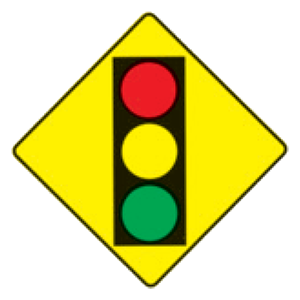
This sign means:
Stop sign ahead.
Lane closed ahead.
Railroad crossing ahead.
Traffic signal ahead.
Q.25.
On a green arrow, you must:
Yield to any vehicle, bicycle, or pedestrian in the intersection.
Yield to pedestrians only in the intersection.
Wait four seconds before proceeding.
Q.26.
A broken yellow line beside a solid yellow line indicates that passing is:
Permitted from the side next to the solid yellow line.
Not permitted from either direction.
Permitted from the side next to the broken yellow line.
Q.27.
If you become drowsy while driving, you should:
Try to fight it.
Take a break.
Take some caffeine pills.
Q.28.
A pedestrian starts to cross in front of your vehicle. You should:
Flash your lights.
Slow down.
Speed up and pass in front of the pedestrian.
Stop and let the pedestrian cross.
Q.29.
This sign means:
All traffic must turn left.
No left turn.
No U-turn.
Truck route to the left.
Q.30.
A solid yellow line on your side of the centerline means:
Slow down.
Pass with caution.
Do not pass.
Keep right on hills.
Q.31.
To help avoid skidding on slippery surfaces, you should:
Shift to a lower gear after starting down a steep hill.
Speed up to enter curves and slow down to exit them.
Slow down before entering curves and intersections.
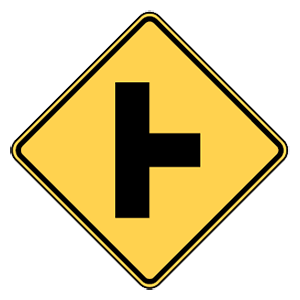
Q.32.
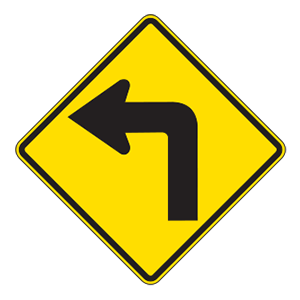
This road sign means:
All traffic must turn right.
All traffic must go straight.
A side road intersects ahead.
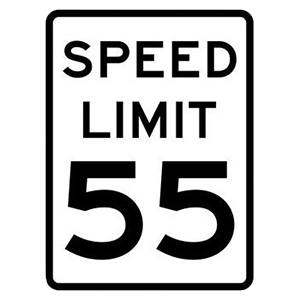
Q.33.
This road sign means:
You must travel at the speed indicated.
The maximum legal speed on the roadway is 55 mph.
You must travel through the intersection at the posted speed.
None of the above.
Q.34.
Which of the following statements about driving speed is true?
As your speed increases, the chance of a fatality increases.
As your speed increases, so should your following distance.
Both of the above.
Q.35.
The act of turning your head and checking your blind spot before changing lanes, driving away from a curb, or merging your vehicle into traffic is:
A bad driving habit.
A good driving habit.
Unnecessary.
Not necessary if you use the rearview mirror.
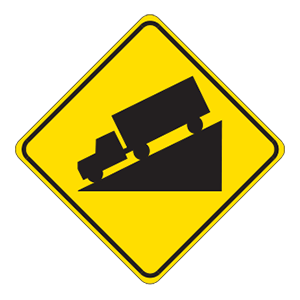
Q.36.
This sign means:
Steep downgrade.
Crossroad ahead.
No right turn.
Narrow bridge.
Q.37.
Seat belts are required to be worn:
Only by children younger than 16 years old.
Only by the driver.
By everyone in a vehicle.
Q.38.
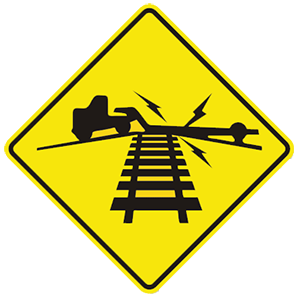
This road sign means:
No passing zone.
Winding road.
Pedestrian crossing.
Low ground railroad crossing.
Q.39.
How far ahead of an intended turn should you activate your turn signal?
25 feet
50 feet
75 feet
100 feet
Q.40.
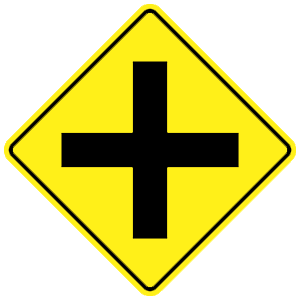
This sign means:
All traffic must turn.
Turn right at the intersection.
Parking area ahead.
Crossroad ahead. Watch for traffic.
Q.41.
This sign means:
No left turn can be made here.
A left turn can be made only after stopping.
All traffic must turn right at the next intersection.
Q.42.
A person's ability to drive can be impaired by:
Alcohol.
Any medication.
A lack of sleep.
All of the above.
Q.43.
If your vehicle starts to lose traction because of water on the road, you should:
Drive at a constant speed to gain better traction.
Apply the brakes firmly to prevent your vehicle from sliding.
Slow down gradually and not apply the brakes.
Q.44.
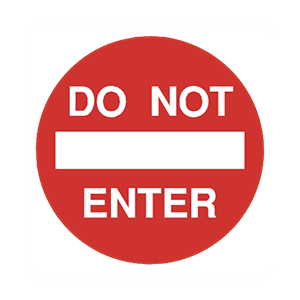
This sign means:
Do not enter.
Yield the right-of-way.
Reserved parking for persons with disabilities.
Q.45.
Which of the following statements is true?
A sudden change in weather calls for a change in driving.
You should slow down when driving in rain and fog.
Be particularly aware of vehicles coming up behind you in inclement weather.
All of the above.
Q.46.
A work zone:
May be moving or stationary.
Is marked with black and white signs.
Does not require a driver to slow down and pay extra attention.
All of the above.
Q.47.
If you parallel park facing downward on a hill:
Turn your wheels sharply toward the side of the road.
Turn your wheels away from the side of the road.
Keep your wheels straight.
Q.48.
On slippery roads, you should:
Slow down.
Drive more quickly.
Drive the speed limit, with caution.
Not drive more quickly than 20 mph.
Q.49.
If a vehicle is equipped with airbags:
Seat belts should still be worn.
Seat belts do not need to be worn.
Seat belts should be worn behind the back.
Q.50.
If your car's suspension is bad, it can cause:
Vehicle control problems.
Squealing brakes.
Slack in the steering.
Support mcqgeeks.com by disabling your adblocker.
×
Please disable the adBlock and continue.
Thank you.
Reload page