MCQGeeks
CBSE
JEE
NTSE
NEET
English
UK Quiz
Quiz
Driving Test
Practice
Games
Driving Test
Wisconsin
Wisconsin Car Driving Permit Test-22
Answers
Q.1.
You may avoid the risks of alcohol-related crashes by:
Deciding before you start drinking that you are not going to drive.
Simply saying, "No thanks, I'm driving," if someone offers you a drink.
Calling a taxi.
Doing any of the above.
Q.2.
When parking your vehicle on any hill:
One of your rear wheels should touch the curb.
Use your parking brake and leave the vehicle in "park."
Your front wheels should be parallel to the road, if there is no curb.
Q.3.
When getting ready to change lanes, you should:
Check your side view mirror.
Check your rearview mirror.
Quickly turn your head to check for other vehicles.
All of the above.
Q.4.
If you’re going to turn left onto a one-way street, you should complete the turn into:
The right lane.
The lane closest to your previous lane.
Either lane.
Neither lane.
Q.5.
A broken yellow centerline indicates that:
Passing is not permitted.
Passing on the right is permitted when the way ahead is clear.
Passing on the left is permitted when the way ahead is clear.
Q.6.
To help prevent crashes, you should:
Communicate with other road users.
Ignore other drivers on the road.
Drive only on side streets and back roads.
Avoid driving during rush hour.
Q.7.
If your turn signals fail, you should use ____ to indicate that you are turning.
Your horn
Your headlights
Hand signals
Your emergency flashers
Q.8.
If it is necessary to make an emergency stop while driving on an interstate, you should:
Sound your horn at passing cars to get their attention.
Get out of your vehicle and flag down the first vehicle that passes.
Pull off the road, turn on your emergency flashers, and stay in your vehicle, if you can.
Q.9.
When should drivers yield the right-of-way to pedestrians in a crosswalk?
Only if the pedestrians first wave to the driver.
Only if the pedestrians are not texting while walking.
At all times.
Q.10.
If your vehicle has a two-part safety belt system, you should:
Use only the lap belt.
Use both the lap and shoulder belts.
Use only the shoulder belt.
Q.11.
To see vehicles in your blind spots, you should check:
The inside rearview mirror.
The outside rearview mirror.
Over your shoulders.
Q.12.
You need to use extra caution when driving near a pedestrian using a white cane because:
He or she is deaf.
He or she is a police officer.
He or she is blind.
He or she has poor balance.
Q.13.
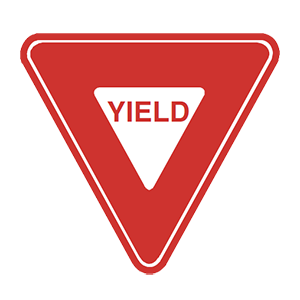
This sign means:
Yield the right-of-way.
No passing zone.
Reduction in lanes.
Q.14.
You are driving when it begins to rain. You should:
Drive faster than surrounding traffic.
Drive at the maximum posted speed limit.
Slow down.
Drive closely behind the vehicle in front of you.
Q.15.
At a school crossing sign, you should:
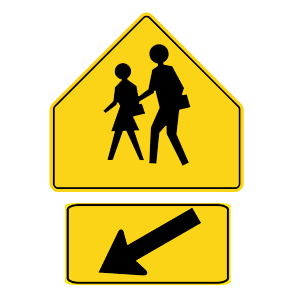
Always stop, whether there is a stop sign or not.
Watch for children and be ready to stop.
Always sound your horn when you see children.
Q.16.
When may you proceed through an intersection that has a stop sign but no stop line or crosswalk?
After slowing down to verify that there is no cross traffic
After coming to a complete stop and verifying that it is safe to proceed
After you have stopped at least 20 feet prior to the intersection
After slowing down to a speed of 10 mph
Q.17.
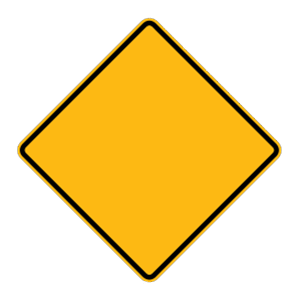
A sign with this shape means:
Railroad crossing.
Warning.
Signal ahead.
Q.18.
It is necessary to use your low beams any time you are:
On a lighted street.
On a freeway.
In fog.
Q.19.
Which of the following driving skills are affected by the use of alcohol and/or drugs?
Alertness and concentration.
Reaction time and coordination.
All of the above.
Q.20.
On long trips, you can prevent drowsiness by:
Turning on your car radio.
Slowing down.
Stopping at regular intervals for a rest.
Moving your eyes from side to side as you drive.
Q.21.
If your vehicle begins to skid, you should:
Overcorrect.
Turn your steering wheel into traffic.
Turn your steering wheel in the direction you want to go.
Release the steering wheel.
Q.22.
If you experience a tire blowout:
Tap or pump the brakes.
Slow down gradually and use your brakes lightly.
Apply the brakes firmly and quickly.
Q.23.
Alcohol is:
A stimulant.
An antihistamine.
A depressant.
Q.24.
When driving past a vehicle that has just stopped in a parked position on the side of the road, you should:
Assume that the driver will open the car door as you approach.
Speed up.
Slam on your brakes.
Assume that the driver will wait for you to pass before opening the door.
Q.25.
On a two-lane street, your vehicle is being followed by a fire engine that is not using its emergency signals. You should:
Continue to drive in a normal manner.
Stop as quickly as you can.
Speed up to get out of its way.
Slow down, move as far to the right as possible, and stop.
Q.26.
When you see other drivers around you acting or reacting in anger:
Don’t make eye contact.
Don't react with hand gestures.
Distance yourself from the situation.
All of these.
Q.27.
A red arrow displayed on a traffic light means that:
A driver must proceed slowly through the intersection.
A driver must stop and then proceed when the way is clear.
A driver must stop and then proceed when the signal changes to a green light or green arrow.
A driver may turn in the direction that the red arrow is pointing.
Q.28.
You are merging onto an interstate highway. You should:
Select a safe gap and merge into the lane of traffic.
Merge across two lanes at once.
Always stop before entering the highway.
Q.29.
You are approaching an intersection when the traffic light changes from green to solid yellow. You should:
Consider it the same as a caution sign and continue through the intersection.
Stop immediately.
Stop before entering the intersection, unless you are too close to stop safely.
Speed up to get through the intersection before the red light appears.
Q.30.
Another driver is trying to pass your car. You should:
Pull off the road.
Signal to the other driver when it is safe for them to pass.
Check for oncoming traffic and adjust your speed to allow safe passing.
Speed up.
Q.31.
If there are two railroad tracks next to each other:
It is always safe to proceed after one train passes.
You must always stop before crossing the tracks.
When one train passes, look for another train on the other track before proceeding.
Honk your horn as you cross the tracks.
Q.32.
Drowsy drivers:
Should drink strong black coffee to stay awake.
Can drive so poorly that they may appear to be drunk.
Can stay alert by opening a window and turning up the radio.
Are usually only older drivers.
Q.33.
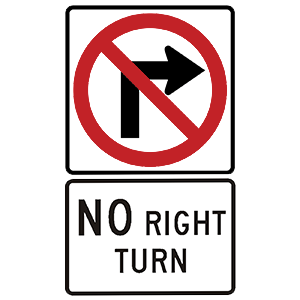
This sign means:
No U-turn.
No left turn.
No right turn.
Q.34.
The Implied Consent Law in Wisconsin means that:
Drivers under age 21 cannot drive after drinking any alcohol.
Penalties become more severe after a first OWI conviction.
Drivers must submit to alcohol testing when requested by a police officer.
A second OWI conviction requires your vehicle to have an ignition interlock device.
Q.35.
Work zone signs mean:
It is summer.
You must immediately stop and back up.
Less than ideal conditions are present for driving.
You should drive faster to get out of the work zone.
Q.36.
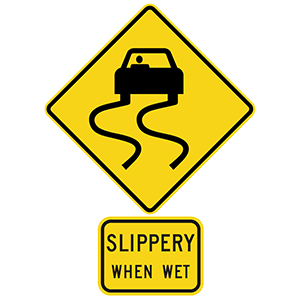
This sign means:
Do not drink and drive.
Slippery when wet.
Road curves ahead.
Q.37.
If you experience a tire blowout:
Take your foot of the gas.
Do not immediately use your brakes.
Gradually slow down and pull off the side of the road.
All of the above.
Q.38.
If a tire blows out, you should:
Apply the brake and hold it.
Hold the steering wheel tightly and use the brakes lightly.
Pull over quickly.
Q.39.
As you near an intersection, the traffic light changes from green to yellow. Your best action is to:
Speed up to beat the red light.
Apply the brakes sharply to stop.
Be prepared to stop in the center of the intersection.
Be prepared to stop before the intersection.
Q.40.
Give the right-of-way to any pedestrian who is:
In a marked crosswalk.
In any crosswalk or intersection.
Crossing any street.
Q.41.
The sign with this shape and color is a ____ sign.

No passing zone
Wrong way
Railroad crossing
Stop
Q.42.
Certain highway signs require drivers to obey an indicated instruction. Such signs are known as:
Regulatory signs.
Warning signs.
Information signs.
Guide signs.
Q.43.
Drivers who have consumed alcohol before getting behind the wheel:
Are always aware of the risks they are taking.
Do not have sufficient control over their bodies and minds or the vehicles being driven.
Are better drivers because they are more careful than sober drivers.
Have quicker reaction times.
Q.44.
Motorcycles are entitled to:
Half the width of a lane.
The bicycle lane.
The same full lane width as other motor vehicles.
The width of the sidewalk.
Q.45.
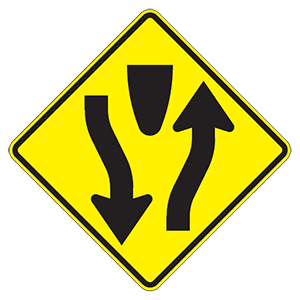
This sign means:
You are approaching the end of a divided highway.
You are approaching the beginning of a divided highway.
The road will be slippery ahead.
Q.46.
Which statement about speed is true?
Driving too slowly on certain highways can be dangerous.
Speeding can kill.
Speeding is not dangerous if you are a skilled driver.
Both "Driving too slowly on certain highways can be dangerous" and "Speeding can kill."
Q.47.
When driving on major highways:
Stay alert.
Keep your eyes moving.
Be ready to react to road hazards.
All of the above.
Q.48.
How far ahead of an intended turn should you activate your turn signal?
25 feet
50 feet
75 feet
100 feet
Q.49.
Which of the following influence(s) the effects of alcohol?
The amount of food in the stomach
The body weight of an individual
How much time passes between drinks
All three choices
Q.50.
The most common color of warning signs is:
Red.
Yellow.
Green.
Blue.
Support mcqgeeks.com by disabling your adblocker.
×
Please disable the adBlock and continue.
Thank you.
Reload page