MCQGeeks
CBSE
JEE
NTSE
NEET
English
UK Quiz
Quiz
Driving Test
Practice
Games
Driving Test
Wisconsin
Wisconsin Car Driving Permit Test-6
Answers
Q.1.
When you see a flashing yellow light at an intersection, you should:
Yield to all traffic before crossing the intersection.
Stop, then enter the intersection when it is safe to do so.
Slow down and cross the intersection carefully.
Q.2.
You may be able to identify an aggressive driver by:
Their erratic and improper lane changes.
The number of passengers in their car.
Their tendency to drive slowly.
Q.3.
Temporary signs used in construction and maintenance work areas:
Have a red background with green writing.
Have an orange background with black writing.
Have a yellow background with blue writing.
Q.4.
When you are behind a motorcycle, you should:
Be ready to use your horn.
Drive more slowly.
Allow a larger following distance.
Q.5.
It is necessary for you to make an emergency stop. You should:
Blow your horn at passing cars to let them know you have stopped.
Get out of the vehicle once you have stopped.
Turn on your emergency flashers and stay in your vehicle, if you can.
Q.6.
It is dangerous to follow a motorcycle too closely because:
They do not follow the same rules as motor vehicles.
A motorcycle can stop much faster than a standard vehicle.
They brake more slowly than motor vehicles.
Q.7.
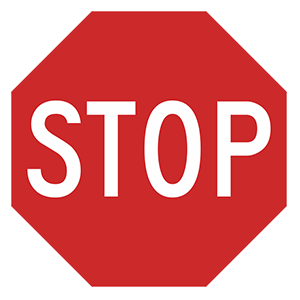
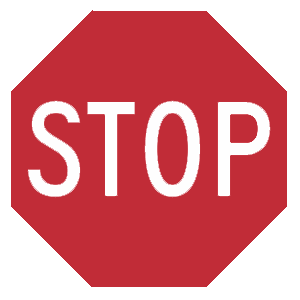
This road sign means:
Slow down or stop.
Stop if necessary.
You must come to a complete stop.
Q.8.
You must yield for emergency vehicles:
Under no circumstances.
When you see a flashing red or blue light or hear a siren.
Only when other vehicles yield.
None of the above.
Q.9.
Which of the following is a safe way to drive through a curve?
Slow down as you enter, speed up as you exit.
Maintain a constant speed throughout the curve.
Speed up as you enter, slow down as you exit.
Stay near the right edge of your lane.
Q.10.
When you are in a line of traffic that is crossing a railroad track that has no signals or gates:
You have the right-of-way and do not need to check for trains.
You may pass slower drivers while crossing the track.
You need to make sure there is space for your vehicle to get all the way across the tracks without stopping.
All of the above
Q.11.
You are driving along a street and hear a siren. You cannot immediately see the emergency vehicle. You should:
Keep driving until you see the vehicle.
Pull to the curb and look to see if it is on your street.
Slow down. Don't stop until you see it.
Speed up and turn at the next intersection.
Q.12.
When driving in work zones, you should:
Increase your speed to get through the zone as quickly as possible.
Reduce your speed and be prepared to stop suddenly.
Maintain your normal speed the whole way through the zone.
Q.13.
When entering an interstate highway, you should:
Stop, check for cars, and enter when safe.
Check for cars and reduce your speed to 25 mph before entering the traffic lane.
Check for cars, increase your speed to match the flow of traffic, and merge when the way is clear.
Q.14.
When driving on major highways:
Stay alert.
Keep your eyes moving.
Be ready to react to road hazards.
All of the above.
Q.15.
A steady red arrow displayed on a traffic light means:
Drivers cannot turn in the indicated direction.
Drivers may turn in the indicated direction after coming to a complete stop.
Drivers may turn in the indicated direction.
Q.16.
Traffic signals sometimes display arrows to control turns from specific lanes. A solid yellow arrow:
Is never used as a traffic signal.
Has the same meaning as a circular yellow traffic light.
Means that drivers may turn in the direction indicated by the arrow.
Tells drivers that a green arrow is about to be shown.
Q.17.
When two vehicles enter an intersection from different highways at the same time, which vehicle must yield the right-of-way?
Either one
The vehicle on the left
The vehicle on the right
Neither
Q.18.
A yellow light that flashes on and off means:
Stop and look for other vehicles, then go if there is no traffic.
Stop and wait for a green light.
Speed up to clear the intersection quickly.
Slow down and proceed with caution.
Q.19.
When driving on slick roads, you should:
Take turns more slowly than usual.
Change lanes quickly.
Accelerate quickly.
Brake hard.
Q.20.
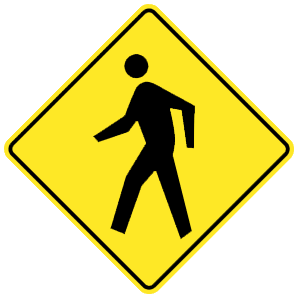
This road sign means:
School crossing.
Pedestrian crossing.
Jogging trail.
Busy sidewalk.
Q.21.
Which of the following must you obey over the other three?
A steady red light
A police officer
A stop sign
A flashing red light
Q.22.
To be able to turn quickly, your hands must be:
On opposite sides of the steering wheel.
Next to each other on the top of the steering wheel.
On the top and bottom of the steering wheel.
Q.23.
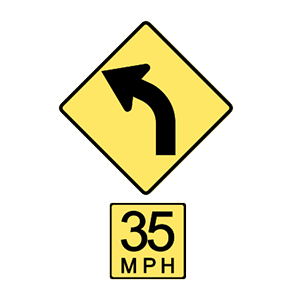
This sign means:
There is a 35 mph speed zone after the curve ahead.
Drive no slower than 35 mph around the upcoming curve.
Approach the upcoming curve at a speed of 35 mph or slower.
Q.24.
Various traffic control devices in construction and maintenance work areas are the color:
Red.
Orange.
Yellow.
Q.25.
While in a motor vehicle on a highway, it is:
Legal to drink alcohol if you're not driving.
Illegal to either drink from or possess open containers of alcohol.
Legal to drink alcohol if you're driving but not drunk.
Q.26.
A double solid yellow line down the center of a two-lane road indicates:
Lanes are moving in opposite directions and drivers are not permitted to pass.
Lanes are moving in opposite directions and drivers are permitted to pass when it is safe to do so.
Lanes are moving in the same direction and drivers are not permitted to pass.
Lanes are moving in the same direction and drivers are permitted to pass when it is safe to do so.
Q.27.
"No passing zone" signs tell drivers:
To speed up slightly.
That it is not safe to pass.
To maintain a steady speed.
Q.28.
Lanes of traffic moving in the same direction are divided by ____ lines.
Yellow
White
Red
Black
Q.29.
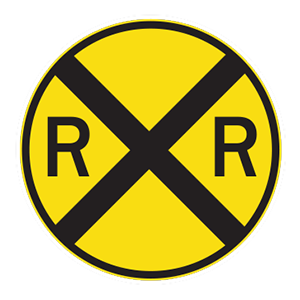
This sign means:
Stop sign ahead.
Railroad crossing ahead.
Construction ahead.
Q.30.
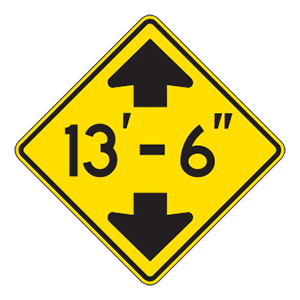
This sign means:
Low clearance.
Fines double in a work zone.
No left turn.
Do not block intersection.
Q.31.
During the first nine months that a driver under the age ofhas a probationary license, there are restrictions regarding:
The type and number of passengers that may be in their car.
Their purpose for driving between midnight and 5:00 a.m.
Both of the above.
Q.32.
When you see an emergency vehicle approaching while using its flashing lights, you must:
Maintain your speed and stay in your lane until the vehicle has passed.
Move into the right lane and drive slowly until the vehicle has passed.
Pull over to the curb or edge of the road and stop until the vehicle has passed.
Q.33.
The posted speed limit shows:
Only a recommended driving speed.
The exact speed at which you must travel to avoid a ticket.
The maximum safe driving speed under ideal road and weather conditions.
The maximum safe driving speed under all road conditions.
Q.34.
When driving in a construction zone:
Slightly increase your speed.
Expect the unexpected.
Expect construction workers to yield to motorists.
Q.35.
As you drive, you're required to stop your vehicle:
At an intersection with a stop sign.
Where there is a red light.
When a traffic officer orders you to stop.
All of the above.
Q.36.
This road sign means:
Slow down or stop.
Stop, if necessary.
You must come to a complete stop.
Drive with caution and be ready to stop.
Q.37.
____ greatly increase stopping distances and severity of crashes.
High speeds
Slow speeds
Night drives
Uphill inclines
Q.38.
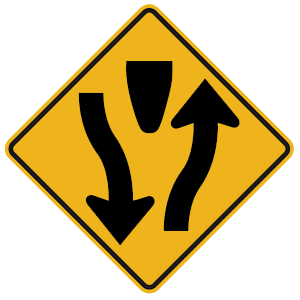
This sign means:
A divided highway ends.
A one-way street begins.
A one-way street ends.
A divided highway begins.
Q.39.
Any amount of alcohol in the blood may affect a driver's:
Right-of-way privileges.
Judgment and physical coordination.
Knowledge.
Q.40.
When a stop is required at an intersection and no markings appear to indicate a stop line or crosswalk, a driver:
Is not required to stop.
Is required to slow down to make sure crossing traffic is clear.
Should stop only at a place where they can see at least 200 feet on either side, even if they have to enter the intersecting roadway.
Should stop where they have a clear view of approaching traffic before they enter the intersecting roadway.
Q.41.
How many alcoholic drinks does it take to affect your driving ability?
Three
Two
One
Q.42.
Your blind spot is the area of the road:
You cannot see without moving your head.
Directly behind your vehicle.
You see in your rearview mirror.
You see in your side mirror.
Q.43.
Prior to entering a curve:
Activate your turn signal.
Reduce your speed.
Brake hard.
Q.44.
If your car becomes disabled while on the highway, you should:
Stop in the right lane.
Park with all four wheels off the traveled highway, if possible.
Stop where you are.
Q.45.
In which of the following scenarios should your wheels not be pointed straight ahead?
When waiting to make a left turn at a traffic light.
When parked on a hill or sloping driveway.
When parked on the side of a level roadway where there is no curb.
Q.46.
If you are under the age ofto qualify for a probationary license, you must:
Have an instruction permit for at least six months.
Have no moving traffic violations during the previous six months.
Complete an approved driver education course.
All of the above.
Q.47.
Who must yield when a driver is turning and a pedestrian is crossing without a traffic light?
Whoever started moving last
The driver
Whoever is slower
The pedestrian
Q.48.
Distracted driving is:
Anything that causes evasive action while driving.
Anything that takes your attention away from driving.
Anything that causes you to pay more attention to driving.
Q.49.
Before changing lanes or attempting to pass another vehicle, you should:
Check your blind spots and mirrors.
Signal your intention before changing lanes.
All of the above.
Q.50.
What does a single dashed white line separating traffic mean?
Drivers may pass, even if it could be dangerous.
Lanes move in opposite directions.
Drivers may not pass.
Drivers may pass if it is safe to do so.
Support mcqgeeks.com by disabling your adblocker.
×
Please disable the adBlock and continue.
Thank you.
Reload page