MCQGeeks
CBSE
JEE
NTSE
NEET
English
UK Quiz
Quiz
Driving Test
Practice
Games
Driving Test
Wisconsin
Wisconsin Motorcycle Driving Permit Test-4
Answers
Q.1.
This road sign means:
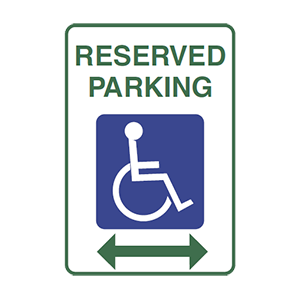
Parking spaces are reserved for people with disabled parking permits.
A circular intersection is ahead.
Traffic in the lane must turn in the direction of the arrow.
Lanes are reserved for buses and vehicles with a driver and one or more passengers.
Q.2.
What should you do when you see this sign?
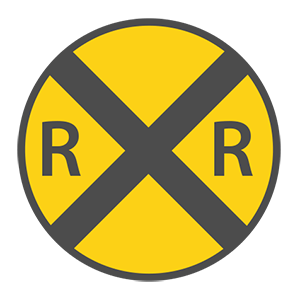
Look for a train station ahead.
Signal before going any further.
Slow down and yield for trains.
Stop.
Q.3.
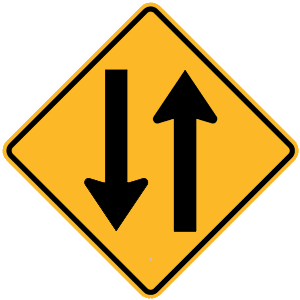
This sign means:
Four-lane traffic ahead.
Divided highway ahead.
Two-way traffic ahead.
Intersection ahead.
Q.4.
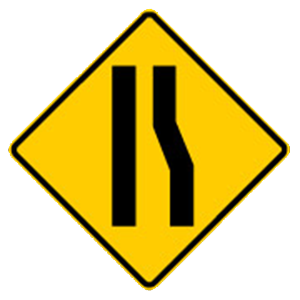
This road sign means:
Road widens ahead.
Lane reduction. The right lane ends soon and traffic should merge left.
Highway entrance ramp ahead.
Q.5.
An engine will seize due to:
A lack of oil.
A lack of fuel.
A lack of coolant.
Q.6.
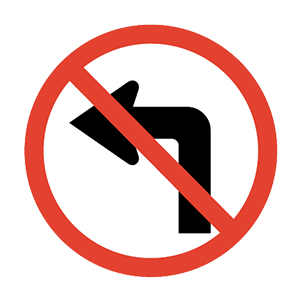
This sign means:
All traffic must turn left.
No left turn.
No U-turn.
Q.7.
At a school crossing sign, you should:
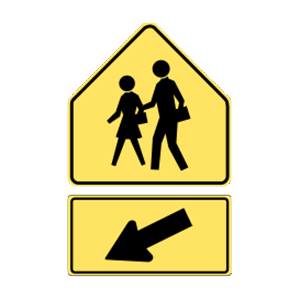
Always stop, whether there’s a stop sign or not.
Watch for children and be ready to stop.
Always sound your horn when you see children.
Be ready to help children crossing the street.
Q.8.
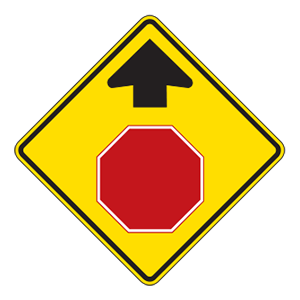
This sign means:
Stop ahead.
Buggy warning.
Limited parking.
Do not block intersection.
Q.9.
The first thing you should do if your throttle becomes stuck is:
Operate the engine cut-off switch.
Jump off the motorcycle.
Twist the throttle back and forth.
Q.10.
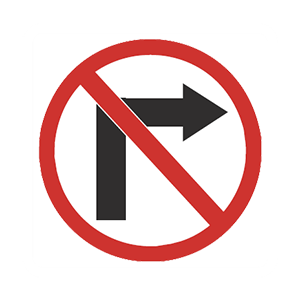
This sign means:
No right turn.
Stop sign ahead.
Divided highway.
Q.11.
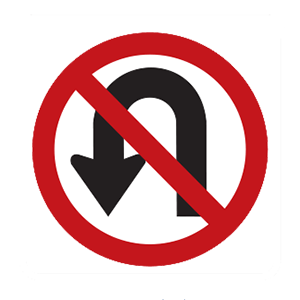
This sign means:
No U-turn.
Two-way left turn.
Minimum speed limit.
No parking.
Q.12.
Which of the following surfaces is unlikely to provide poor traction for motorcyclists?
Metal plates
Dry pavement
Manhole covers
Q.13.
When you see this sign, you must:
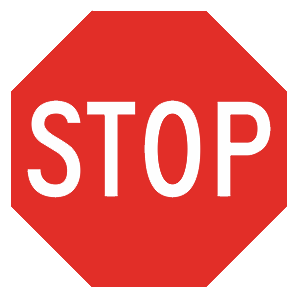
Stop completely and check for pedestrians and cross traffic.
Slow down without coming to a complete stop.
Stop completely and wait for a green light.
Slow down and check for traffic.
Q.14.
Riding a motorcycle is ______ driving a car.
Less tiring than
More tiring than
Just as tiring as
No different from
Q.15.
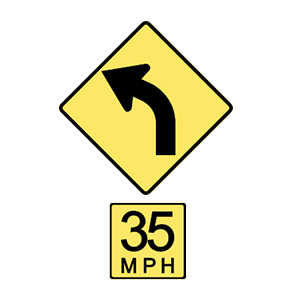
This sign means:
There is a 35 mph speed zone after the curve ahead.
Drive no slower than 35 mph around the upcoming curve.
Approach the upcoming curve at a speed of 35 mph or slower.
Q.16.
On which of the following surfaces does a motorcycle have the best traction?
Dry pavement
Gravel
Snow
Leaves
Q.17.
If another driver is following you too closely, it is best to:
Not worry about them.
Change lanes and let them pass.
Speed up.
Get off the roadway.
Q.18.
When choosing a helmet, you will get the most protection by using a helmet that:
Fits loosely.
Meets U.S. DOT standards.
Has survived a previous crash.
Provides hearing protection.
Q.19.
If you must brake and swerve to avoid danger, you should:
Use only the front brake while swerving.
Brake and swerve at the same time.
Either brake then swerve or swerve then brake.
Q.20.
When riding in a group, inexperienced riders should position themselves:
Just behind the leader.
In front of the group.
At the tail end of the group.
Beside the leader.
Q.21.
To lessen your chances of an accident, you should:
Only ride in the afternoon.
Follow the vehicle in front of you as closely as possible.
Not look ahead and focus only on your controls.
Communicate your intentions to other drivers.
Q.22.
When braking on a slippery surface, you should:
Use only the rear brake.
Use only the front brake.
Use both brakes.
Not use any brakes, but downshift.
Q.23.
Small vehicles can appear ______ and seem to be traveling ______ than they actually are.
Farther away, more slowly
Farther away, faster
Closer, more slowly
Closer, faster
Q.24.
What may help if you experience slippage of your drive chain?
Tightening the chain
Loosening the chain
Using the throttle more
Applying the rear brake
Q.25.
If the throttle is stuck, you should:
Jump off the motorcycle.
Apply the brakes.
Twist the throttle back and forth several times.
Not try to twist the throttle.
Q.26.
A helmet should not:
Meet U.S. DOT standards.
Fit snugly.
Be without obvious defects.
Have been previously worn in an accident.
Q.27.
You should use a larger cushion of space:
When roads are slippery.
When it is sunny outside.
When it is colder than usual.
When you are following other motorcycles.
Q.28.
As your motorcycle increases speed, you will:
Need to shift up through the gears.
Need to shift down through the gears.
Need to put the motorcycle into neutral.
Q.29.
A motorcycle operator can improve their visibility by:
Wearing darkly-colored clothing.
Turning off their headlight.
Following another vehicle very closely.
Wearing brightly-colored clothing.
Q.30.
A pre-ride inspection usually takes:
A few minutes and should be done no more than once a month.
A few minutes and should be done before every ride.
Over an hour and should be performed by a mechanic.
Over an hour and must only be done if you will be carrying a passenger.
Q.31.
In general, which position within a lane is the best to ride in?
The left position
The right position
There is no single best lane position.
Q.32.
How can you regain control if your rear tire locks up?
Release the rear brake.
Continue using the rear brake.
Swerve the bike in the direction with the fewest hazards.
With the brake engaged, try to accelerate.
Q.33.
Of the following, which is not a reason to keep a cushion of space between your motorcycle and the vehicle in front of you?
It allows you more time to respond to hazards.
It prevents you from finding an escape route.
It provides space to maneuver your motorcycle.
Q.34.
To lessen the chances of a crash occurring, you should:
Not use turn signals.
Use proper lane positions.
Follow other vehicles closely.
Q.35.
When traveling in a group, riders should:
Spread out to make the group easier to see.
Stay close together to make the group easier to see.
Separate occasionally.
Ride in pairs.
Q.36.
A sign that your rear tire has suddenly gone flat is that:
The back of your motorcycle is swaying from side to side.
You heard a loud noise.
A discharge of air can be seen.
Q.37.
If your front tire goes flat while you are riding:
The steering will feel heavy.
The steering will feel loose.
There will be no change in the steering.
The ride will feel too smooth.
Q.38.
When riding in a group, inexperienced riders should be placed:
In the front of the group.
Just behind the lead rider.
At the back of the group.
Anywhere within the group.
Q.39.
When braking, you should:
First apply the front brake, then the rear.
First apply the rear brake, then the front.
Use both brakes at the same time.
Use brakes in any order.
Q.40.
When approaching a blind intersection, you should:
Ride in the portion of the lane that will bring you into other drivers' fields of vision at the earliest possible moment.
Always be in the left lane to be the farthest from oncoming traffic.
Slowly sneak up to the intersection.
Weave slightly in your lane so your headlight has a better chance of being spotted.
Support mcqgeeks.com by disabling your adblocker.
×
Please disable the adBlock and continue.
Thank you.
Reload page