MCQGeeks
CBSE
JEE
NTSE
NEET
English
UK Quiz
Quiz
Driving Test
Practice
Games
Driving Test
Wisconsin
Wisconsin Motorcycle Driving Permit Test-9
Answers
Q.1.
When looking through a turn, you should:
Turn both your head and your shoulders to get a better look.
Turn just your head, not your shoulders.
Use only your mirrors.
Only move your eyes, not your head.
Q.2.
This road sign means:
Intersection ahead.
Steep grade ahead.
Winding road.
Q.3.
Lanes of traffic moving in the same direction are separated by:
White lines.
Yellow lines.
Road signs.
Q.4.
What does a flashing red traffic light mean?
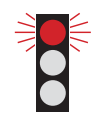
Come to a complete stop and proceed when it is safe to do so.
Only stop to yield to other traffic.
Vehicles will be entering the roadway.
Q.5.
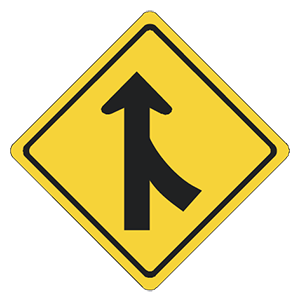
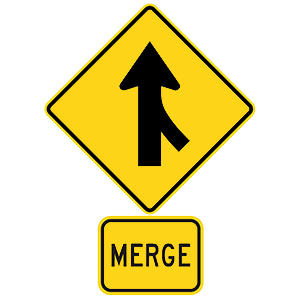
This sign means:
Merge.
Winding road ahead.
Reserved parking for persons with disabilities.
Q.6.
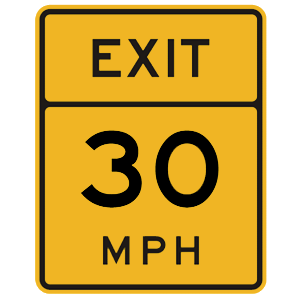
This road sign indicates:
The maximum safe speed for a residential area.
The maximum safe speed for an expressway exit.
The maximum safe speed for an expressway entrance.
The maximum safe speed for a work zone.
Q.7.
From top to bottom, the following is the proper order for traffic lights:
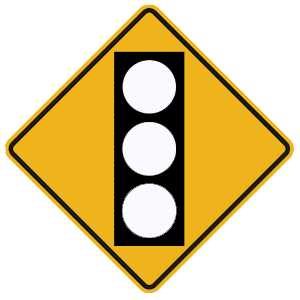
Red, yellow, green.
Red, green, yellow.
Green, red, yellow.
Green, yellow, red.
Q.8.
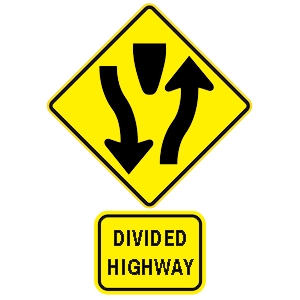
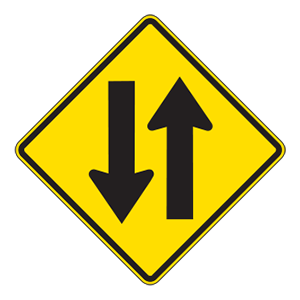
This sign means:
One-way traffic.
Divided highway ahead.
Two-way traffic.
Keep left.
Q.9.
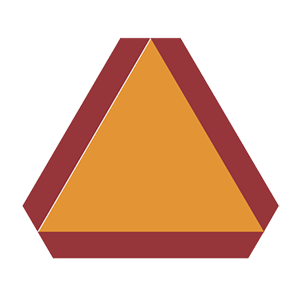
This sign means:
Slow-moving vehicle.
Road construction/maintenance area.
Traffic signal ahead.
Q.10.
This road sign means:
Cars in the right lane must slow down.
No left turn.
Merge.
Q.11.
This sign means:
Two-way traffic.
Lane shifting.
Low clearance.
Added lane.
Q.12.
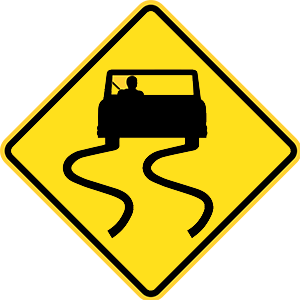
This yellow signs means:
The road ahead has many curves.
There is a sharp curve in the road ahead.
The road ahead may be slippery.
Q.13.
This sign means:
One-way traffic.
Intersection ahead.
Merging traffic from the right.
Q.14.
When carrying a passenger, you should:
Sit farther forward than you usually do.
Sit farther back than you usually do.
Sit in your usual comfortable position.
Q.15.
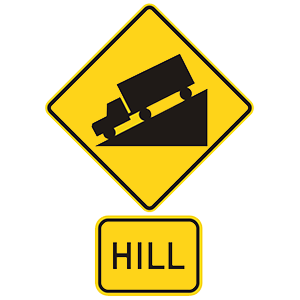
This sign indicates that:
There is a steep hill ahead.
No trucks are allowed on the upcoming hill.
A logging road is ahead.
Q.16.
This road sign means:
Steep grade ahead.
The road ahead winds with a series of turns or curves.
Slippery when wet.
Q.17.
When riding over rough surfaces, you should:
Hold the handgrips loosely to allow for movement.
Hold the handgrips firmly to maintain control.
Use lots of throttle to help you get over the rough surface.
Ride without a helmet as the helmet could become loose and cover your face.
Q.18.
What can remove alcohol from a person's system?
Time
Coffee
Exercise
Q.19.
To receive maximum protection, wear a helmet that is certified by the:
U.S. Department of Transportation.
Federal Trade Commission.
Federal Transportation Network.
National Association of Helmets.
Q.20.
It can be difficult to ride right after it starts raining because:
Some other drivers may not react quickly enough to the rain.
Pavement will be especially slippery.
Other drivers do not drive fast enough in wet weather.
Q.21.
When riding in a group, the best formation for keeping riders together while maintaining adequate space cushions is generally:
A single-file formation.
Riding in pairs.
A staggered formation.
Q.22.
When riding in a group, motorcyclists:
Do not need space cushions.
Should increase their space cushions.
Should reduce their usual space cushions by half.
Should maintain adequate space cushions.
Q.23.
To increase your chances of being seen at an intersection, you should:
Try to make eye contact with other drivers.
Ride with your headlight on.
Reduce your space cushion.
Ride in a weaving pattern.
Q.24.
If a driver is tailgating you, you should:
Speed up.
Allow them to pass.
Prevent them from passing.
Move to one side of your lane to allow them to share the lane.
Q.25.
When carrying a passenger or cargo:
It may take less time to accelerate, but more time to stop.
It may take more time to accelerate and stop.
It may take more time to accelerate, but less time to stop.
It may take less time to accelerate and stop.
Q.26.
When slowing or stopping a motorcycle, you should:
Not change gears.
Shift up through the gears.
Shift down through the gears.
Q.27.
Which of the following does not offer protection to a motorcycle rider?
A leather jacket
Boots that go over the ankle
A baseball cap that fits snugly
Gloves
Q.28.
You will ______ hear a tire going flat.
Always
Usually
Frequently
Seldom
Q.29.
Swerving a motorcycle:
Requires a lot of traction.
Requires little traction.
Is a slow maneuver.
Should be done to avoid a hazard on a slippery road.
Q.30.
How can you increase your ability to be seen at an intersection?
Try to make eye contact with other drivers.
Make sure you always ride using your headlight.
Wave your arms.
Ride closely to vehicles in front of you.
Q.31.
The formation you should take when riding in a group:
Is always single-file.
Depends on the situation.
Is always staggered.
Q.32.
A linked braking system:
Connects the front and rear brakes, applying both brakes when either brake lever is applied.
Connects the front brake to the gear shifter, applying the brake when the rider downshifts.
Connects the rear brake to a foot control.
Connects the rear brake to a switch on the handlebar.
Q.33.
Footrests:
May be shared by the driver and passenger
Are required for the driver and passenger
Are not required
Q.34.
When selecting a helmet, make sure it is all of the following, except:
Designed to meet U.S. Department of Transportation standards.
Snug.
Defect-free.
Attractive.
Q.35.
You should flash your brake light to:
Tell other motorists that you are riding near them.
Help other motorists see your motorcycle while traveling in slow traffic.
Tell other motorists that you are going to slow down or stop where they don't expect you to do so.
Q.36.
Which formation is best for a group of riders entering a curve?
Pyramid
Staggered
Single-file
Compressed
Q.37.
If you are preparing to pass another operator on the left, you should:
Get into the right part of the lane so you can be seen in their side mirror.
Get into the left part of the lane to increase your line of sight.
Stay in the center part of the lane so you can be seen in their rearview mirror.
Weave in your lane to draw attention to yourself.
Q.38.
When riding in the rain, you should:
Ride down the center of your lane.
Ride on the right side of your lane.
Ride in tire tracks left by other cars.
Q.39.
Motorists entering a highway from an entrance ramp to your right may not see your motorcycle. To help the entering drivers, you should:
Sound your horn.
Flash your lights.
Move to the left portion of your lane so they can share the lane, if necessary.
Move into another lane, if necessary.
Q.40.
What should a motorcyclist do to prevent possible injury when riding on a slippery surface?
Increase their speed.
Reduce their speed.
Make sudden moves.
Ride on the shoulder.
Support mcqgeeks.com by disabling your adblocker.
×
Please disable the adBlock and continue.
Thank you.
Reload page