MCQGeeks
CBSE
JEE
NTSE
NEET
English
UK Quiz
Quiz
Driving Test
Practice
Games
Driving Test
Wyoming
Wyoming Car Driving Permit Test-11
Answers
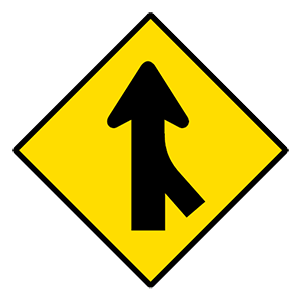
Q.1.
This sign means:
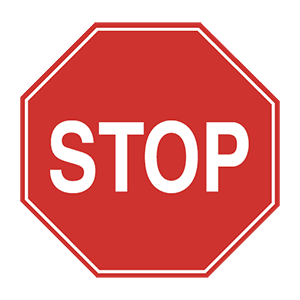
Stop.
Merge.
Upcoming change in direction.
Q.2.
What does this road sign indicate?
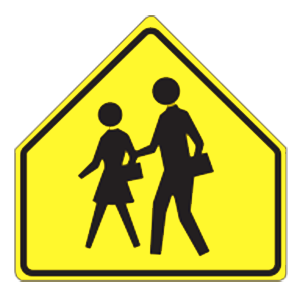
Directions for children
School zone ahead
Playground area ahead
Q.3.
When driving in fog or mist, never put your headlights on the high beam setting because:
The light will reflect back into your eyes.
Approaching vehicles might not see you.
Vehicles behind you may follow too closely.
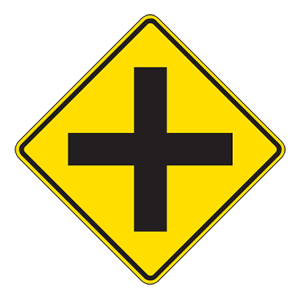
Q.4.
This sign means:
One-way traffic.
Intersection ahead.
Merging traffic from the right.
Q.5.
When you are behind a motorcycle, you should:
Be ready to use your horn.
Drive more slowly.
Allow a larger following distance.
Q.6.
When approaching a roundabout, you should always:
Increase your speed.
Maintain your speed.
Decrease your speed.
Q.7.
It is illegal for a personyears of age or older to drive with a minimum blood alcohol concentration (BAC) of:
0.05 percent.
0.08 percent.
0.02 percent.
Q.8.
This sign shows one type of:
Intersection.
Road curve.
Right turn.
Q.9.
A broken yellow centerline means that:
Passing is not permitted.
Passing on the right is permitted when the way ahead is clear.
Passing on the left is permitted when the way ahead is clear.
Q.10.
If you parallel park facing downward on a hill:
Turn your wheels sharply toward the side of the road.
Turn your wheels away from the side of the road.
Keep your wheels straight.
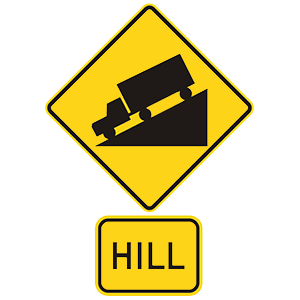
Q.11.
This sign indicates that:
There is a steep hill ahead.
No trucks are allowed on the upcoming hill.
A logging road is ahead.
Q.12.
It is unlawful to:
Pass another vehicle in any marked no passing zone.
Pass another vehicle over a railroad crossing.
Both of the above.
Q.13.
You are driving on a city street and see an emergency vehicle with flashing lights behind you. What should you do?
Drive to the right edge of the road and slow down.
Drive to the right edge of the road and stop.
Stay in your lane, slow down, and let it pass.
Q.14.
When passing another car, you have enough space to return to the driving lane:
If the other driver signals for you to re-enter the lane.
If you look over your shoulder and see the passed car behind you.
If you can see both of the passed vehicle's headlights in your rearview mirror.
Q.15.
When driving in fog, you should:
Slow down and use your low beam headlights.
Slow down and use your high beam headlights.
Turn your lights on and off to warn other drivers.
Q.16.
When merging onto the freeway, you should be driving:
At or near the speed of the freeway traffic.
At the legal speed limit.
More slowly than the freeway traffic.
Q.17.
A U-turn is not permitted:
In a parking lot.
On or near any curve or hill.
On a straight roadway with a clear view for 500 feet in both directions.
Q.18.
If you are driving and you see animals standing near the roadway:
Speed up to scare them away.
Slow down and proceed with caution.
Quickly swerve into the next lane.
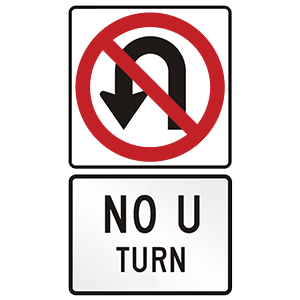
Q.19.
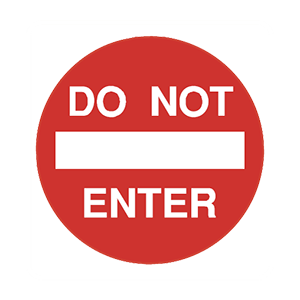
This road sign means:
Do not enter.
No parking.
No U-turn.
Q.20.
Children on bicycles should be given extra space by motor vehicle operators because:
They do not have the same physical reflexes as adults.
They are smaller and more difficult to see than adults.
Both of the above.
Q.21.
Which of these statements is true about roadwork zones?
Fines are the same for violations committed in work zones as they are under normal traffic conditions.
You must "Slow for the Cone Zone."
Slow down only if you think workers are present.
Q.22.
A steady red arrow displayed on a traffic light means:
Drivers cannot turn in the indicated direction.
Drivers may turn in the indicated direction after coming to a complete stop.
Drivers may turn in the indicated direction.
Q.23.
As you enter into a roundabout, you should slow down and:
Yield to any crossing pedestrians and bicyclists.
Yield to any car already within the roundabout.
Both of the above.
Q.24.
As the percentage of alcohol (BAC) in your blood increases, you become:
More intoxicated.
More sober.
More coordinated.
Q.25.
This sign means:
Do not enter.
Yield the right-of-way.
Reserved parking for persons with disabilities.
Q.26.
Drivers turning left must yield to:
Overtaking cars.
Oncoming cars.
No one.
Q.27.
What message will be found on this yellow pennant-shaped sign?
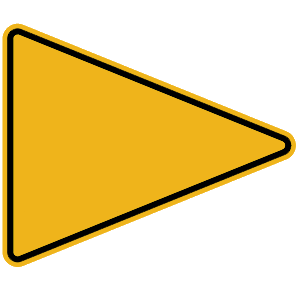
Right turns only.
Right turns permitted.
No passing zone.
Q.28.
You should not make sudden stops in front of large trucks and buses because:
Small vehicle drivers cannot adequately see large trucks and buses in their rearview mirrors.
Large trucks and buses, due to their size and weight, require longer distances to stop than smaller passenger vehicles.
Large trucks and buses travel at a higher speeds than small vehicles.
Q.29.
Interstate driving requires drivers to:
Have the ability to safely drive at increased speeds.
Be constantly alert.
Both of the above.
Q.30.
Increase your following distance when driving behind a large vehicle:
To better see around the sides of the vehicle.
Because other drivers tend to pull behind large vehicles before trying to pass them.
Because following too closely will get you caught in the vehicle's slipstream.
Q.31.
Which of the following statements about blind spots is true?
They are eliminated if you have one outside mirror on each side of the vehicle.
Large trucks have bigger blind spots than most passenger vehicles.
Blind spots can be checked by looking in your rearview mirrors.
Q.32.
If a child is about to run into the street, you should:
Start to prepare to slow down.
Flash your headlights.
Sound a sharp blast of your horn.
Q.33.
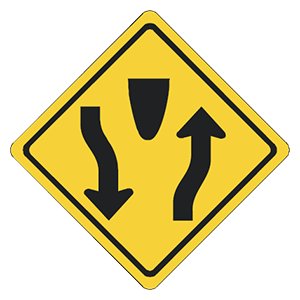
This sign means:
Divided highway.
Railroad warning.
No passing zone.
Q.34.
When driving under snowy or icy conditions:
It is safe to use your cruise control.
Make speed and directional changes more gradually than you would otherwise.
Drive as you would under normal conditions.
Q.35.
A steady green traffic light at an intersection means:
Increase your speed.
Adjust your mirrors.
You may continue through the intersection at a safe and reasonable speed, if it is clear to do so.
Q.36.
When passing a row of parked vehicles, you should:
Be prepared for a person or vehicle to unexpectedly enter your lane.
Expect all other drivers and pedestrians to respect your right-of-way.
Drive closely to the parked vehicles to allow more room for moving traffic.
Q.37.
Reaction time is slower after:
Drinking alcohol.
Sleeping.
Working hard.
Q.38.
If you must park your vehicle in an area not usually used for parking:
Park with your reverse lights on.
Make sure your vehicle is visible to drivers approaching from any direction.
Park five feet from the curb.
Q.39.
This sign means:
Winding road ahead.
Do not enter.
Pedestrian crossing.
Q.40.
At a school crossing sign, you should:
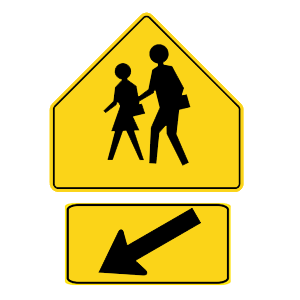
Always stop, whether there is a stop sign or not.
Watch for children and be ready to stop.
Always sound your horn when you see children.
Q.41.
Stopping distances and severity of crashes:
Decrease as vehicle speed increases.
Are not affected by vehicle speed.
Increase as vehicle speed increases.
Q.42.
"No zones" are areas around trucks where cars:
Disappear into blind spots or are so close that they restrict the truck driver's ability to stop and maneuver safely.
Have sufficient space to travel behind the truck.
Have several car lengths between their vehicle and the truck.
Q.43.
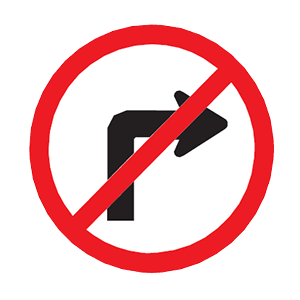
This sign means:
No right turn.
You must turn right.
Watch for traffic on your right.
Q.44.
When approaching an intersection controlled by a flashing yellow light, you must:
Come to a complete stop at the intersection.
Maintain your normal speed.
Slow down and proceed with caution.
Q.45.
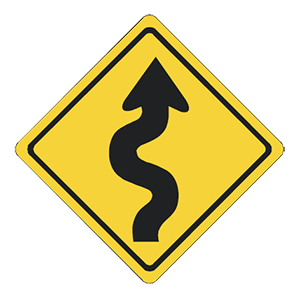
This sign tells you that:
No turns are allowed on the road.
The road narrows ahead.
There is a series of curves ahead.
Q.46.
Large trucks are likely to lose speed when:
Driving up long or steep hills.
Driving in long, gradual curves.
Driving down long, gradual hills.
Q.47.
When arriving to an uncontrolled intersection at the same time as vehicles to your right and left, you should:
Yield the right-of-way to the vehicle on your left.
Yield the right-of-way to the vehicle on your right.
Wait until there are no vehicles at the intersection before proceeding.
Q.48.
To turn left from a multilane one-way street onto a one-way street, you should start your turn from:
Any lane (as long as it is safe).
The lane closest to the left curb.
The lane in the center of the road.
Q.49.
If you are driving and a tire suddenly goes flat, you should:
Rapidly pump the brake pedal several times.
Slow down gradually and not brake.
Press down on the brake pedal as hard as you can.
Q.50.
When approaching an intersection with a flashing red light, you must:
Come to a complete stop, yield to oncoming traffic and pedestrians, then proceed.
Reduce your speed and proceed with caution.
Come to a complete stop and remain stopped as long as the light is red.
Support mcqgeeks.com by disabling your adblocker.
×
Please disable the adBlock and continue.
Thank you.
Reload page