MCQGeeks
CBSE
JEE
NTSE
NEET
English
UK Quiz
Quiz
Driving Test
Practice
Games
Driving Test
Wyoming
Wyoming Car Driving Permit Test-16
Answers
Q.1.
When backing up:
Look through the rear window.
Press hard on the gas pedal.
Rely only on your rearview mirror.
Q.2.
When driving on a slippery surface, such as snow or ice:
Shift to a low gear before going down steep hills.
Maintain traction by following other vehicles closely.
Pump your brakes to keep them from freezing.
Q.3.
Prior to entering a curve:
Activate your turn signal.
Reduce your speed.
Brake hard.
Q.4.
When entering traffic after being parked at a curb, you:
Should drive more slowly than other traffic for 200 feet.
Should wait for a large enough gap to get up to the speed of traffic.
Should wait for the first two vehicles to pass, then drive into the lane.
Q.5.
Use your headlights on rainy, snowy, or foggy days:
To keep your engine warm.
So others can see your vehicle.
To warn others of bad weather conditions.
Q.6.
In a vehicle equipped with airbags, the safest place for children ageand under to ride is in:
The front seat.
The back seat.
The bed of a pick-up truck.
Q.7.
What can you do to reduce road rage?
Always signal your intention when changing lanes.
Talk on your cell phone while driving.
Use your horn frequently.
Q.8.
To avoid glare from the headlights of an approaching car:
Look briefly toward the right side of the road.
Stay focused on the centerline on the road.
Flash your high beams.
Q.9.
Which of these statements is true about driving and taking medications?
Most cold medications can make a person drowsy.
Over-the-counter medications cannot impair driving ability if taken in the recommended dosages.
Medications are safe to take at any time, if prescribed by a doctor.
Q.10.
Check your rearview mirrors:
Often to see how traffic is moving behind you.
To see if a vehicle is in your blind spot.
Only when you are slowing down.
Q.11.
When driving behind another vehicle at night, you should:
Keep your headlights on the low beam setting.
Use your high beam headlights until you are within 10 feet of the vehicle ahead.
Use your high beam headlights.
Q.12.
Which of the following are factors commonly contributing to traffic crashes?
Exceeding the posted speed limit and driving too fast for conditions or circumstances.
Getting adequate rest and staying alert.
Scanning the environment and staying focused on the driving task.
Q.13.
"No passing zone" signs tell drivers:
To speed up slightly.
That it is not safe to pass.
To maintain a steady speed.
Q.14.
A flashing yellow light at an intersection means you should:
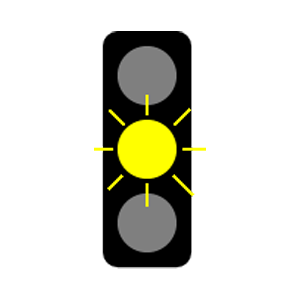
Slow down and proceed with caution.
Come to a complete stop as quickly as possible.
Stop and proceed only when the intersection is clear.
Q.15.
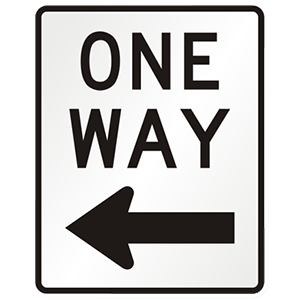
This road sign means:
No right turn.
Drive only in the direction of the arrow.
Curve ahead.
Q.16.
Any amount of alcohol in the blood may affect a driver's:
Right-of-way privileges.
Judgment and physical coordination.
Knowledge.
Q.17.
Changing from one lane to another is best done:
Quickly and often.
When a car is in your blind spot.
Gradually and carefully.
Q.18.
When changing lanes:
Check your side mirror and look over your shoulder to make sure the lane is clear.
Check the inside rearview mirror.
Slow down.
Q.19.
Having a driver license is a:
Requirement.
Privilege.
Right.
Q.20.
This sign indicates that the road ahead:
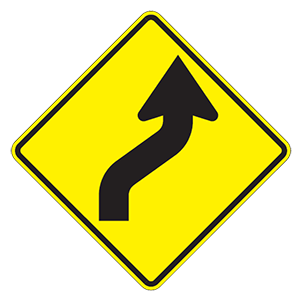
Turns sharply right, then left.
Curves right, then left.
Curves right.
Q.21.
Which of the following statements about driving speed is true?
As your speed increases, the chance of a fatality increases.
As your speed increases, so should your following distance.
Both of the above.
Q.22.
After you have passed a vehicle moving in the same direction, it is safe to move back into the right lane:
After about three seconds.
When you can no longer see the passed vehicle over your right shoulder.
When you can see the entire front of the passed vehicle in your rearview mirror.
Q.23.
Which of the following is most likely to be slippery in cold weather after snow or rain?
A hilly, open road
A residential road
A road in a shaded area
Q.24.
You have allowed the wheels of your vehicle to run off the edge of the pavement. What should you do first?
Turn the front wheels slightly to the left to edge the car back onto the pavement.
Hold the steering wheel firmly, release the gas pedal, and gently apply the brakes.
Apply the brakes and turn the front wheels sharply to the left.
Q.25.
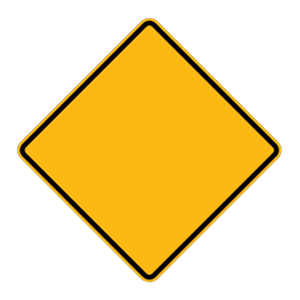
A sign with this shape means:
Railroad crossing.
Warning.
Signal ahead.
Q.26.
If you approach a stopped school bus that has its lights flashing and signal arm extended, you should:
Stop.
Proceed at 15 mph if no children are present.
Proceed at normal speed, but watch for children.
Q.27.
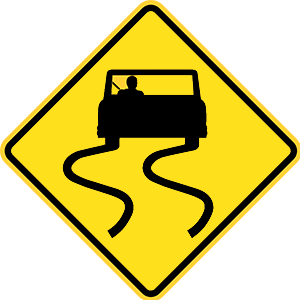
This yellow signs means:
The road ahead has many curves.
There is a sharp curve in the road ahead.
The road ahead may be slippery.
Q.28.
When passing on the left of a vehicle, it is safe to move back into the right lane:
After about three seconds.
When you can no longer see the vehicle over your right shoulder.
When you can see the front of the vehicle in your rearview mirror.
Q.29.
Which of the following road surfaces freezes first?
A tunnel
An intersection
A bridge
Q.30.
When changing lanes:
Rely on the rearview mirror.
Look over your shoulder in the direction you plan to move.
Rely on the left side mirror.
Q.31.
Which of the following is not a safe driving practice when driving on the interstate?
Slower traffic must keep to the right.
Change lanes without signaling.
If you miss your exit, you must go to the next exit.
Q.32.
What does a traffic signal with a yellow left arrow indicate?
Drivers should prepare to yield to oncoming traffic.
The protected left turn is about to end.
Both of the above.
Q.33.
When you see this yellow sign, you should:
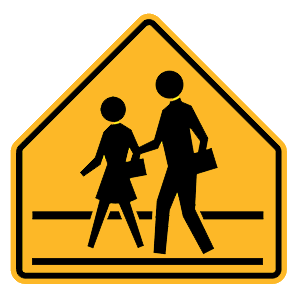
Always stop at the crosswalk.
Stop at the crosswalk until a crossing guards signals for you to go.
Be prepared to stop if children are in the crosswalk.
Q.34.
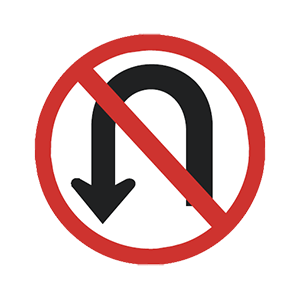
This sign means:
No U-turn.
Traffic signal ahead.
Railroad ahead.
Q.35.
When turning left from a two-way street onto a one-way street, you should:
Turn into any lane.
Turn into first lane.
Turn into second lane.
Q.36.
If you are getting tired while driving, you should:
Stop and either get rest or change drivers.
Drink something with caffeine.
Open a window.
Q.37.
This sign means:
Cars on the right move first.
You have the right-of-way.
Let cross traffic pass before proceeding.
Q.38.
Which of these statements is true about large trucks?
They take longer to stop than passenger vehicles.
They all have air brakes that allow them to stop quickly.
They are more maneuverable than passenger vehicles.
Q.39.
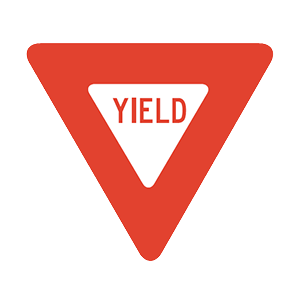
This is the shape and color of a ____ sign.
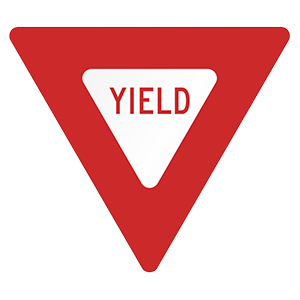
Stop
Wrong way
Yield
Q.40.
When turning left at an intersection:
You should always yield to oncoming traffic and pedestrians.
Oncoming traffic and pedestrians should yield to you.
You should never yield to oncoming traffic and pedestrians.
Q.41.
When turning left at an intersection:
You should always yield to oncoming traffic and pedestrians.
Oncoming traffic and pedestrians should yield to you.
You should never yield to oncoming traffic and pedestrians.
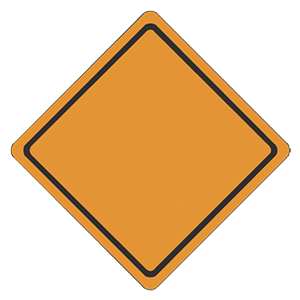
Q.42.
This sign means:
Road construction/maintenance area.
Side road.
Railroad ahead.
Q.43.
It is very foggy. You should slow down and:
Turn on your emergency flashers.
Turn your lights to their high beam setting.
Turn your lights to their low beam setting.
Q.44.
Which of the following statements is correct?
Use your left foot to brake.
Use your right foot for both braking and accelerating your vehicle.
You should always brake abruptly to ensure stopping.
Q.45.
A driver entering interstate traffic from an entrance or acceleration ramp:
Has the right-of-way.
Should yield to drivers already on the interstate.
May force their way into traffic.
Q.46.
You enter a designated turn lane to make a left turn at an upcoming intersection. There is oncoming traffic. You should:
Move to the left of the center lane.
Signal before you arrive at the intersection.
Turn your front wheels to the left to be prepared to turn.
Q.47.
If you are about to be hit from the rear, you should not:
Release your seat belt.
Brace yourself.
Press your head against the head restraint.
Q.48.
You may not park within ____ of a fire hydrant.
25 feet
15 feet
30 feet
Q.49.
This sign is a warning that you are approaching:
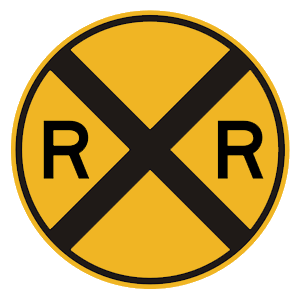
An intersection.
A crosswalk.
A railroad crossing.
Q.50.
At a crosswalk:
You must yield to pedestrians.
Pedestrians must yield to you.
Construction workers must yield to you.
Support mcqgeeks.com by disabling your adblocker.
×
Please disable the adBlock and continue.
Thank you.
Reload page