MCQGeeks
CBSE
JEE
NTSE
NEET
English
UK Quiz
Quiz
Driving Test
Practice
Games
Driving Test
Wyoming
Wyoming Car Driving Permit Test-17
Answers
Q.1.
You may pass a vehicle when:
You are on a hill or curve.
You are on a road with a solid line next to your lane.
You are on a road with a broken line next to your lane.
Q.2.
If your car begins to skid out of control, you should:
Pump the brakes.
Apply the brakes lightly.
Stay off the brakes.
Q.3.
If you find yourself in a skid:
Brake lightly.
Stay off the brakes.
Brake abruptly.
Q.4.
The first thing that alcohol effects is:
Vision.
Judgment.
Balance.
Q.5.
As you approach an intersection with a flashing yellow light:
Stop before crossing the intersection.
Slow down and proceed with caution.
Wait for a green light before proceeding.
Q.6.
A broken yellow line between two lanes of traffic means:
Both lanes of traffic are going in the same direction.
Passing is permitted when it's safe.
Passing is not permitted.
Q.7.
When driving in fog, it is best to drive with:
High beam headlights.
Low beam headlights.
Four-way flashers.
Q.8.
When driving in fog, you should:
Use your high beam headlights.
Use your parking lights.
Use your low beam headlights.
Q.9.
What should you do if an emergency vehicle is approaching while displaying flashing red or blue lights?
Pull over to the side of the road and come to a complete stop.
Continue driving, but try to stay out of its way.
See if you can reach your destination before the emergency vehicle catches up to you.
Q.10.
On a multilane road, a dashed yellow line next to a solid yellow line means:
Passing is prohibited from both directions.
Passing is permitted from both directions.
Passing is permitted only from the direction next to the dashed line.
Q.11.
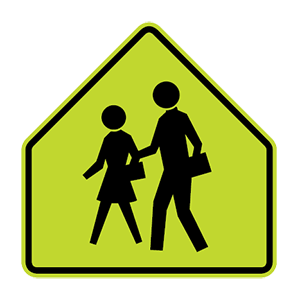
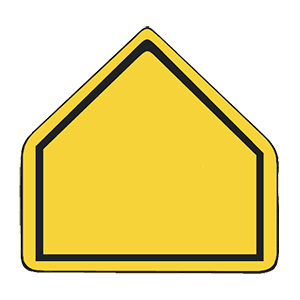
This yellow warning sign means:
You are approaching a school or school crosswalk.
Slow down, drive with caution, and watch for children.
Both of the above.
Q.12.
If you have an argument with another person and you are angry, you should:
Loudly play the radio while driving so you won’t think about your argument.
Take a few minutes to cool off before driving.
Drive on the interstate to let off steam.
Q.13.
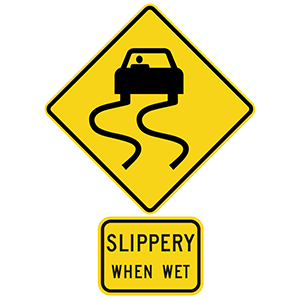
This road sign means:
When pavement is wet, reduce your speed.
The road ahead winds in a series of turns or curves.
Traffic increases ahead.
Q.14.
When you are facing a green light and there are pedestrians in the intersection:
You must yield the right-of-way to pedestrians.
You have the right-of-way over pedestrians.
Pedestrians must wait for you to cross.
Q.15.
If you have a sudden tire blowout:
Use the brakes lightly.
Pump the brakes.
Apply the brakes firmly.
Q.16.
If the roadway is wet or icy, you should:
Reduce your speed.
Drive at the posted speed.
Speed up.
Q.17.
Which of these statements is true about drugs and driving?
Any prescription drug is safe to use if you don't feel drowsy.
Even over-the-counter drugs can impair your driving.
Only illegal drugs can impair your driving.
Q.18.
If you plan to pass another vehicle, you should:
Not assume the other driver will make space for you to return to your lane.
Assume the other driver will let you pass if you use your turn signal.
Assume the other driver will maintain a constant speed.
Q.19.
You are required to stop your vehicle:
At any intersection where a police officer orders you to stop.
Where there is a red traffic light.
Both of the above.
Q.20.
While driving at night, a vehicle coming toward you has its high beams on, making it hard for you to see the road ahead. You should:
Look ahead toward the left edge of your lane.
Look ahead toward the right edge of your lane.
Look straight ahead in your lane.
Q.21.
When you see an emergency vehicle approaching while using its flashing lights, you must:
Maintain your speed and stay in your lane until the vehicle has passed.
Move into the right lane and drive slowly until the vehicle has passed.
Pull over to the curb or edge of the road and stop until the vehicle has passed.
Q.22.
To pass on a two-lane road, you should:
Sound your horn as you pass.
Flash your headlights as you pass.
Judge the distance to any oncoming vehicles.
Q.23.
When a school bus is picking up or dropping off children, you must:
Stop, regardless of your direction of travel.
Stop if you are driving in the same direction.
Slow down and be prepared to stop.
Q.24.
A solid yellow arrow on a traffic signal means:
You should speed up so you can make the turn before the light changes.
You do not need to signal to turn from the indicated lane.
You should prepare to stop and yield the right-of-way to oncoming traffic.
Q.25.
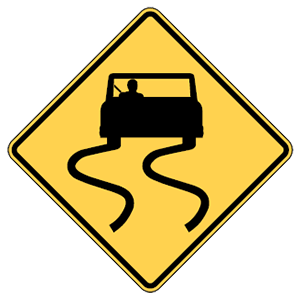
This road sign means:
Steep grade ahead.
The road ahead winds with a series of turns or curves.
Slippery when wet.
Q.26.
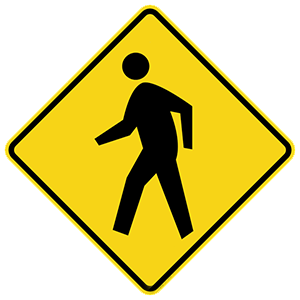
This sign means:
Pedestrians walking along the road ahead.
Pedestrian crossing ahead.
Pedestrians must not cross here.
Q.27.
Before changing lanes or attempting to pass another vehicle, you should:
Check your blind spots and mirrors.
Signal your intention before changing lanes.
All of the above.
Q.28.
If you park facing uphill where there is no curb, set the parking brake and:
Turn your wheels toward the edge of the road.
Turn your wheels away from the edge of the road.
Keep your wheels facing straight.
Q.29.
When may you legally drive around or under a railroad crossing gate?
Never.
When you can see clearly in both directions.
When the warning lights are not flashing.
Q.30.
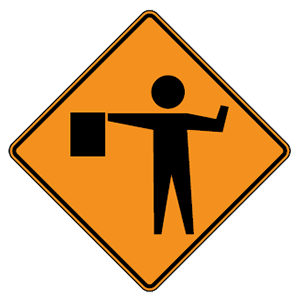
This road sign means:
Flagger ahead.
Turn left at the intersection.
Last turn before a toll road.
Q.31.
Motorcycles on the road:
Are vehicles with the same rights and responsibilities as larger motor vehicles.
Do not follow specific rules of the road.
Must always yield the right-of-way to larger motor vehicles.
Q.32.
You have stopped for a train at a railroad crossing. After the train passes, you should:
Wait for signal lights to stop flashing.
Look for a second train.
Both of the above.
Q.33.
When passing another vehicle, it is safe to return to your lane if you:
Cannot see the vehicle directly to your right.
See the vehicle’s headlights in your rearview mirror.
Have passed the other vehicle’s front bumper.
Q.34.
What should you do when approaching a pedestrian who is using a white cane or a guide dog?
Honk your horn so they know to clear a path.
Yield the right-of-way.
Swerve quickly around them.
Q.35.
What is an important step in turning?
Check traffic in all directions.
Increase your speed.
Always move to the left lane.
Q.36.
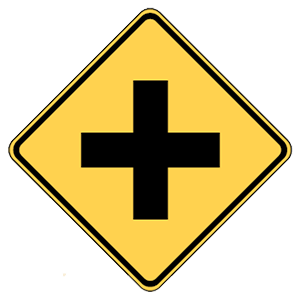
This road sign means:
Hospital.
Upcoming intersection.
Railroad crossing.
Q.37.
A driver should:
Assume all drivers automatically obey the right-of-way rules.
Assume most drivers obey the right-of-way rules.
Always be prepared to yield the right-of-way.
Q.38.
When a car with bright headlights drives toward you at night, you should:
Stop until the other driver passes.
Look below their headlights.
Glance toward the right edge of your lane.
Q.39.
It is necessary to use your low beams any time you are:
On a lighted street.
On a freeway.
In fog.
Q.40.
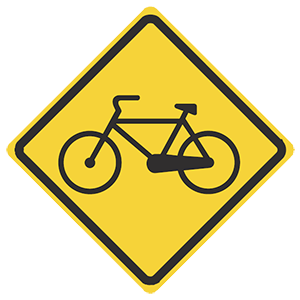
This sign means:
Watch for bicycles.
Bicycles not allowed.
Bicycle repair shop ahead.
Q.41.
Drivers are required to obey instructions from:
Security guards patrolling parking lots.
Other drivers whose vehicles are broken down on the roadway.
Flaggers (signal persons) at construction sites.
Q.42.
This sign means:
School zone or crossing.
Pedestrian crossing.
Railroad ahead.
Q.43.
When approaching a school bus that is stopped on the opposite side of a divided highway, drivers:
May continue driving.
Must stop until the school bus begins moving.
Must stop until the stop arm is lifted.
Q.44.
When traveling at high speeds, drivers should signal ____ before changing lanes or turning.
One second
Two to three seconds
Four to five seconds
Q.45.
Who is required to wear a safety belt in a moving vehicle?
Just the driver
Only children
All of the vehicle's occupants
Q.46.
When parking next to a curb, you should use your turn signals:
Only when pulling away from the curb.
When pulling next to, but not away from, the curb.
When pulling next to or away from the curb.
Q.47.
When passing another vehicle:
Pass the vehicle as slowly as possible.
Drive at the same speed as the vehicle you are passing.
Pass the vehicle as safely and as quickly as possible.
Q.48.
When using a roundabout, drivers should:
Yield to traffic already in the roundabout.
Yield to entering traffic.
Drive in a clockwise direction.
Q.49.
If your car's suspension is bad, it can cause:
Vehicle control problems.
Squealing brakes.
Slack in the steering.
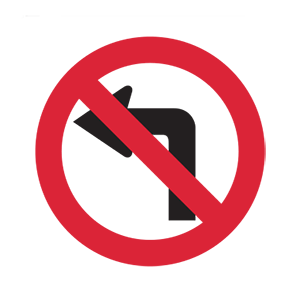
Q.50.
This sign means:
No left turn can be made here.
A left turn can be made only after stopping.
All traffic must turn right at the next intersection.
Support mcqgeeks.com by disabling your adblocker.
×
Please disable the adBlock and continue.
Thank you.
Reload page