MCQGeeks
CBSE
JEE
NTSE
NEET
English
UK Quiz
Quiz
Driving Test
Practice
Games
Driving Test
Wyoming
Wyoming Car Driving Permit Test-18
Answers
Q.1.
When you are merging onto the freeway, you should be driving:
At or near the speed of traffic on the freeway.
Five to 10 mph slower than the speed of traffic on the freeway.
The posted speed limit for freeway traffic.
Q.2.
Various traffic control devices in construction and maintenance work areas are the color:
Red.
Orange.
Yellow.
Q.3.
The proper way to make a right turn is to:
Signal, slow down, and get into the lane closest to the centerline before turning.
Signal, slow down, and get into the lane closest to the right curb before turning.
Approach the corner in the lane nearest the right curb, but move over toward the middle of the street before turning.
Q.4.
How many alcoholic drinks does it take to affect your driving ability?
Three
Two
One
Q.5.
Night driving presents unique problems because:
The speed limit is increased at night.
There are fewer cars on the roads at night.
Distance and vehicle speed are difficult to judge in the dark.
Q.6.
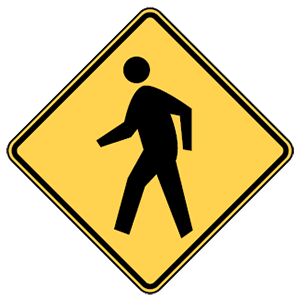
This road sign means:
Pedestrian crossing.
School crossing.
Jogging trail.
Q.7.
Trucks' blind spots are:
Directly behind the body.
On the immediate left of the cab.
Both on the immediate left of the cab and directly behind the body.
Q.8.
Which of the following driving skills is/are affected by the use of alcohol and/or drugs?
Alertness.
Coordination.
Both of the above.
Q.9.
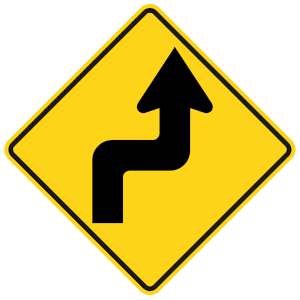
This road sign means:
Sharp right turn ahead.
A road joins from the right.
The road ahead turns sharply right then sharply left.
Q.10.
You may cross double yellow lines to pass another vehicle if the:
Vehicle in front of you moves to the right to let you pass.
Yellow line next to your side of the road is broken.
Yellow line next to the opposite side of the road is broken.
Q.11.
Motorcycles are entitled to:
The bicycle lane.
Half the width of a lane.
The same full lane width as other motor vehicles.
Q.12.
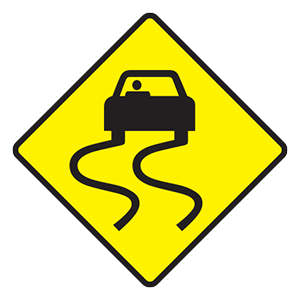
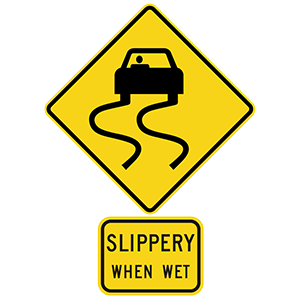
This sign means:
Slow down; curving road ahead.
Slow down and do not use your brakes.
Slow down; slippery when wet.
Q.13.
Unless otherwise posted, the speed limit on secondary highways is:
55 mph.
60 mph.
70 mph.
Q.14.
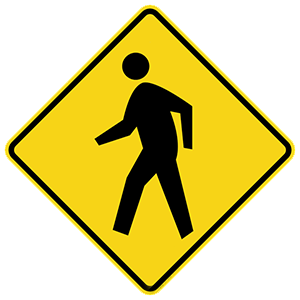
This road sign means:
School crossing.
Pedestrian crossing.
Jogging trail.
Q.15.
A broken yellow line down the center of a road indicates that:
A construction zone is ahead.
Passing is not permitted from either direction.
Passing is permitted from either direction.
Q.16.
When driving on an interstate, to avoid traffic merging from on-ramps to your right, the best thing to do is to:
Change lanes to the left.
Slow down.
Maintain your speed and position.
Q.17.
A sign with this shape means:
No passing zone.
Right turn permitted on red.
Yield right-of-way.
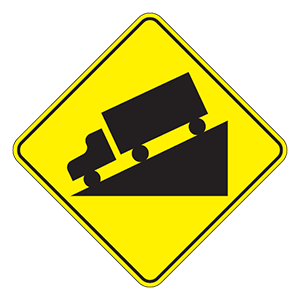
Q.18.
This sign means:
Upcoming downgrade or hill.
Road construction area.
Upcoming narrowing of roadway.
Q.19.
There are oncoming vehicles to your left and a row of parked vehicles to your right. You should steer:
Closer to the oncoming vehicles than the parked vehicles.
Closer to the parked vehicles than the oncoming vehicles.
A middle course between the oncoming and parked vehicles.
Q.20.
If you come to a railroad crossing with lowered gates and flashing warning lights, you should:
Drive around the crossing gates if you can't see a train.
Come to a complete stop well behind the gates, wait for the tracks to clear, and proceed once the gates are lifted.
Slow down and drive around the gates.
Q.21.
The driver ahead of you stops at a crosswalk. What should you do?
Cautiously pass the vehicle at 10 mph or slower.
Stop, proceeding only when all the pedestrians have crossed.
Change lanes, look carefully, and pass the stopped vehicle.
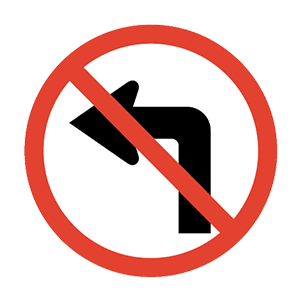
Q.22.
This sign means:
All traffic must turn left.
No left turn.
No U-turn.
Q.23.
Which medications can affect a driver's ability to operate a vehicle?
Only sleeping pills
Any medication
Only illegal drugs
Q.24.
When entering the interstate on a short entrance ramp where there is no acceleration lane, you should:
Immediately enter the far-right traffic lane on the interstate and speed up to match the flow of traffic.
Use the shoulder of the main road to get up to the speed of traffic.
Speed up and enter the interstate only after you have identified a gap in traffic.
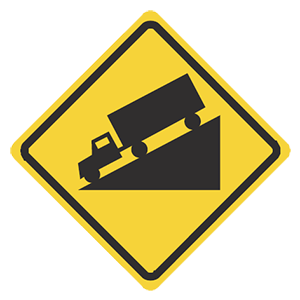
Q.25.
This sign means:
Trucks entering.
Truck exit only.
Steep downgrade ahead.
Q.26.
If your vehicle begins to skid, you should:
Ease up on the gas pedal.
Brake as hard as possible.
Turn off the ignition.
Q.27.
When double solid yellow lines separate lanes of traffic:
Passing is permitted from the left.
Passing is permitted from the right.
Passing is not permitted from either direction.
Q.28.
Motorcycles, scooters, and mopeds are not easy to see; therefore, you should:
Slow down when driving.
Make constant visual checks.
Share a lane with a motorcycle.
Q.29.
Excessive speed:
Saves time so you can get to your destination more quickly.
Helps you maneuver around obstacles.
Increases the likelihood of serious bodily injury and death.
Q.30.
If you approach a traffic light with a red signal and a police officer directs you to go through the intersection without stopping, you should:
Stop until the light turns green.
Go through the intersection without stopping.
Come to a complete stop before proceeding.
Q.31.
When changing lanes, you should never:
Look over your shoulder to check your blind spot.
Change lanes abruptly or spontaneously.
Check for other vehicles moving into the same lane.
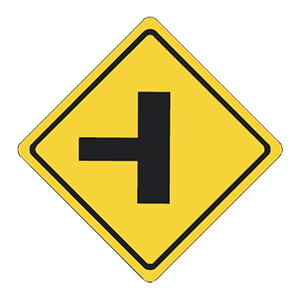
Q.32.
This sign means:
Side road.
Merge.
Yield the right-of-way.
Q.33.
The best thing to do if you become tired while driving is to:
Stop to rest or change drivers.
Drink coffee.
Open a window.
Q.34.
If you are driving on a highway next to a single broken white line marking:
You cannot cross the line to pass.
You may cross the line to pass and change lanes.
You may only cross the line to change lanes if you are in the left lane.
Q.35.
You must yield to a pedestrian using a white cane or guide dog:
Only when the guide dog is leading the person across the street.
At all times.
Only if a crossing guard is present.
Q.36.
It is dangerous to follow a motorcycle too closely because:
They do not follow the same rules as motor vehicles.
A motorcycle can stop much faster than a standard vehicle.
They brake more slowly than motor vehicles.
Q.37.
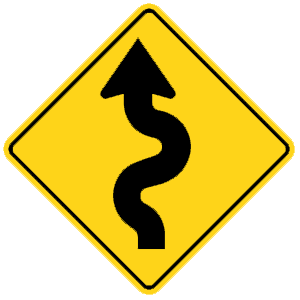
This road sign means:
Sharp turn to the right ahead.
Upcoming sharp left and right turns.
Winding road ahead.
Q.38.
You are merging onto an interstate highway. You should:
Select a safe gap and merge into the lane of traffic.
Merge across two lanes at once.
Always stop before entering the highway.
Q.39.
What does this road sign mean?
Winding road
Loose gravel
Slippery when wet
Q.40.
You are involved in a minor collision at an intersection. There are no injuries and there is very little vehicle damage. You should:
Leave your vehicle in the traffic lane until law enforcement arrives.
Move your vehicle out of the traffic lane, if possible.
Not move your vehicle for any reason.
Q.41.
Unless otherwise posted, the speed limit in residential areas is:
20 mph.
30 mph.
45 mph.
Q.42.
If a child is riding a bicycle near your vehicle:
Beep your horn.
Expect the child to be in total control of the bicycle.
Expect the unexpected.
Q.43.
When entering the interstate, check for a gap in traffic in the nearest lane, adjust your speed to match traffic, signal, and:
Expect traffic to allow you to proceed into the lane, since you have the right-of-way.
Merge carefully into the gap.
Wait for the lane to clear before merging.
Q.44.
If it is necessary to make an emergency stop while driving on an interstate, you should:
Sound your horn at passing cars to get their attention.
Get out of your vehicle and flag down the first vehicle that passes.
Pull off the road, turn on your emergency flashers, and stay in your vehicle, if you can.
Q.45.
You are on the freeway and traffic is merging into your lane. You should:
Make room for the merging traffic, if possible.
Assert your right-of-way by driving faster.
Always maintain your position.
Q.46.
A driver should:
Stare directly in front of their car.
Only focus on the middle of the road.
Watch beside, ahead, and to the rear of their car.
Q.47.
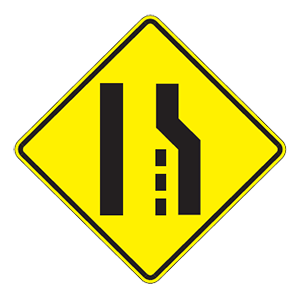
This sign means:
Merge right.
Divided highway begins.
Lane ends.
Q.48.
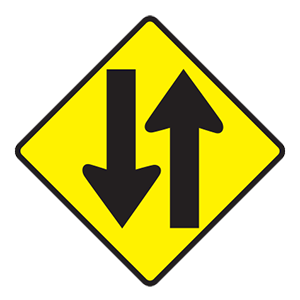
This sign means:
You can travel in either direction in this lane.
There is two-way traffic.
You are approaching a divided highway.
Q.49.
An orange-colored sign like this means:
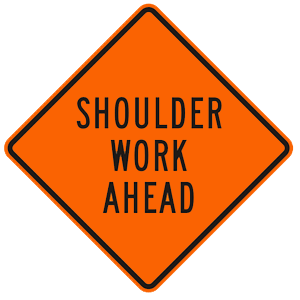
There is roadwork ahead.
You must change lanes ahead.
There is a detour ahead.
Q.50.
You should yield to a pedestrian:
Only if they are in a crosswalk.
At all times, even if the pedestrian is not obeying traffic laws.
Only if the traffic lights are in the pedestrian's favor.
Support mcqgeeks.com by disabling your adblocker.
×
Please disable the adBlock and continue.
Thank you.
Reload page