MCQGeeks
CBSE
JEE
NTSE
NEET
English
UK Quiz
Quiz
Driving Test
Practice
Games
Driving Test
Wyoming
Wyoming Motorcycle Driving Permit Test-14
Answers
Q.1.
When stopping, you should:
Use both brakes.
Use the front brake only.
Use the rear brake only.
Q.2.
Which brake is more powerful on a motorcycle?
The front brake
The rear brake
Both brakes are equally powerful.
Q.3.
Improper braking:
Usually has no consequences.
Is a significant contributing factor to many motorcycle crashes.
Should not be a concern, since the motorcycle has two brakes.
Q.4.
If you must brake and swerve to avoid danger, you should:
Use only the front brake while swerving.
Brake and swerve at the same time.
Either brake then swerve or swerve then brake.
Q.5.
Which of the following is not a potential problem?
An upcoming change in road surface characteristics
Surrounding traffic
Conditions that do not appear to change as you approach
Q.6.
When riding a motorcycle, it is important to:
Focus only on what is in front of you.
Focus only on what is behind you.
Know what’s happening both in front of and behind you.
Q.7.
Locking your brakes can:
Be helpful in most situations.
Improve steering.
Cause control problems.
Q.8.
When scanning the area around your motorcycle, you should:
Look for potential escape routes near intersections, shopping areas, or schools.
See if you can travel faster than other vehicles.
Stare at pedestrians.
Q.9.
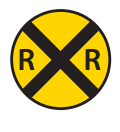
What does this sign mean?
Railroad crossing ahead
Yield
Reduce speed
Q.10.
White lines on a roadway:
Separate lanes of traffic moving in the same direction.
Separate traffic moving in opposite directions.
Indicate a no passing zone.
Q.11.
When riding over grooved pavement in a work zone, you should:
Look down to watch for changes in the road surface.
Keep your head and eyes up.
Move to the edge of the roadway.
Q.12.
When riding, jackets and pants should:
Fit loosely enough to allow the wind to catch the fabric.
Be snug enough to keep from flapping in the wind.
Be tight enough to prevent you from moving freely.
Q.13.
When slowing or stopping a motorcycle, you should:
Not change gears.
Shift up through the gears.
Shift down through the gears.
Q.14.
You should conduct a safety inspection of your motorcycle:
Before every ride.
Every week.
Once a month.
Q.15.
When preparing to ride with a passenger, instruct the passenger to:
Get onto the motorcycle before you.
Sit as far back as possible.
Hold firmly onto your waist, hips, or belt.
Q.16.
Under normal riding conditions, one of the best ways to help others see your motorcycle is:
To flash your lights.
To keep your high beam headlight turned on.
To ensure that your motorcycle is painted a dark color.
Q.17.
If riding during the day, you should wear:
Clothing with reflective material.
A short-sleeved shirt.
Darkly-colored clothing.
Q.18.
The best way to avoid fatigue when riding your motorcycle on a long trip is to:
Take frequent breaks to rest.
Ride as fast as possible.
Take artificial stimulants.
Q.19.
When taking a curve while riding in a group, you should be in:
A single-file formation.
Pairs.
A staggered formation.
Q.20.
Riding gloves should be made of:
Leather.
Wool.
Any soft material.
Q.21.
When passing a vehicle, you:
May exceed the speed limit by 10 mph.
Must not exceed the speed limit.
Are required to ride faster than the speed limit.
Q.22.
A solid white line on the side of the road indicates:
No parking is permitted.
The right edge of a traffic lane.
Traffic must merge.
Q.23.
When stopping, you should:
Use both brakes.
Use the front brake only.
Use the rear brake only.
Q.24.
A primary cause of single-vehicle motorcycle collisions is:
Motorcyclists' tendency to ride too fast for weather conditions.
Motorcyclists turning too wide in a curve or turn.
Motorcyclists running off the road while trying to avoid a collision with another vehicle.
Q.25.
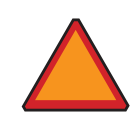
What does this sign mean?
Yield
Slow-moving vehicle
Railroad crossing
Support mcqgeeks.com by disabling your adblocker.
×
Please disable the adBlock and continue.
Thank you.
Reload page