The mesh method can be applied to circuits with any number of loops.
-
True -
False
The branch current method is based on Kirchhoff's voltage law and Kirchhoff's current law.
-
True -
False
When assigning branch currents, you need not be concerned with the direction you choose.
-
True -
False
The first row of a certain determinant has the numbers 3 andThe second row has the numbers 7 andThe value of this determinant is
-
31 -
–31 -
39 -
–29
The first row of a certain determinant has the numbersandThe second row has the numbers 3 andThe value of this determinant is
-
18 -
50 -
32 -
–32
The expansion method for evaluating determinants is
-
better than any other method -
good for only one determinant -
more flexible than the cofactor method -
good for second- and third-order determinants
The branch current method uses
-
Kirchhoff's voltage and current laws -
Thevenin's theorem and Ohm's law -
Kirchhoff's current law and Ohm's law -
the superposition theorem and Thevenin's theorem
The expansion method for evaluating determinants is
-
better than any other method -
good for only one determinant -
more flexible than the cofactor method -
good for second- and third-order determinants
In assigning the direction of branch currents,
-
the directions are critical -
the directions are not critical -
they must point into a node -
they must point out of a node
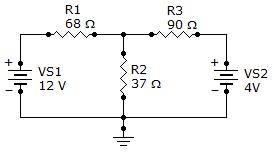
Find branch current IR2.
-
5.4 mA -
–5.4 mA -
113.0 mA -
119.6 mA
Find I1.
4I1 + 4I2 = 26I1 + 7I2 = 4
-
0.5 A -
50 mA -
–0.5 A -
–50 mA
Find I2.
4I1 + 4I2 = 26I1 + 7I2 = 4
-
1 A -
–1 A -
100 mA -
–100 mA
Find I2.
4I1 + 4I2 = 26I1 + 7I2 = 4
-
1 A -
–1 A -
100 mA -
–100 mA
Find I1.
4I1 + 4I2 = 26I1 + 7I2 = 4
-
0.5 A -
50 mA -
–0.5 A -
–50 mA
The expansion method for evaluating determinants is
-
better than any other method -
good for only one determinant -
more flexible than the cofactor method -
good for second- and third-order determinants
Find I1.
4I1 + 4I2 = 26I1 + 7I2 = 4
-
0.5 A -
50 mA -
–0.5 A -
–50 mA
Using the mesh current method, find the branch current, IR1, in the above figure.
-
115 mA -
12.5 mA -
12.5 A -
135 mA
Find I2.
4I1 + 4I2 = 26I1 + 7I2 = 4
-
1 A -
–1 A -
100 mA -
–100 mA
Find I2.
4I1 + 4I2 = 26I1 + 7I2 = 4
-
1 A -
–1 A -
100 mA -
–100 mA
- 518 mV
- 5.18 V
- 9.56 V
- 956 mV