In an RC differentiator, responding to repetitive pulses, the average value of the output
-
is zero -
is equal to the input voltage -
is 63 percent of the input voltage -
cannot be determined
The output of an RC integrator is taken across the
-
diode -
capacitor -
resistor -
source
In an RC differentiator, the sum of the capacitor voltage and the resistor voltage at any instant
-
must be zero -
must be equal to the applied voltage -
is less than the applied voltage but greater than zero -
cannot be determined
When aV input pulse with a width equal to five time constants is applied to an RC integrator, the capacitor charges to
-
24 V -
15.12 V -
20.64 V -
12 V
If the capacitor in an integrator becomes leaky,
-
the time constant will be effectively reduced -
the waveshape of the output voltage across C is altered -
the amplitude of the output is reduced -
all of the above
If a periodic pulse waveform has a pulse width and the time between pulses each equal to or greater than five time constants, the capacitor will
-
partially charge and fully discharge during each period of the input waveform -
fully charge and partially discharge during each period of the input waveform -
fully charge and fully discharge during each period of the input waveform -
partially charge and partially discharge during each period of the input waveform
A steady-state condition is reached when
-
the output voltage reaches the average value of the input voltage -
the output voltage reaches the input voltage -
the output voltage reaches approximately 63% of the input voltage -
the output voltage reaches the effective value of the input voltage
If the RC time constant of an integrator is increased, as the time constant is increased
-
the capacitor charges more during a pulse and discharges less between pulses -
the capacitor charges less during a pulse and discharges more between pulses -
the capacitor charges more during a pulse and discharges more between pulses -
the capacitor charges less during a pulse and discharges less between pulses
If the capacitor in an integrator opens, the output has the same voltage as the input.
-
True -
False
The flat portions of a pulse waveform contain low-frequency components.
-
True -
False
An RC differentiator acts as a
-
low-pass filter -
high-pass filter -
band-pass filter -
band-stop filter
In electronic systems, repetitive-pulse waveforms are encountered
-
more often than single pulses -
less often than single pulses -
about as often as single pulses -
twice as often as single pulses
The rising and falling edges of a pulse waveform contain the higher frequency component.
-
True -
False
In electronic systems, repetitive-pulse waveforms are encountered
-
more often than single pulses -
less often than single pulses -
about as often as single pulses -
twice as often as single pulses
To understand how the output voltage is shaped by a differentiator, you must consider
-
the response to the rising pulse edge -
the response between the rising and falling edges -
the response to the falling pulse edge -
all of the above
In an RL differentiating circuit, the output voltage is taken across the resistor.
-
True -
False
In an RC integrating circuit, the output voltage is taken across the capacitor.
-
True -
False
In an RL differentiator, when the input pulse goes from its low level to its high level,
-
the inductor prevents a sudden change in voltage -
the inductor prevents a sudden change in current -
voltage across the inductor instantly reaches 63% of input voltage -
voltage across the inductor is zero
In an RC differentiator, the capacitor
-
charges exponentially at a rate depending on the RC time constant -
charges exponentially at a rate depending on the input voltage -
charges when the input voltage is decreasing -
charges to approximately one time constant
When aV input pulse with a width equal to two time constants is applied to an RC integrator, the capacitor charges to
-
15 V -
12.9 V -
8.6 V -
19.45 V
In an electric circuit, the reaction of a circuit to a given pulse input is known as the pulse response.
-
True -
False
A dc component is the peak value of a pulse waveform.
-
True -
False
To understand how the output voltage is shaped by a differentiator, you must consider
-
the response to the rising pulse edge -
the response between the rising and falling edges -
the response to the falling pulse edge -
all of the above
To understand how the output voltage is shaped by a differentiator, you must consider
-
the response to the rising pulse edge -
the response between the rising and falling edges -
the response to the falling pulse edge -
all of the above
In an RC differentiating circuit, the output voltage is taken across the resistor.
-
True -
False
In an RL integrating circuit, the output voltage is taken across the inductor.
-
True -
False
Referring to Problemhow long will it take the capacitor to discharge if the internal resistance of the pulse source is ?
?
-
300  s
s -
600 s -
900 s -
1.5 ms
In an integrator, when the pulse width of the input is much less than the transient time, the output voltage approaches the shape of the input.
-
True -
False
Referring this figure, on the falling edge,
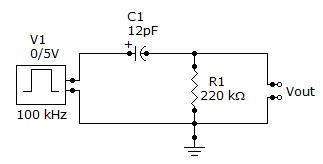
-
the resistor voltage drops to –5 V and then goes back to zero exponentially -
the resistor voltage jumps to –5 V and then goes back to zero exponentially -
the capacitor voltage remains constant -
the resistor voltage jumps to +5 V and then decreases exponentially to zero
To understand how the output voltage is shaped by a differentiator, you must consider
-
the response to the rising pulse edge -
the response between the rising and falling edges -
the response to the falling pulse edge -
all of the above