If 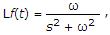 the value of
-
cannot be determined -
0 -
1 -
∞
For the signal in the given figure the Fourier transform is Then the Fourier transform of the signal in the given figure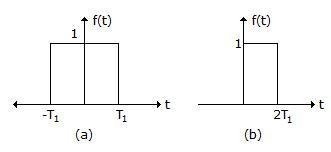

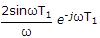

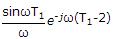
Assertion (A): Transient periods are of short duration but can result in dangerously high voltages and currents.
Reason (R): Circuit equations in transient analysis are integral differential equations.
-
Both A and R are correct and R is correct explanation of A -
Both A and R are correct but R is not correct explanation of A -
A is true, R is false -
A is false, R is true
The energy associated with a function f(t) is . In terms of Fourier transform, E =


If f(t) is an odd function, F(jω) =


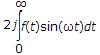
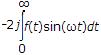
The function sinc x is equal to


The inverse Laplace transform of  is
is
-
t2 e-t 

-

-
te-t
-

Transfer function of a linear system ise-j10ω The system is a
-
distortionless Attenuator -
amplifier with Phase distortion -
distortionless Amplifier -
attenuator with Phase distortion
which one is discrete time periodic signal?
-
sin 3pn -
cos 2pn -
sin 3pn -
all
State space analysis is applicable to
-
time invariant systems -
time varying systems -
both time invariant and time varying systems -
none of the above
A signal x(n) = sin(ω0n + φ) is the input to a linear time invariant system having a frequency response H(ejω) If the O/P of the system is Ax(n -n0), then the general form of H(ejω) will be
-
- n0ω0 + β for any arbitrary real β -
- n0ω0 + 2pk for any arbitrary integer k -
n0ω0 + 2pk for any arbitrary integer k -
- n0ω0 + φ
ROC of sequence x[n] = (3)n ∪[n] + (4)n ∪[- n - 1]
-
|z| > 4 -
3 < |z| < 4 -
|z| < 4 -
|z| > 3
A voltage v = 5 +sin ωt/ + 5 sin 5 &omegat is applied to a pure capacitor of capacitance 1 ωF. If f/=rad/sec, current is
-
1 + 0.0157 cos 314 t + 0.00785 cos 1570 t -
0.0157 cos 314 t + 0.00785 cos 1570 t -
0.0157 sin 314 t + 0.00785 sin 1570 t -
0.0157 sin (314 t / + 45°) + 0.00785 sin (1570 t + 45°)
A voltage wave is i =sin (ωt). Its average value calculated over one half cycle is
-
zero -
70.72 V -
63.70 V -
none of the above
Which one is a non-causal system?
-
y(n) = x(2n) -
y(n) = x(n/2) -
y(n) = x(n/2) + x(n) -
all
Frequency domain of a periodic triangular function is a
-
discrete sinc function -
continuous sampling function -
discrete sampling function -
continuous sampling square function
If Fn represents Fourier series coefficient of f(t), then Fourier series coefficient of f(t + t) =
-
Fne -jω0t -
Fne jω0t -
Fne jnω0t -
Fne -jnω0t
δ(t - b) is a pulse function.
-
True -
False
The stationary process has
-
all the statistical Properties dependent on time. -
all the statistical Properties independent of time. -
aime average is equal to ensemble average. -
zero variance.
An RLC series circuit has a variable inductance. The value of L for resonance conditions at fundamental frequency is 0.H. For resonance conditions at third harmonic frequency the value of inductance is
-
0.54 H -
0.06 H -
0.02 H -
1.62 H
A linear system is characterized by H(ω) = Be-2ω2 the system is physically
-
unrealizable -
realizable -
depends upon B -
depends upon constant 2
The F.T. of a conjugate symmetric function is always
-
imaginary -
real -
conjugate Unsymmetric -
conjugate symmetric
For exponential function e-at the Laplace transform 1/(s - a)
-
True -
False
If Fn represents Fourier series coefficient of f(t), then Fourier series coefficient of f(t + t) =
-
Fne -jω0t -
Fne jω0t -
Fne jnω0t -
Fne -jnω0t
If x1(t) = 2 sin pt + cos 4 pt and x2(t) = sin 5 pt + 3 sinpt then
-
x1, x2 both periodic -
x1 x2 both not periodic -
x1 periodic, x2 not periodic -
x1 is not periodic ; but x2 is periodic
which of the following is not correct?
-
P(A) = P(A) - 1 -
0 ≤ P ≤ 1 -
If A and B are mitual exclusive then P(A + B) = P(A) + P(B) -
P(A) = 1 - P(A)
The current in a circuit withΩ resistance is i = 3 + 4 sin (t + 45°) + 4 sin (t + 60°) A. The rms current and power dissipated are
-
41 A and 410 W -
35 A and 350 W -
5 A and 250 W -
11 A and 1210 W
Which one is time invariant system?
-
y[n] = x[2n] -
y[n] = x[n] x[n - 1] -
y[n] = x[n/2] -
all
Consider the sequence x[n] = [- 4 - j5 1 + J2 4]
-
[- 4 - J2.5 J2 4 - J2.5] -
[- J2.5 1 J2.5] -
[- J5 J2 0] -
[- x 1 4]
If Fn represents Fourier series coefficient of f(t), then Fourier series coefficient of f(t + t) =
-
Fne -jω0t -
Fne jω0t -
Fne jnω0t -
Fne -jnω0t
An ac network has a power factor of 0.8 leading if the applied wave is of fundamental frequency. If the applied wave contains third and fifth harmonics, the overall power factor will be
-
0.8 leading -
less than 0.8 leading -
more than 0.8 leading -
0.8 leading or more
The signal define by the equations u(t - a) = 0 for t < a and u(t - a) = 1 for t ≥ a is
-
a unit step function -
a shifted unit step function orginating at t = a -
a pulse function -
none of the above
Fourier transform pair are
-
autocorrelation and power spectral density -
autocorrelation and convoloution -
convolution and power spectral density -
autocorrelation and energy
δ(t - b) is a pulse function.
-
True -
False
The Fourier series representation of a periodic current (2 + 62 cos ωt +48 sin 2ωt) A. The effective value is
-
(2 + 6 + 24) A -
8 A -
6 A -
2 A
If Fn represents Fourier series coefficient of f(t), then Fourier series coefficient of f(t + t) =
-
Fne -jω0t -
Fne jω0t -
Fne jnω0t -
Fne -jnω0t
Assertion (A): A sweep circuit operates by virtue of recurring transient phenomenon.
Reason (R): Transients are always undesirable.
-
Both A and R are correct and R is correct explanation of A -
Both A and R are correct but R is not correct explanation of A -
A is true, R is false -
A is false, R is true
δ(t - b) is a pulse function.
-
True -
False
δ(t - b) is a pulse function.
-
True -
False
The Laplace transform of unit ramp function starting at t = a is


Consider the sequence x[n] = [- 4 - j5 1 + J2 4]
-
[- 4 - J2.5 J2 4 - J2.5] -
[- J2.5 1 J2.5] -
[- J5 J2 0] -
[- x 1 4]
Consider the sequence x[n] = [- 4 - j5 1 + J2 4]
-
[- 4 - J2.5 J2 4 - J2.5] -
[- J2.5 1 J2.5] -
[- J5 J2 0] -
[- x 1 4]
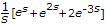
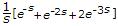
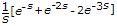
The Laplace transform of the waveform shown in the below figure is 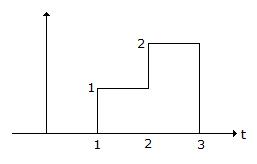
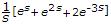
If function f(t) has an initial value f(0-) at t = 0-, the Laplace transform of  is
is
-
sF(s) - f(0-) -
sF(s) + f(0-) -
s2F(s) - f(0-) -
s2F(s) + f(0-)
The inverse Laplace transform of 
-
eat -
-eat -
1 - eat -
-1 + eat
The Laplace transform of unit ramp function starting at t = a is
The Laplace transform of the waveform shown in the below figure is
The inverse Laplace transform of
-
eat -
-eat -
1 - eat -
-1 + eat
The Laplace transform of unit ramp function starting at t = a is
If function f(t) has an initial value f(0-) at t = 0-, the Laplace transform of is
-
sF(s) - f(0-) -
sF(s) + f(0-) -
s2F(s) - f(0-) -
s2F(s) + f(0-)