In the state equation x = AX + Bu is a n x m matrix.
-
True -
False
A 1 kHz sinusoidal signal is ideally sampled atsamples/sec and the sampled signal is passed through an ideal low pass filter with cut off frequencyHz. The output signal has the frequency.
-
0 Hz -
0.75 kHz -
0.5 kHz -
0.25 kHz
Principle of superposition is applicable to
-
linear systems only -
nonlinear systems only -
both linear and non linear system -
linear systems and some nonlinear systems
The function (sin x)/x
-
has a period 2p, decays with increasing x and has zeros at np, n = ± 1, ± 2 -
has a period p -
has a period p/2 -
has a period 2p, decays with increasing x, is an even function and has zeros at np, n = ± 1, ± 2
A trigonometric series has
-
single sided spectra -
zero -
sync function -
undefined
For the differential equation (D3 - D2 + D -[y(t)] = 0 the root of auxiliary equation are
-
-j, j, 1 -
-j, j, 2 -
1, 2, j -
1, 2, -j
The signal x(t) = A cos (ω0t + φ) is
-
energy signal -
power signal -
energy Power -
none
A voltage wave containingthird harmonic is applied to a scries R-L circuit. The percentage third harmonic content in the current wave will be
-
more than 10% -
10% or less than 10% -
less than 10% -
10% or more or less
It f(t) is an odd function, the coefficients Fn in the exponential form of Fourier series
-
are real -
are imaginary -
are complex -
may be real or imaginary
Choose the function f(t), - ∞ < t < + ∞, for which a Fourier series cannot be defined
-
3 sin (25t) -
4 cos (20t + 3) + 2 sin (10t) -
exp - | t | sin 25 t -
1
A signal m(t) is multiplied by a sinusoidal waveform of frequency fc such that
v(t)=m(t) cos 2pfct
If Fourier transform of m(t) is M(f), Fourier transform of v(t) will be
-
0.5 M(f + fc) -
0.5 M(f - fc) -
0.5 M(f + fc) + 0.5 M(f - fc) -
0.5 M(f - fc) + 0.5 M(f - fc)
A signal f(t) = cos 10pt + 3 cos 4pt is instantaneously sampled. The maximum allowable value of sampling interval Ts in sec is
-
1 / 4 sec -
1 / 8 sec -
1 / 8p sec -
1 / 10 sec
The range of value "a" for which system will be stable. If impulse response of DT system is = an ∪[n]
-
a > 1 -
a < 1 -
1 < a < ∞ -
-1 < a < 1
Which of the following represents a stable system?
- Impulse response decreases exponentially.
- Area within the impulse response in finite.
- Eigen values of the system are positive and real.
- Roots of the characteristic equation of the system are real and positive.
-
1 and 4 -
1 and 3 -
2, 3 and 4 -
1, 2
If sequence y(n) = x(-n) then it is
-
Causal -
Non-Causal -
Depends on x(-n) -
None
If a number of odd functions are added, the resultant sum is
-
even function -
odd funtion -
either even or odd function -
mixture of odd amd even functions
The DTFT of x(n) = δ(n) will be
-
1 -
0 -
∞ -
not defined
If a sequence is causal then ROC is (where a is any number)
-
|z| > a -
|z| < a -
|z| = a -
Entire Plane
The auto correlation of a sampling function is a
-
triangular function -
gate function -
signum function -
none of the above
The inverse Fourier transform of δ(t) is
-
∪(t) -
1 -
δ(t) -
ej2pt
Which one of the following is the correct statement of the system characterized by the equation y(t) = ax(t) + b?
-
linear for any value of b -
linear if b > 0 -
linear if b < 0 -
non-linear
A rectangular pulse train s(t) is shown in figure is convolved with the signal cos2(4p x 103t). The convolved signal will be a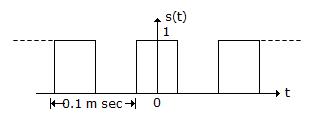
-
DC -
12 kHZ sinusoidal -
8 kHZ sinusoidal -
14 kHZ sinusoidal
A signum function is
-
zero for t greater than zero -
zero for t less than zero -
unity for t greater than zero -
2∪(t) - 1
If f(t) ↔ F(jω), and f(t) is real, then 


A gate function which occurs at t = t0 and lasts for duration T can be written as
-
u (t - t0 - T) -
u(t - t0) = u(t - t0 - T) -
u(t - t0) - u(t - t0 - T) -
u(t - t0) - u(t - t0 + T)
Assertion (A): The response of a network to an impluse is determined only by the parameters of the network.
Reason (R): If f(t) is a unit parabolic function, its Laplace transform is 1/s3
-
Both A and R are correct and R is correct explanation of A -
Both A and R are correct but R is not correct explanation of A -
A is true, R is false -
A is false, R is true
A voltage wave havingfifth harmonic content is applied to a series RC circuit. The percentage fifth harmonic content in the current wave will be
-
5% -
more than 5% -
less than 5% -
equal or more than 5%
A voltage V(t) is a Gaussian ergodic random process with a mean of zero and a variance of 4 volt2. If it is measured by a dc meter. The reading will be
-
0 -
4 -
2 -
2
A first order system will never be able to give a __________ response
- band stop
- band pass
- all pass
-
1, 2, 3 true -
1 and 3 true, 2 false -
1, 2 are true 3 is false -
1, 2 are false, 3 is true
If a function has only cosine terms, it must satisfy the equation
-
f(t) = -f(t) -
f(-t) = f(t) -
f(-t) = -f(t) -
none of the above
In what range should Re(s) remains so that Laplace transform of the function e(a + 2)t + 5 exists?
-
Re(s) > a + 2 -
Re(s) > a + 7 -
Re(s) < a -
Re(s) > a + 5
Which one is a causal system?
-
y(n) = 3x[n] - 2x[n - 1] -
y(n) = 3x[n] + 2x[n + 1] -
y(n) = 3x[n + 1] + 2x[n - 1] -
y(n) = 3x[n + 1] 2x[n - 1] + x[n]
The signal defined by the equations f(t) = 0 for t <f(t) = E for 0 ≤ t ≤ a and f(t) = 0 for t > a is
-
a step function -
a pulse function -
a shifted step function originating at t = a -
none of the above
A signal g(t) = A then g(t) is a
-
energy signal -
power signal -
neither energy nor power signal -
insufficient data
Assertion (A): δ(t - b) is an impulse occuring at t = b
Reason (R): Intergal of unit impulse gives unit step function.
-
Both A and R are correct and R is correct explanation of A -
Both A and R are correct but R is not correct explanation of A -
A is true, R is false -
A is false, R is true
If transfer function of a system is H(z) = 6 + z-1 + z-2 then system is
-
minimun phase -
maximum phase -
mixed phase -
none
δ(t) is a
-
energy signal -
power signal -
neither energy nor power -
none
Auto correlation for t = 0 is equal to
-
average power S of waveform -
square of average power S of waveform -
half of average power S of waveform -
square root of average power S of waveform
Which one of the following rules determines the mapping of s-plane to z-plane?
-
Right half of the s-plane maps into outside of the unit circle in z-plane -
Left half of the s-plane maps into outside of the unit circle. -
Imaginary axis in s-plane maps in to the circumference of the unit circle. -
All of the above
If 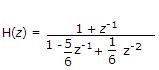 the poles of H(z) are at
-

-
z = 1 and z = 3 
-

-
z = -1 and z = -3
A rectangular pulse train s(t) is shown in figure is convolved with the signal cos2(4p x 103t). The convolved signal will be a
-
DC -
12 kHZ sinusoidal -
8 kHZ sinusoidal -
14 kHZ sinusoidal
A rectangular pulse train s(t) is shown in figure is convolved with the signal cos2(4p x 103t). The convolved signal will be a
-
DC -
12 kHZ sinusoidal -
8 kHZ sinusoidal -
14 kHZ sinusoidal
Double integration of a unit step function would lead to
-
an impulse -
a parabola -
a ramp -
a doublet
The Fourier series of an odd periodic function contains
-
odd harmonics only -
even harmonics only -
cosine harmonics only -
sine harmonics only
The analog signal m(t) is given below m(t) = 4 cospt + 8 sinpt + cospt, the Nyquist sampling rate will be
-
1/100 -
1/200 -
1/300 -
1/600
If autocorrelation sequence is Rc(n) = 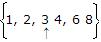 then what will be energy of sequence?
-
2 -
24 -
3 -
288
If a signal g(t) has energy E, then the energy of the signal g(2t) is equal to ...
-
E/2 -
E/4 -
E -
2E
The analog signal given below is sampled bysamples per second for m(t) = 3 sinpt + 2 sinpt then folding frequency is
-
500 Hz -
700 Hz -
300 Hz -
1400 Hz
If f(t) = A d(t - a), F(s) is
-
A e-as -
A eas -
A a e-as -
Aa eas
If £[f(t)] = F(s), then £[f(t - T)] =
-
est F(s) 

-
e-st F(s)
-

-
